LISTENING TEXTS
New School, New Friends (Pages 10–11)
Audio 1
Good morning, pupils! I’m happy to announce that
registration for our school clubs is now open.
For the Visual Art Club, pupils who like drawing,
painting or making crafts should sign up. If you
enjoy doing experiments and learning how things
work, the Science Club is a good choice for you.
Pupils who enjoy playing badminton and are
ready to practise their serves, footwork and
shots can join the Badminton Club. If singing,
playing a musical instrument or performing
music is your thing, come and sign up for the
Music Club.
Finally, the English Club is perfect for pupils
who enjoy reading novels, playing word games,
performing role plays and telling stories
in English.
Choose a club that matches your interests and
sign up today!
Audio 2
Adam : Have you decided which club you
want to join, Jessica?
Jessica : I think I’ll join the English Club. I read
novels and play word games in my
free time. My goal is to get better at
speaking English. What about you?
Adam
: I’m thinking about the Badminton Club.
I play badminton with my friends every
weekend. My goal is to improve my
footwork and shots.
Jessica : That sounds good, but wouldn’t you
like the Music Club too? You play the
guitar quite well.
Adam
: I do enjoy playing the guitar, but
I’d rather join the Badminton Club.
My goal is to become a better player.
Jessica : Fair enough. I also enjoy doing
experiments, so the Science Club
sounds interesting. But I think the
English Club is better for me because I
want to become more confident when
I speak.
Adam
: I agree. You can practise speaking
through role plays and storytelling.
Jessica : Exactly! I guess we’ve made our
choices.
Adam
: Yes! Let’s go and sign up!
Smart Discoveries (Pages 24–25)
Hello and welcome to Smart Discoveries
Malaysia! Today, we are looking at two
interesting Malaysian inventions.
First, let’s talk about Datuk Hew Ah Kow.
In 1973, he created an egg boiler to help people
prepare soft-boiled eggs more easily. The idea
came from his own experience. He noticed
that his colleagues sometimes cooked their
eggs for too long and did not get the results
they wanted. Datuk Hew designed a simple
device that uses hot water to cook eggs
for the right amount of time. The eggs are
ready when the water has completely drained
from the container. His invention became a
useful kitchen tool for people who enjoy soft-
boiled eggs.
Now, let’s discover a more recent invention.
A team of six pupils from SMK Dato’ Klana
Putra in Negeri Sembilan created the Smart
Sense watch. The watch was designed to help
older people, people with special needs and
people who have difficulty seeing. It can sense
objects in front of the user and give a warning
in real time.
In June 2026, the team took their invention
to the Innovation World Cup in Jakarta,
Indonesia, accompanied by their teachers.
The competition had more than 1,400 entries
from 16 countries. The Malaysian team won a
Gold Award for their Smart Sense watch.
These inventions show that smart ideas can
come from anyone. Whether we are solving a
simple problem at home or helping people stay
safe, an invention can make a difference.
Rainforest Treasures (Pages 38–39)
Audio 1
Day two in the Malaysian rainforest. What an
incredible journey this is! As I walk deeper into
the thick trees, I notice these amazing plants
all around me. My guide is now pointing to
the towering Meranti tree. Its strong wood
is important for building parts of a house.
Right beside it is this giant Tualang tree. It
is super tall with wild bees building massive
beehives high up in its branches.
Next, we are now stopping to look at
Tongkat Ali. The locals use its roots
to make a traditional energy drink.
Now as I am looking up to another huge tree,
I can see bunches of Petai, the green beans
with a very strong smell. Their beans grow in
long clusters.
149
LISTENING TEXTS
The guide is now showing the Salak—a sweet
fruit with brown skin that looks like a snake.
Finally, we are at the wild Durian tree. It’s famous
for being the king of fruits, with sharp spikes on
the outside and a very strong smell!
The jungle is really full of living treasures. I can’t
wait to see what else is out here!
Audio 2
Hello, nature explorers! Welcome back to
Wild Malaysia. Today, we are taking a special
trip into the bright, green Malaysian rainforest to
meet some incredible animals and see how they
move through their natural homes.
Listen closely as we track them across
the jungle.
First, look way up high in the green canopy
branches. Can you picture the orangutan
swinging smoothly from branch to branch?
Now, look down low in the tall grass and
thick bushes. That is where the tiger prowls
quietly through the shadows.
Listen to those heavy footsteps shaking the
ground on the open forest floor! That is the
elephant stomping loudly through the trees.
Over by the water, look near the muddy river
bank, where the tapir trots steadily along the
shore.
And finally, look high up on the thick tree trunk.
That is the sun bear, busy climbing up the bark!
That’s our trip for today. Can you remember
how each animal moves and where they can be
found in the rainforest? Keep exploring, and we
will see you next time on Wild Malaysia for more
wildlife adventures. Goodbye, explorers!
Making Wise Choices (Pages 52–53)
Thank you for inviting me to your school for
Money Matters Week. My name is Ms Jeya, and
I am a bank officer from SmartBank Malaysia.
Today, I am happy to share some simple ways to
make wise choices with your money.
Many pupils receive pocket money every week.
Before buying something, ask yourself, “Do
I really need it?” It is always better to buy the
things you need before the things you want.
Another good habit is to save a small amount of
money every week. Even RM2 or RM5 can make
a big difference over time. You can also set a
savings goal, such as buying a new school bag,
a dictionary or a bicycle.
150
Finally, remember that wise people do not
spend all their money at once. They plan
ahead, save regularly and spend carefully.
Thank you for listening. I hope you will start
making wise financial choices today.
Our Colourful Celebrations (Pages 66–67)
Advertisement 1
Balik Kampung Raya at Sterling Mall
Get ready for Hari Raya at Sterling Mall this
weekend! Enjoy special activities for the
whole family, including a traditional kuih
tasting, a ketupat weaving workshop and
a cultural performance. Come with your
family and friends and enjoy the festive
atmosphere together. Everyone is welcome!
Look out for our green decorations!
Advertisement 2
Celebrate Together this Chinese New Year!
Join us at the multipurpose hall this Friday at
5:00 p.m. for a colourful Chinese New Year
celebration. Enjoy a lion dance, traditional
music and a special cultural performance.
There will also be activities for children and
mandarin oranges for visitors. Bring your
family and friends and enjoy the celebration
together under the red lanterns!
Advertisement 3
Festival of Lights at Harmoni
Community Centre
Come and celebrate Deepavali with us this
Saturday evening at Harmoni Community
Centre. Enjoy beautiful kolam displays,
traditional music and delicious laddu, a popular
Indian sweet. You can also join our kolam
workshop and learn how these colourful
designs are made.
See the warm glow of traditional oil lamps
and learn about some Deepavali traditions.
Families often wear traditional Indian clothes,
such as a kurta and sari, when they celebrate
Deepavali. Families can take part in the
activities, learn something new and enjoy the
celebration together.
Don’t miss this special evening of lights,
colours and traditions. See you there!
LISTENING TEXTS
Technology Use in Malaysia (Pages 80–81)
Host
: Welcome to Today in Malaysia.
This afternoon, we’re going to talk
about two technologies that make
everyday payments and banking
easier: QR Pay and e-banking. Joining
me are Ms Yasmin, a young business
owner, and Mr Darren Lee, a digital
payments expert. Welcome to the
show!
Yasmin : Thank you. I’m happy to be here.
Darren : Thanks for having us.
Host
: Yasmin, how do you use QR Pay?
Yasmin : I use it to pay for things without cash.
I scan a QR code with my smartphone
and make the payment. I also use it in
my small business to receive payments
from customers.
Host
: Where can people use QR Pay and
how else can they use it?
Yasmin : They can use it in shops, restaurants
and school canteens. They can also
use it to send money to friends and
family.
Host
: Darren, what is your opinion on QR
Pay?
Darren : To me, it is practical, as people don’t
need to carry much cash anymore.
Host
: So, it is practical and useful?
Darren : Certainly, QR Pay is useful because it
is quick and convenient. Besides not
having to carry much cash, they can
check their payment records on their
phones. However, they should check
the payment details before confirming
a transaction.
Host
: What about e-banking?
Darren : E-banking allows people to manage
their bank accounts online. They can
check their account balance, pay bills
and transfer money using a banking
app or website.
Host
: How does it help you, Yasmin?
Yasmin : It saves me time. I can check payments,
transfer money and pay bills without
going to a bank.
Host
: Any safety tips?
Darren : Yes. Keep your passwords, PINs and
banking details private. Also, avoid
suspicious links and check who you
are sending money to.
Host
: Thank you, Yasmin and Darren.
Yasmin : You’re welcome.
Darren : Thank you.
Exploring Nature (Pages 94–95)
Hi! I’m Hana. Last weekend, I went on a hiking
adventure with my family at Sungai Chiling
Waterfall in Selangor. We drove there early in
the morning.
When we arrived at the entrance, we walked
along the forest trail. The air was cool, and I
could hear birds singing everywhere.
After about 30 minutes, we reached a river.
We crossed the river carefully. This was
the most challenging part of the hike.
Then, we continued walking to the waterfall.
My brother and I climbed onto some large rocks
to take photos.
Later, we had a small picnic near the water.
I ate sandwiches while sitting on a big flat
stone. The water was cold, but it felt refreshing.
Before we left, we made sure we took all our
rubbish home with us.
I really enjoyed the trip because I love spending
time outdoors with my family. I hope we can go
hiking together again soon!
Reduce, Reuse, Recycle (Pages 108–109)
Nisha : Hi, Amir. What are you doing?
Amir : I’m helping the Eco Club prepare for
tomorrow’s 3R Campaign.
Nisha : The 3Rs? What do they mean?
Amir : They stand for Reduce, Reuse
and Recycle. Reduce means using
fewer things and avoiding waste.
For example, I bring a reusable
water bottle instead of buying
plastic bottles every day. I also use
both sides of my exercise book
before getting a new one.
Nisha : That’s a good idea. What about Reuse?
Amir : Reuse means using things again
instead of throwing them away.
My mother uses old glass jars to
keep spices.
Nisha : I think I can do that too. So, what
does Recycle mean?
Amir : Recycle means collecting materials
like paper, plastic and glass so they
can be made into new products.
Our school has recycling bins for
paper, plastic and aluminium cans.
Nisha : Now I understand! If everyone practises
the 3Rs, we can reduce waste and help
protect the environment.
Amir : Exactly! Every small action makes a
big difference.
151
LISTENING TEXTS
Travel Adventures (Pages 122–123)
Audio 1
At the ticket counter
Staff
: Good morning! How can I help you?
Passenger : Hi. I’d like a ticket to Genting
Highlands, please.
Staff
: Single or return?
Passenger : Return, please.
Staff
: The next bus departs at 12:45
p.m. from Platform 4. That will be
RM28 for the return ticket.
Passenger : Thank you. Do I have a seat
number?
Staff
: Yes, Seat 12. Please be at the
platform by 12:35 p.m.
Passenger : Great. Thanks very much.
Staff
: You’re welcome. Have a nice trip!
At the platform
Passenger : Hi, I was told to wait at Platform 4,
but there’s no bus there.
Staff
: Oh yes, the bus has been moved
to Platform 6. We apologise for
any inconvenience.
Passenger : Oh, okay. Do I need to get a
new ticket?
Staff
: No, you don’t. Your ticket is still
valid. You can use it at
Platform 6.
Passenger : All right, thanks.
Staff
: No problem.
Audio 2
Attention, please.
The 11:20 a.m. bus to Larkin Sentral, Johor
Bahru will depart from Platform 4, stopping
at Seremban, Melaka Sentral, Muar and
Batu Pahat. Thank you.
Attention, please.
Please note there is a platform change.
The 11:30 a.m. bus to Kuantan Sentral will now
depart from Platform 2, stopping at Putrajaya
Sentral, Temerloh and Gambang. Thank you.
Attention, please.
The bus currently waiting at Platform 3 is the
11:40 a.m. bus to Penang Sentral, with stops at
Rawang, Slim River, Ipoh Amanjaya and Taiping.
Thank you.
152
Attention, please.
We regret to inform passengers that the
11:50 a.m. bus to Kota Bharu at Platform 1 is
delayed by 15 minutes. We apologise for the
inconvenience caused. Thank you.
Attention, please.
To all passengers, please be reminded not to
leave your luggage unattended. Thank you.
Think Before You Click! (Pages 136–137)
The internet is a great place to chat with
friends, watch videos and find information, but
it is important to use it safely. Here are a few
online safety tips. First, keep your personal
information private. For example, if a new online
friend asks which school you attend, do not tell
them. You should also keep your home address
and real-time location private. Remember that
people you only know online may not always be
who they say they are.
Next, think carefully before you post photos
or messages. If someone sends you a message
that makes you feel uncomfortable, you do
not have to reply. Instead, stop communicating
with the person and block them. If the messages
continue, tell a trusted adult, such as a parent
or teacher. Then, make sure you keep your
password private. Never share it, even with
a friend.
Finally, if someone you only know online wants
to meet you, talk to a trusted adult first. Never
meet the person alone. The internet can be useful
and fun when we use it safely. But remember to
think before you click, post or reply.
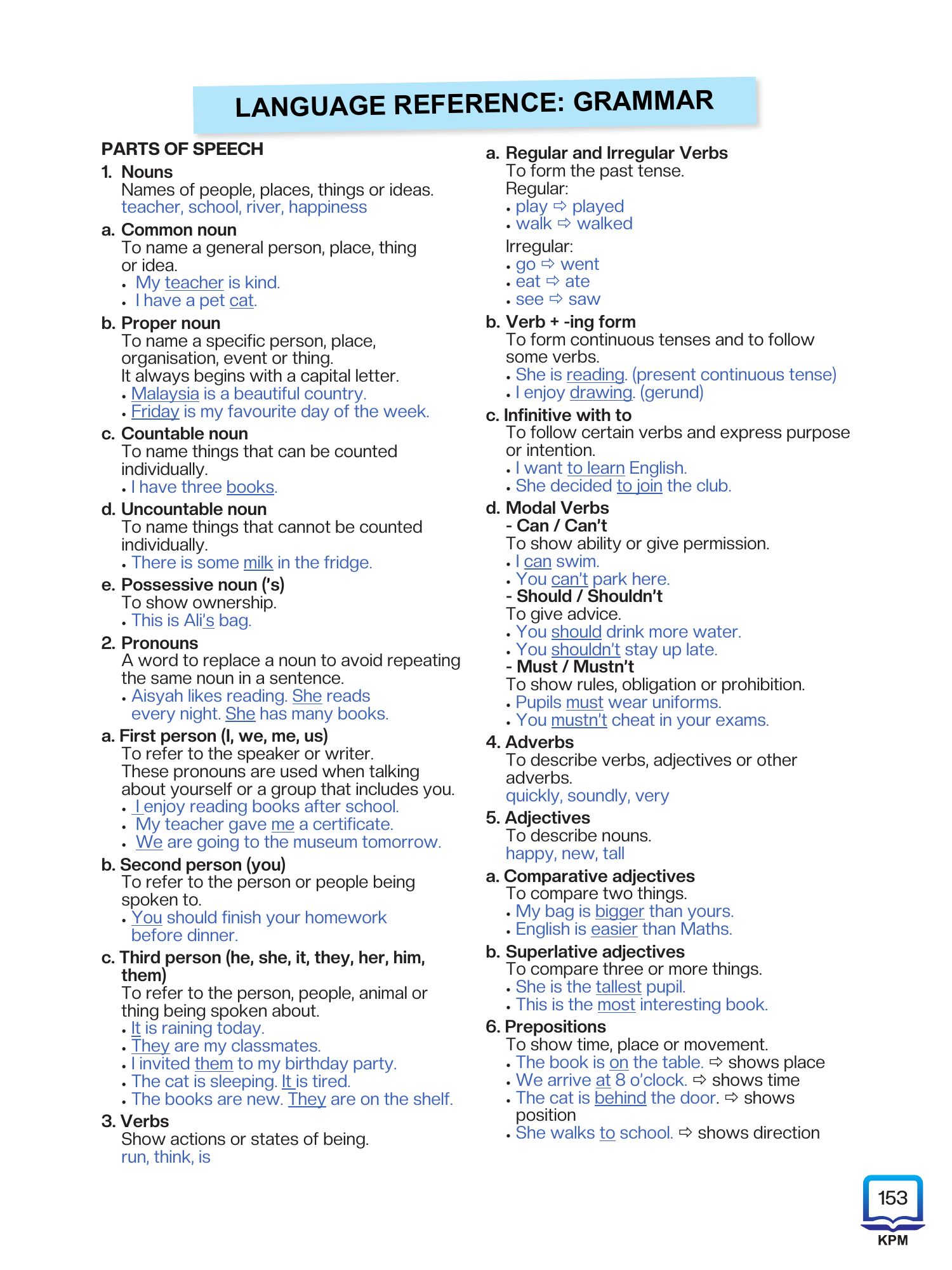
LANGUAGE REFERENCE: GRAMMAR
PARTS OF SPEECH
1. Nouns
Names of people, places, things or ideas.
teacher, school, river, happiness
a. Common noun
To name a general person, place, thing
or idea.
• My teacher is kind.
• I have a pet cat.
b. Proper noun
To name a specific person, place,
organisation, event or thing.
It always begins with a capital letter.
• Malaysia is a beautiful country.
• Friday is my favourite day of the week.
c. Countable noun
To name things that can be counted
individually.
• I have three books.
d. Uncountable noun
To name things that cannot be counted
individually.
• There is some milk in the fridge.
e. Possessive noun (’s)
To show ownership.
• This is Ali’s bag.
2. Pronouns
A word to replace a noun to avoid repeating
the same noun in a sentence.
• Aisyah likes reading. She reads
every night. She has many books.
a. First person (I, we, me, us)
To refer to the speaker or writer.
These pronouns are used when talking
about yourself or a group that includes you.
• I enjoy reading books after school.
• My teacher gave me a certificate.
• We are going to the museum tomorrow.
b. Second person (you)
To refer to the person or people being
spoken to.
• You should finish your homework
before dinner.
c. Third person (he, she, it, they, her, him,
them)
To refer to the person, people, animal or
thing being spoken about.
• It is raining today.
• They are my classmates.
• I invited them to my birthday party.
• The cat is sleeping. It is tired.
• The books are new. They are on the shelf.
3. Verbs
Show actions or states of being.
run, think, is
a. Regular and Irregular Verbs
To form the past tense.
Regular:
• play played
• walk walked
Irregular:
• go went
• eat ate
• see saw
b. Verb + -ing form
To form continuous tenses and to follow
some verbs.
• She is reading. (present continuous tense)
• I enjoy drawing. (gerund)
c. Infinitive with to
To follow certain verbs and express purpose
or intention.
• I want to learn English.
• She decided to join the club.
d. Modal Verbs
- Can / Can’t
To show ability or give permission.
• I can swim.
• You can’t park here.
- Should / Shouldn’t
To give advice.
• You should drink more water.
• You shouldn’t stay up late.
- Must / Mustn’t
To show rules, obligation or prohibition.
• Pupils must wear uniforms.
• You mustn’t cheat in your exams.
4. Adverbs
To describe verbs, adjectives or other
adverbs.
quickly, soundly, very
5. Adjectives
To describe nouns.
happy, new, tall
a. Comparative adjectives
To compare two things.
• My bag is bigger than yours.
• English is easier than Maths.
b. Superlative adjectives
To compare three or more things.
• She is the tallest pupil.
• This is the most interesting book.
6. Prepositions
To show time, place or movement.
• The book is on the table. shows place
• We arrive at 8 o’clock. shows time
• The cat is behind the door. shows
position
• She walks to school. shows direction
153
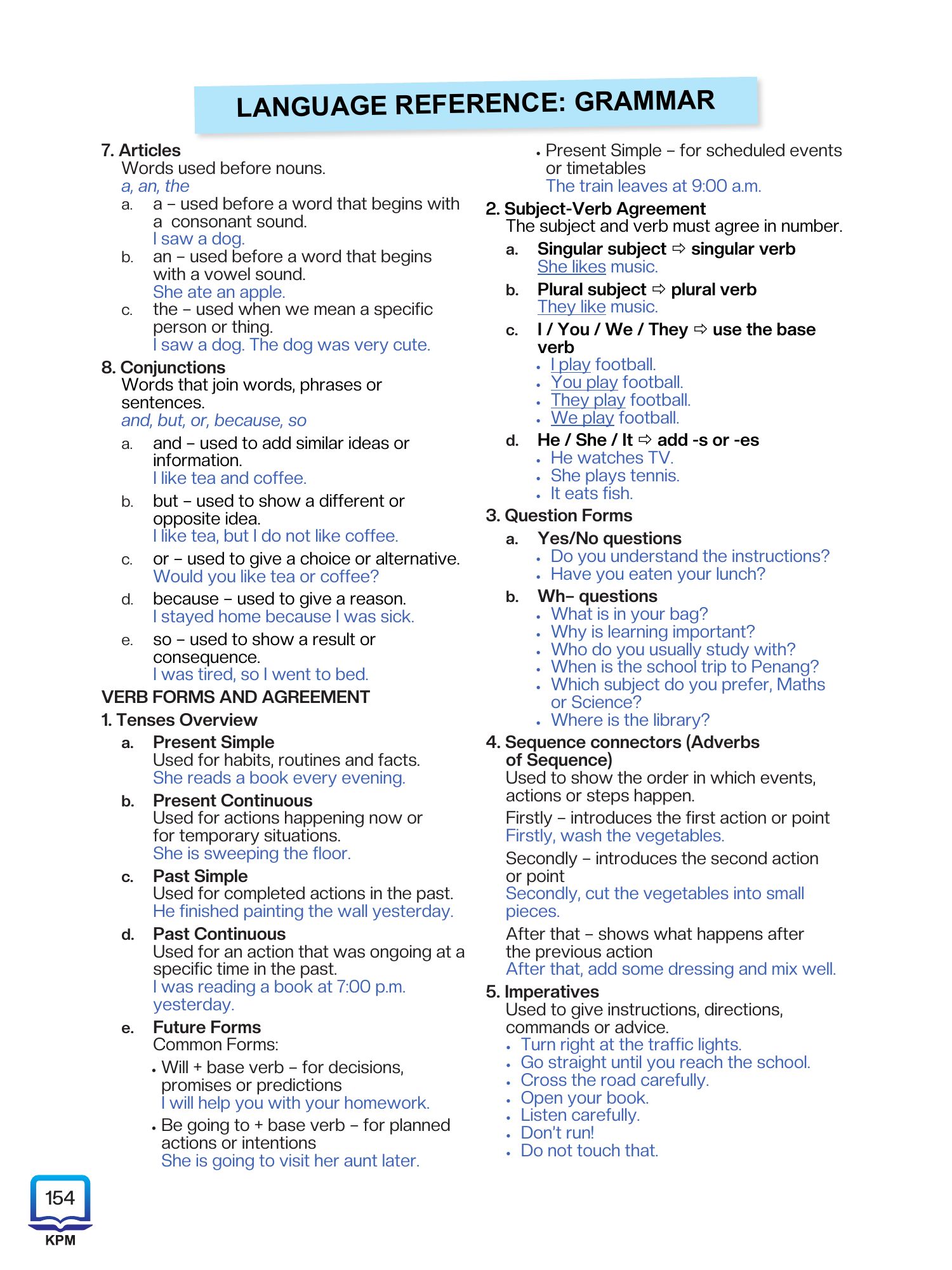
LANGUAGE REFERENCE: GRAMMAR
7. Articles
Words used before nouns.
a, an, the
a. a – used before a word that begins with
a consonant sound.
I saw a dog.
b. an – used before a word that begins
with a vowel sound.
She ate an apple.
c. the – used when we mean a specific
person or thing.
I saw a dog. The dog was very cute.
8. Conjunctions
Words that join words, phrases or
sentences.
and, but, or, because, so
a. and – used to add similar ideas or
information.
I like tea and coffee.
b. but – used to show a different or
opposite idea.
I like tea, but I do not like coffee.
c. or – used to give a choice or alternative.
Would you like tea or coffee?
d. because – used to give a reason.
I stayed home because I was sick.
e. so – used to show a result or
consequence.
I was tired, so I went to bed.
VERB FORMS AND AGREEMENT
1. Tenses Overview
a. Present Simple
Used for habits, routines and facts.
She reads a book every evening.
b. Present Continuous
Used for actions happening now or
for temporary situations.
She is sweeping the floor.
c. Past Simple
Used for completed actions in the past.
He finished painting the wall yesterday.
d. Past Continuous
Used for an action that was ongoing at a
specific time in the past.
I was reading a book at 7:00 p.m.
yesterday.
e. Future Forms
Common Forms:
• Will + base verb – for decisions,
promises or predictions
I will help you with your homework.
• Be going to + base verb – for planned
actions or intentions
She is going to visit her aunt later.
154
• Present Simple – for scheduled events
or timetables
The train leaves at 9:00 a.m.
2. Subject-Verb Agreement
The subject and verb must agree in number.
a. Singular subject singular verb
She likes music.
b. Plural subject plural verb
They like music.
c. I / You / We / They use the base
verb
• I play football.
• You play football.
• They play football.
• We play football.
d. He / She / It add -s or -es
• He watches TV.
• She plays tennis.
• It eats fish.
3. Question Forms
a. Yes/No questions
• Do you understand the instructions?
• Have you eaten your lunch?
b. Wh– questions
• What is in your bag?
• Why is learning important?
• Who do you usually study with?
• When is the school trip to Penang?
• Which subject do you prefer, Maths
or Science?
• Where is the library?
4. Sequence connectors (Adverbs
of Sequence)
Used to show the order in which events,
actions or steps happen.
Firstly – introduces the first action or point
Firstly, wash the vegetables.
Secondly – introduces the second action
or point
Secondly, cut the vegetables into small
pieces.
After that – shows what happens after
the previous action
After that, add some dressing and mix well.
5. Imperatives
Used to give instructions, directions,
commands or advice.
• Turn right at the traffic lights.
• Go straight until you reach the school.
• Cross the road carefully.
• Open your book.
• Listen carefully.
• Don’t run!
• Do not touch that.
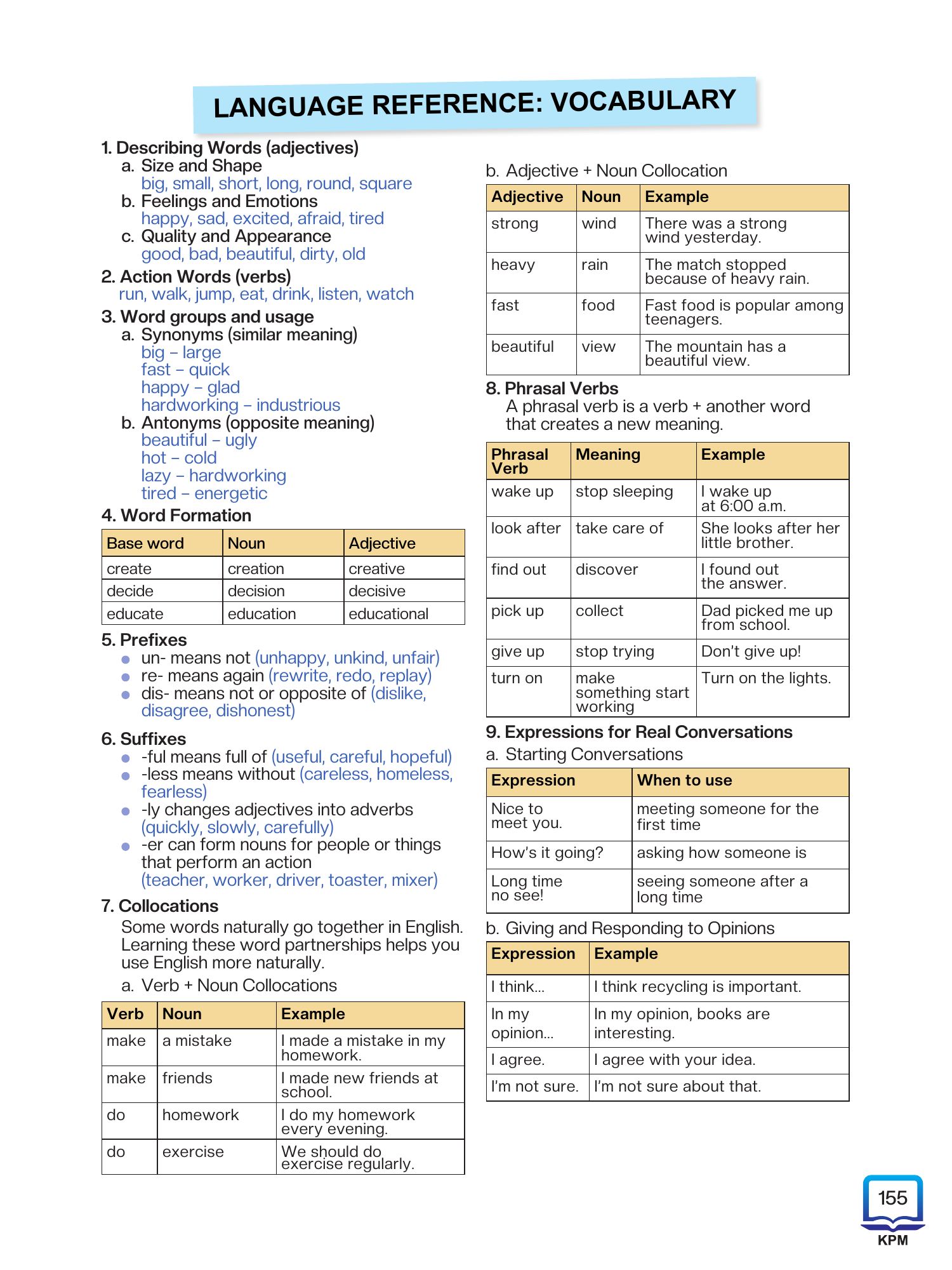
LANGUAGE REFERENCE: VOCABULARY
1. Describing Words (adjectives)
a. Size and Shape
big, small, short, long, round, square
b. Feelings and Emotions
happy, sad, excited, afraid, tired
c. Quality and Appearance
good, bad, beautiful, dirty, old
2. Action Words (verbs)
run, walk, jump, eat, drink, listen, watch
3. Word groups and usage
a. Synonyms (similar meaning)
big – large
fast – quick
happy – glad
hardworking – industrious
b. Antonyms (opposite meaning)
beautiful – ugly
hot – cold
lazy – hardworking
tired – energetic
4. Word Formation
Base word
Noun
Adjective
create
decide
educate
creation
decision
education
creative
decisive
educational
5. Prefixes
un- means not (unhappy, unkind, unfair)
re- means again (rewrite, redo, replay)
dis- means not or opposite of (dislike,
disagree, dishonest)
b. Adjective + Noun Collocation
Adjective
Noun
Example
strong
wind
There was a strong
wind yesterday.
heavy
rain
The match stopped
because of heavy rain.
fast
food
Fast food is popular among
teenagers.
beautiful
view
The mountain has a
beautiful view.
8. Phrasal Verbs
A phrasal verb is a verb + another word
that creates a new meaning.
Phrasal
Verb
wake up
Meaning
Example
stop sleeping
I wake up
at 6:00 a.m.
She looks after her
little brother.
look after take care of
find out
discover
I found out
the answer.
pick up
collect
Dad picked me up
from school.
give up
stop trying
Don’t give up!
turn on
make
Turn on the lights.
something start
working
6. Suffixes
-ful means full of (useful, careful, hopeful)
-less means without (careless, homeless,
fearless)
-ly changes adjectives into adverbs
(quickly, slowly, carefully)
-er can form nouns for people or things
that perform an action
(teacher, worker, driver, toaster, mixer)
7. Collocations
Some words naturally go together in English.
Learning these word partnerships helps you
use English more naturally.
a. Verb + Noun Collocations
9. Expressions for Real Conversations
a. Starting Conversations
Verb
Noun
Example
make
a mistake
make
friends
do
homework
do
exercise
I made a mistake in my
homework.
I made new friends at
school.
I do my homework
every evening.
We should do
exercise regularly.
Expression
When to use
Nice to
meet you.
meeting someone for the
first time
How’s it going?
asking how someone is
Long time
no see!
seeing someone after a
long time
b. Giving and Responding to Opinions
Expression
Example
I think...
I think recycling is important.
In my
opinion...
In my opinion, books are
interesting.
I agree.
I agree with your idea.
I’m not sure. I’m not sure about that.
155
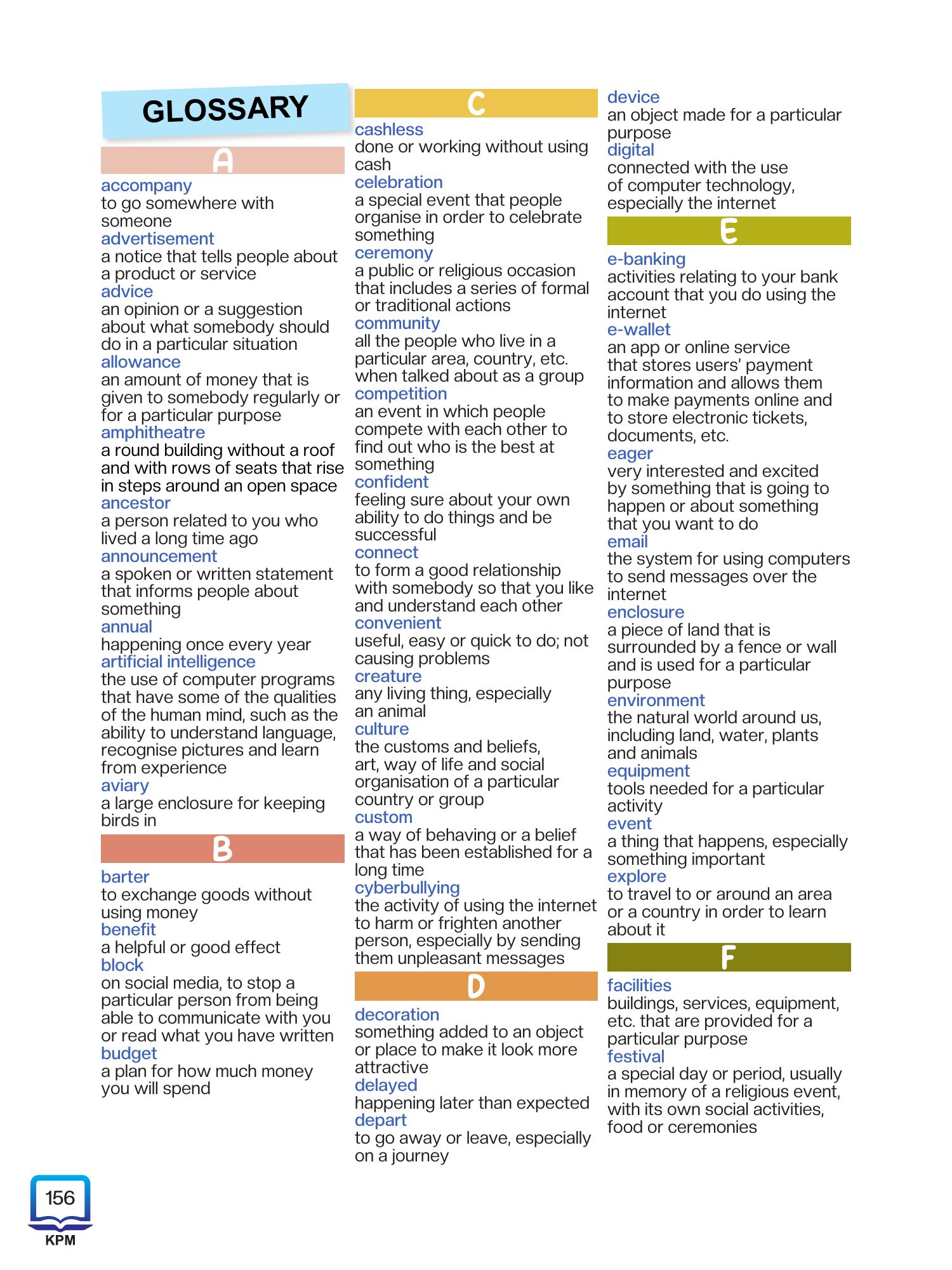
GLOSSARY
device
an object made for a particular
purpose
digital
connected with the use
of computer technology,
especially the internet
cashless
done or working without using
cash
celebration
accompany
a special event that people
to go somewhere with
organise in order to celebrate
someone
something
advertisement
a notice that tells people about ceremony
e-banking
a public or religious occasion
a product or service
activities relating to your bank
that includes a series of formal account that you do using the
advice
or traditional actions
an opinion or a suggestion
internet
about what somebody should community
e-wallet
all the people who live in a
do in a particular situation
an app or online service
particular area, country, etc.
allowance
that stores users’ payment
when talked about as a group information and allows them
an amount of money that is
given to somebody regularly or competition
to make payments online and
an event in which people
for a particular purpose
to store electronic tickets,
compete with each other to
amphitheatre
documents, etc.
a round building without a roof find out who is the best at
eager
and with rows of seats that rise something
very interested and excited
in steps around an open space confident
by something that is going to
feeling sure about your own
ancestor
happen or about something
ability to do things and be
a person related to you who
that you want to do
successful
lived a long time ago
email
connect
announcement
the system for using computers
a spoken or written statement to form a good relationship
to send messages over the
with somebody so that you like internet
that informs people about
and understand each other
something
enclosure
convenient
annual
a piece of land that is
useful, easy or quick to do; not surrounded by a fence or wall
happening once every year
causing problems
artificial intelligence
and is used for a particular
the use of computer programs creature
purpose
that have some of the qualities any living thing, especially
environment
of the human mind, such as the an animal
the natural world around us,
ability to understand language, culture
including land, water, plants
the customs and beliefs,
recognise pictures and learn
and animals
art, way of life and social
from experience
equipment
organisation of a particular
aviary
tools needed for a particular
country or group
a large enclosure for keeping
activity
custom
birds in
event
a way of behaving or a belief
a thing that happens, especially
that has been established for a something important
long time
explore
barter
cyberbullying
to travel to or around an area
to exchange goods without
the activity of using the internet or a country in order to learn
using money
to harm or frighten another
about it
benefit
person, especially by sending
a helpful or good effect
them unpleasant messages
block
on social media, to stop a
facilities
particular person from being
buildings, services, equipment,
able to communicate with you decoration
etc. that are provided for a
or read what you have written something added to an object particular purpose
or place to make it look more
budget
festival
attractive
a plan for how much money
a special day or period, usually
delayed
you will spend
in memory of a religious event,
happening later than expected with its own social activities,
depart
food or ceremonies
to go away or leave, especially
on a journey
156
functional
designed to be practical and
useful rather than attractive
future
a period of time that is to come
fuzzy
covered with short, soft hairs
inventor
a person who has invented
something or whose job is
inventing things
online
(of an activity or service)
available on or done using the
internet or other computer
network
outdoors
outside, not inside a building
landfill
an area of land where large
amounts of waste material are
gadget
buried under the earth
a small tool or device that does lightweight
something useful
not weighing much
passenger
generation
lively
a person who is travelling in
all the people who were born
full of energy and activity
a vehicle but is not driving it,
at about the same time
livestock
flying it or working on it
goal
farm animals
pedestrian
something a person wants to
long-lasting
a person who is walking,
achieve
continuing for a long period of especially in an area where
time
vehicles go
luggage
picnic
the bags, suitcases, etc. that
habitat
an occasion when people
contain your possessions and pack a meal and take it to eat
the natural home of a plant or
that you take with you when
animal
outdoors
you are travelling
handy
platform
useful or convenient
a flat raised area or structure
harvest
portable
the time of year when the
machine
light and small enough to be
crops are gathered in on a farm a piece of equipment with
easily carried or moved
heritage
several moving parts that uses practical
the traditions and history of
power to do a particular type
fitting the needs of a particular
a country or society that are
of work
situation in a helpful way
considered an important part of materials
pristine
its character
things that are needed in order fresh and clean, as if new
hiking
to do a particular activity
privacy
the activity of going for long
meaningful
the right that someone has
walks in the countryside
serious and important
to keep their personal life or
hope
mobility
personal information secret or
a feeling of wanting something the ability to be moved from
known only to a small group of
good to happen
one place to another
people
modern
process
designed and made using the
a series of actions that you
most recent ideas and methods take in order to achieve a result
iconic
being a famous person or thing multicultural
protect
that people admire and see as relating to or including several to keep someone or something
different cultures
a symbol of a particular idea,
safe from injury, damage or
museum
way of life, etc.
loss
a building in which objects of
inconvenience
prowl
artistic, cultural, historical or
a problem or difficulty that
to move around quietly in a
scientific interest are kept and place trying not to be seen or
causes trouble or delay
shown to the public
innovation
heard, as an animal does when
a new idea or method
hunting
interaction
communicating with somebody, needs
especially while you work, play the things that a person
QR code
or spend time with them
a pattern of black and
must have in order to have a
invention
satisfactory life or accomplish white squares that contains
something that has been
information, that can be read by
something
designed or created for the
the camera on a smartphone
first time
157
tradition
save
to keep something, especially a belief, custom or a way of
rainforest
doing something passed down
money, for use in the future
a thick forest in tropical parts
from generation to generation
screen time
of the world that have a lot of time spent using a device such transform
rain
to change the form of
as a computer, television or
rare
something
tablet
not done, seen, happening, etc. sense
trot
very often
to notice or become aware of to run or walk fast, taking short,
recede
quick steps
something
to move gradually back from a shady
previous position, such as the sheltered from direct light from
sea when the tide moves away the sun
unattended
from the shore
smart city
left alone, with no one watching
recess
an urban area that uses digital useful
a period of time between
technology, data collection,
effective; helping you to do or
lessons at school
and communication networks
achieve something
recognised
to improve public services,
known or officially accepted
run more efficiently, and raise
recommend
the overall quality of life for
valuables
suggest something as a good residents
things that are worth a lot
choice
smartphone
of money, especially small
recycle
a mobile phone that also has
personal things such as
to treat things that have
some of the functions of a
jewellery, cameras, etc.
already been used so that they computer, for example the
voyage
can be used again
facility to use apps and the
a long journey, especially by
reduce
internet
sea or in space
to make something less or
surveillance
smaller in size, quantity, price,
the careful watching of people
etc.
or places, often for safety or
wants
reflect
security
things that people desire or
to think carefully and deeply
system
luxury items that improve life
about something
a way of doing things
but are not strictly necessary
reliable
for basic survival
that can be trusted to do
warning
something well; that you can
technology
a statement, an event,
rely on
the methods for using scientific etc. telling somebody that
resources
discoveries for practical
something bad or unpleasant
useful materials or supplies that purposes
may happen in the future so
people can use
terminal
that they can try to avoid it
reuse
a place, building or set of
waste
to use something again
buildings where journeys by
materials that are no longer
rhythm
train, bus or boat begin or end needed and are thrown away
a strong regular repeated
token
wildlife
pattern of sounds or
a round piece of metal or
animals, birds and insects
movements
plastic used instead of money that live in their natural
rotting
to operate some machines or
environments
decaying naturally or gradually as a form of payment
wise
rumour
tool
an interesting story or piece of a piece of equipment that you having or showing the ability to
make good judgments, based
news that may or may not be
use with your hands to make or on a deep understanding and
true, that spreads quickly from repair something
experience of life
person to person
track
woven
to follow, monitor or trace the made by crossing pieces of
course, progress or physical
material across, over and under
safety
path of a person, animal, object each other
the state of being safe and
or data over time
protected from danger or harm
158
REFERENCES
Ab Jabar, N., Sukri, S., Daeng Jamal, D. H., Kiffli, S., & Suliman, M. S. (2024). Literature and
cultural ecology: The relationship between folklore and environmental sustainability. BIO Web
of Conferences, 131, 03007. https://doi.org/10.1051/bioconf/202413103007
CILISOS. (2020, March 25). These ‘fire snails’ only live in one place around the world: A
mountain range in Malaysia. https://cilisos.my/these-fire-snails-only-live-in-one-place-around-
the-world-a-mountain-range-in-malaysia/
Cyberview. (n.d.). Sustainable smart city. Retrieved August 15, 2026, from https://www.cyberview.
com.my/the-capital/smart-city/
Education + TVET. (2026, June 3). Malaysian brothers win highest invention award at WYIE
2026 for AI education innovation. https://educationtvet.com/malaysian-brothers-win-highest-
invention-award-at-wyie-2026-for-ai-education-innovation/
Higgs, E. (2025, December 1). Meet the Malaysian earthtiger tarantula: Secretive and stripy with a
leg span for days. IFLScience. https://www.iflscience.com/meet-the-malaysian-earthtiger
-tarantula-secretive-and-stripy-with-a-leg-span-for-days-81752
Idris, N. (2018, August). Nepenthes gracilis Korthals. Malaysia Biodiversity Information System
(MyBIS). Retrieved July 28, 2026, from https://www.mybis.gov.my/art/230
Jabatan Kemajuan Orang Asli. (2022, March 7). Hari Moyang Puja Pantai.
https://www.jakoa.gov.my/hari-moyang-puja-pantai/
Malaysian brothers win best young inventors, launch AI startup with Google. (2025, June 4).
Malay Mail. https://www.malaymail.com/news/tech-gadgets/2025/06/04/malaysian-brothers-
win-best-young-inventors-launch-ai-startup-with-google/179263#goog_rewarded
Md Mokhtar, M. H. A., & Hoe, V. (2022, January 25). Dr Wu Lien-Teh the plague fighter.
Department of Social and Preventive Medicine, Faculty of Medicine, Universiti Malaya. https://
spm.um.edu.my/2022/01/25/dr-wu-lien-teh-the-plague-fighter/
Md Raieh, R. (2026, June 23). Smart Sense Watch & Smart Serve SMK Dato’ Klana Putra
harumkan nama Malaysia di pentas antarabangsa! Hebat pelajar kita. Sinar Bestari.
https://sinarbestari.sinarharian.com.my/article/649835/sekolah-menengah/smart-sense-
watch-smart-serve-smk-dato-klana-putra-harumkan-nama-malaysia-di-pentas-antarabangsa-
hebat-pelajar-kita
My Backyard Tour. (2016, August 20). 15 interesting facts about the Rafflesia flower.
https://mybackyardtour.com/15-things-about-rafflesia/
Nair, N. (n.d.). Naga Tasik Chini: The lake dragon. Mythlok. Retrieved August 4, 2026, from https://
mythlok.com/naga-tasik-chini/
Sarawak Tourism Board. (n.d.). Gawai Dayak festival: A time of thanksgiving and merrymaking.
Retrieved September 4, 2026, from https://www.sarawaktourism.com/web/stories/story-
view/gawai-dayak-festival-a-time-of-thanksgiving-and-merrymaking
Shelley, M. W. (2018). Frankenstein; or, The modern Prometheus. Penguin Classics. (Original work
published 1818)
The Morning Founder. (2025, December 5). Hew Ah Kow / Half-boiled egg maker. https://
themorningfounder.com/stories/hew-ah-kow-egg-boiler/
Tourism Malaysia. (n.d.). Kaamatan. Retrieved August 13, 2026, from https://www.malaysia.travel/
events/kaamatan
Trisha, N. (2025, August 25). Clothes recycling to ease landfills. The Star.
https://www.thestar.com.my/news/nation/2025/08/25/clothes-recycling-to-ease-landfills
Wells, H. G. (2017). The time machine. William Collins. (Original work published 1895)
159
ACKNOWLEDGEMENTS
The Ministry of Education extends its sincere appreciation and gratitude to
all individuals and organisations whose valuable contributions, support and
cooperation have made the development of this textbook possible.
Special appreciation is extended to:
Educational Resources and Technology Division, Ministry of Education
Malaysia, including its subject matter experts, educators and reviewers, for their
valuable insights, professional expertise and constructive feedback throughout
the development of this textbook.
Curriculum Development Division, Ministry of Education Malaysia, for its
valuable guidance and support in ensuring that the content of this textbook is
aligned with the national curriculum.
The editorial team, for their dedication to research, writing and editing.
The production team, for their creativity, technical expertise and commitment to
producing high-quality educational materials.
Maryam Muzamir and family, for their kind cooperation and for sharing
information about Maryam’s invention and achievements.
Mohammad Parsa Parhizkar, Mohammad Rohan Parhizkar and family, for their
kind cooperation and for sharing information about their educational innovation.
160