RAINF OREST
TREASURES
Rainforest Discovery
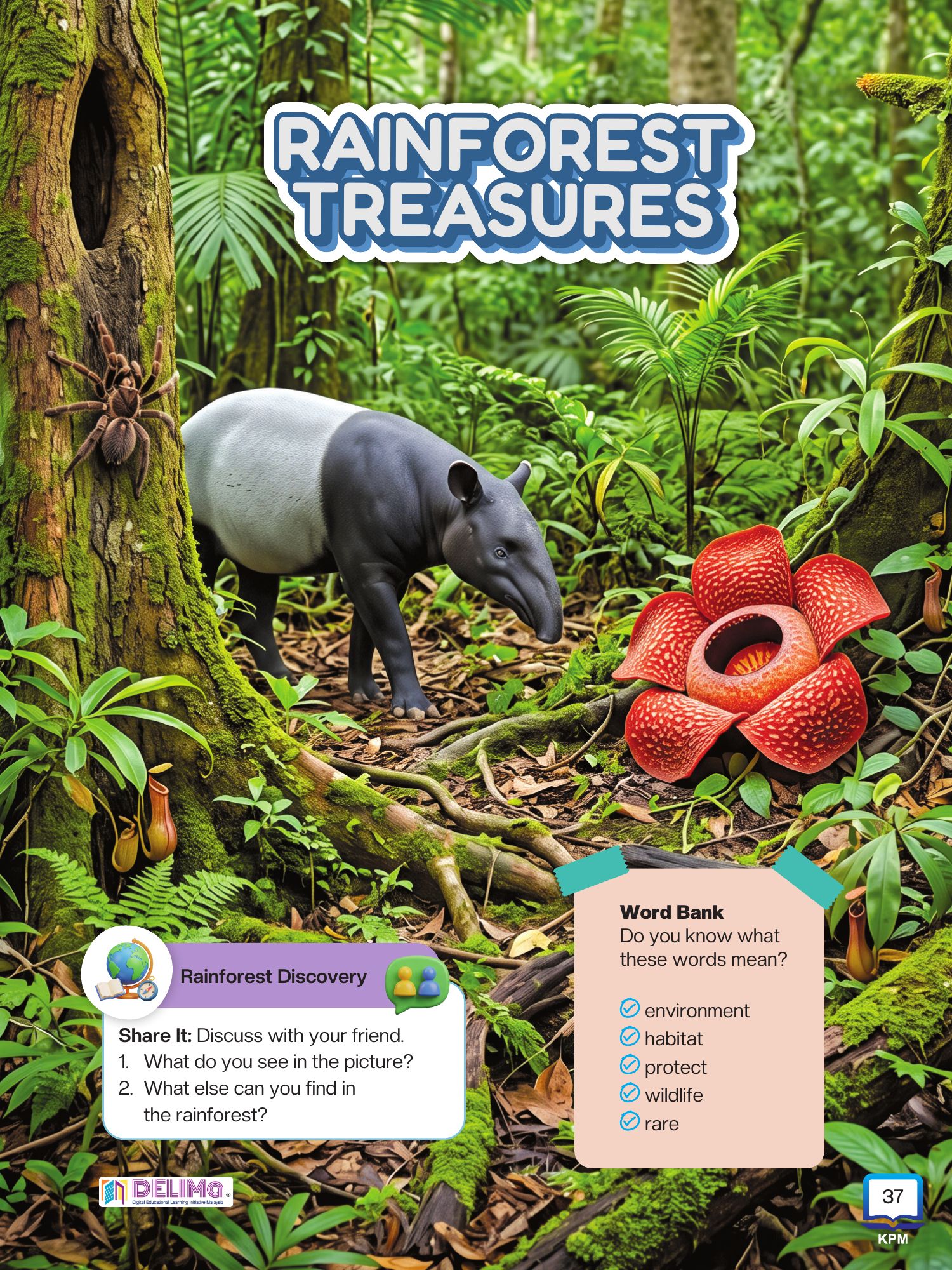
Share It: Discuss with your friend.
1. What do you see in the picture?
2. What else can you find in
the rainforest?
Word Bank
Do you know what
these words mean?
environment
habitat
protect
wildlife
rare
37
RAINFOREST WONDERS
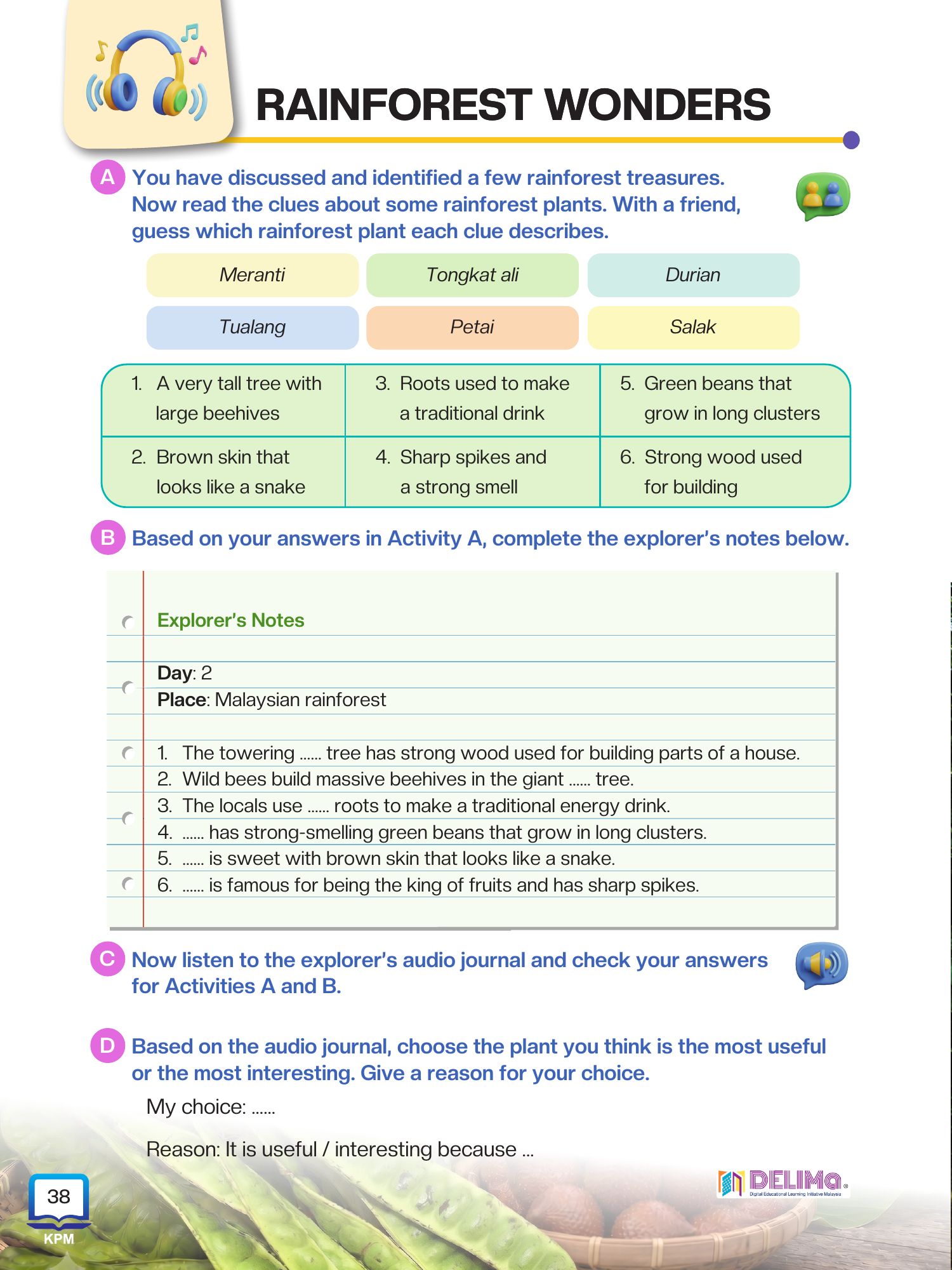
A You have discussed and identified a few rainforest treasures.
Now read the clues about some rainforest plants. With a friend,
guess which rainforest plant each clue describes.
Meranti
Tongkat ali
Durian
Tualang
Petai
Salak
1. A very tall tree with
3. Roots used to make
5. Green beans that
large beehives
a traditional drink
2. Brown skin that
4. Sharp spikes and
looks like a snake
a strong smell
grow in long clusters
6. Strong wood used
for building
B Based on your answers in Activity A, complete the explorer’s notes below.
Explorer’s Notes
Day: 2
Place: Malaysian rainforest
1. The towering …… tree has strong wood used for building parts of a house.
2. Wild bees build massive beehives in the giant …… tree.
3. The locals use ...… roots to make a traditional energy drink.
4. ...… has strong-smelling green beans that grow in long clusters.
5. ...… is sweet with brown skin that looks like a snake.
6. ...… is famous for being the king of fruits and has sharp spikes.
C Now listen to the explorer’s audio journal and check your answers
for Activities A and B.
D Based on the audio journal, choose the plant you think is the most useful
or the most interesting. Give a reason for your choice.
My choice: ......
Reason: It is useful / interesting because ...
38
E You have met the rainforest’s plants. Now it is time to meet the animals.
Use a dictionary to find out what these words and phrases mean.
climb
prowl
forest floor
canopy
trot
tree trunk
swing
stomp
near the river
tall grass
F Here are five animals from the rainforest. How do you think each
one moves? Choose a verb from Activity E for each animal. Then,
listen to the documentary Wild Malaysia and check your predictions.
Tiger
Tapir
Sun bear
Orangutan
Elephant
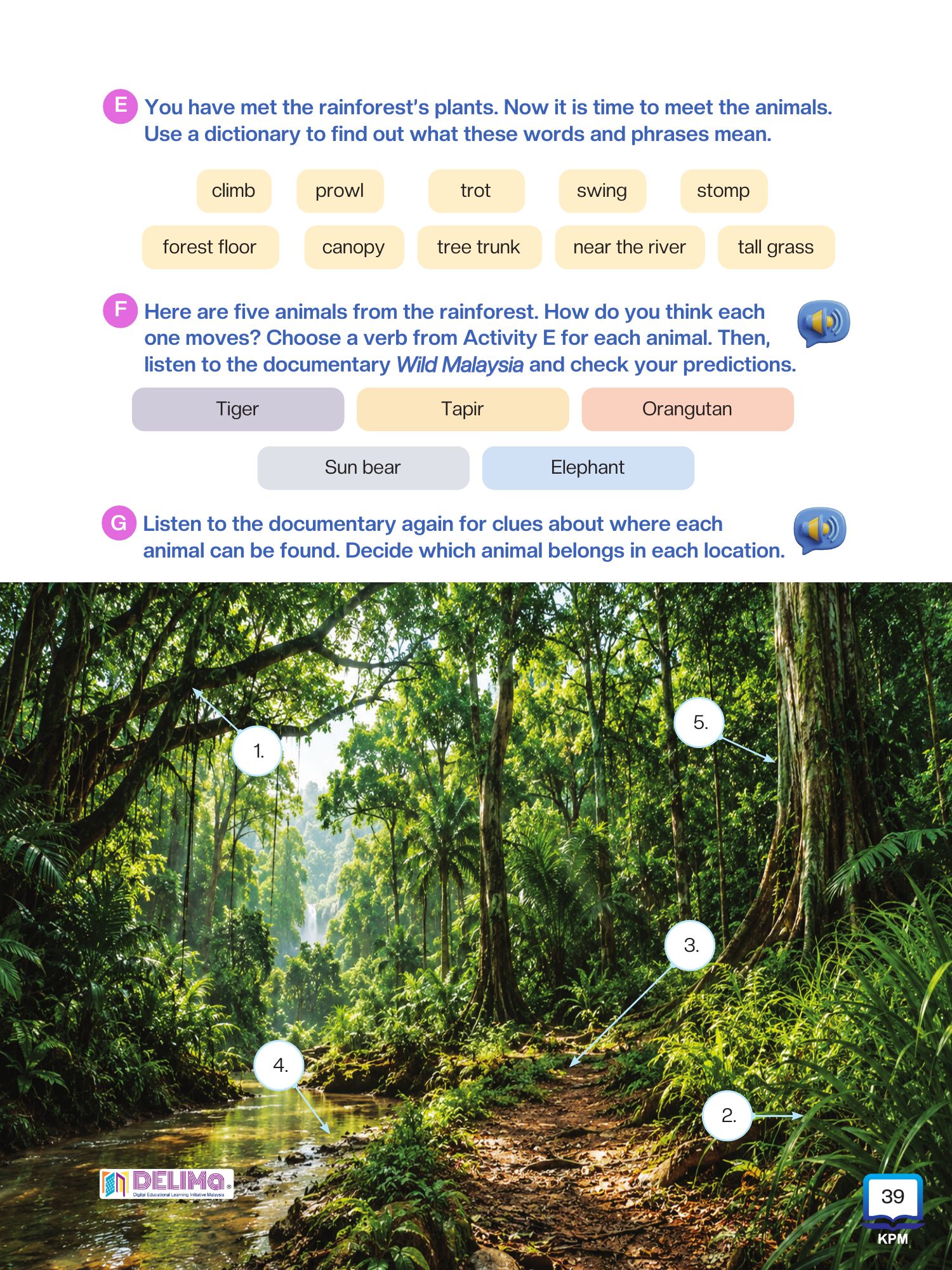
G Listen to the documentary again for clues about where each
animal can be found. Decide which animal belongs in each location.
39
INTO THE WILD
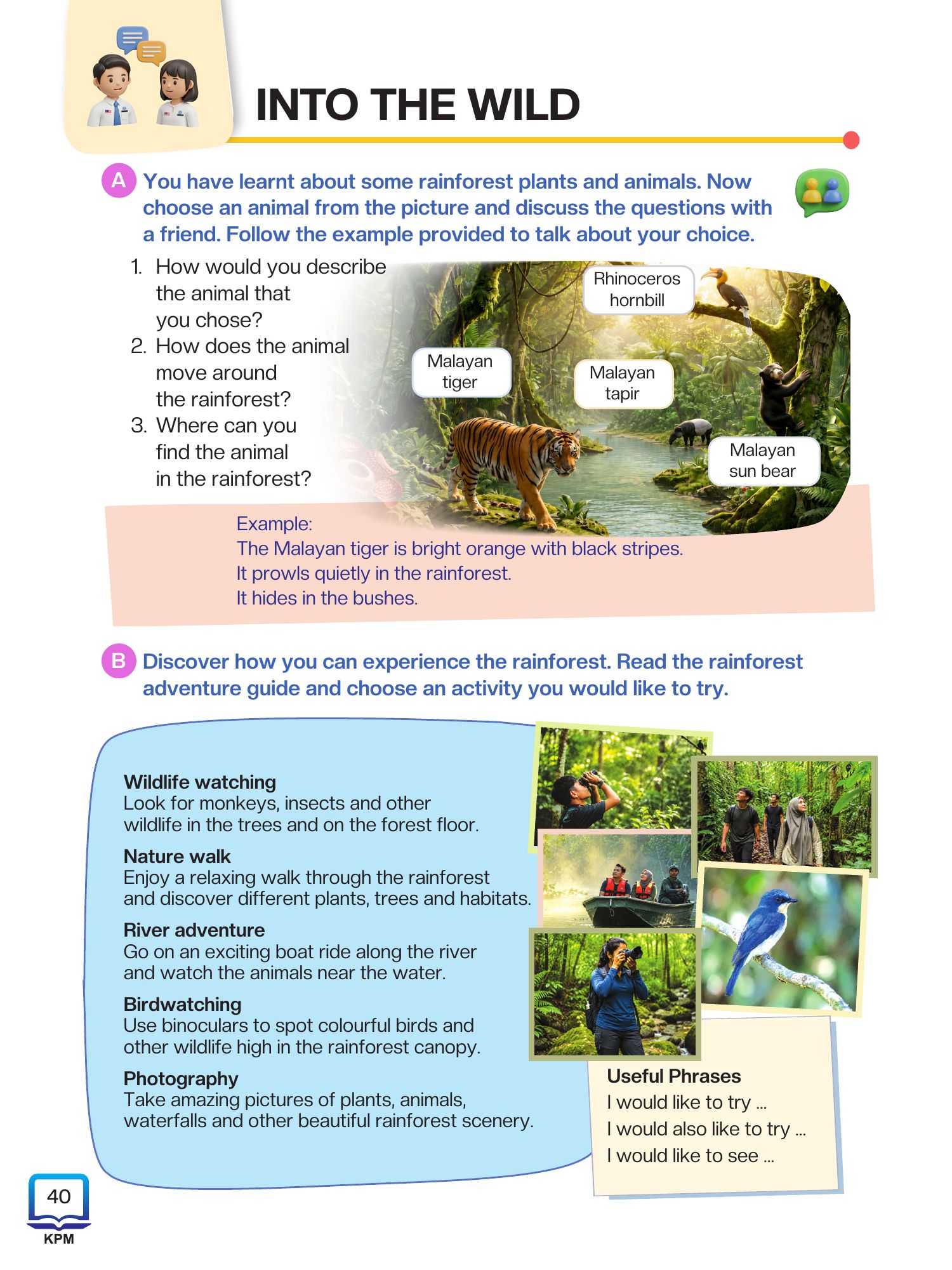
A You have learnt about some rainforest plants and animals. Now
choose an animal from the picture and discuss the questions with
a friend. Follow the example provided to talk about your choice.
1. How would you describe
the animal that
you chose?
2. How does the animal
move around
the rainforest?
3. Where can you
find the animal
in the rainforest?
Rhinoceros
hornbill
Malayan
tiger
Malayan
tapir
Malayan
sun bear
Example:
The Malayan tiger is bright orange with black stripes.
It prowls quietly in the rainforest.
It hides in the bushes.
B Discover how you can experience the rainforest. Read the rainforest
adventure guide and choose an activity you would like to try.
Wildlife watching
Look for monkeys, insects and other
wildlife in the trees and on the forest floor.
Nature walk
Enjoy a relaxing walk through the rainforest
and discover different plants, trees and habitats.
River adventure
Go on an exciting boat ride along the river
and watch the animals near the water.
Birdwatching
Use binoculars to spot colourful birds and
other wildlife high in the rainforest canopy.
Photography
Take amazing pictures of plants, animals,
waterfalls and other beautiful rainforest scenery.
40
Useful Phrases
I would like to try …
I would also like to try …
I would like to see …
C Imagine you are planning a trip to a rainforest park. Work with a
friend and answer the questions below. Add more ideas to each list.
1. Where should we go
• Kinabalu Park
?
2. When should we go?
• Bako National Park
• this weekend
• ......
• in the morning
• ......
3. What should we bring?
• boots
• hat
• ......
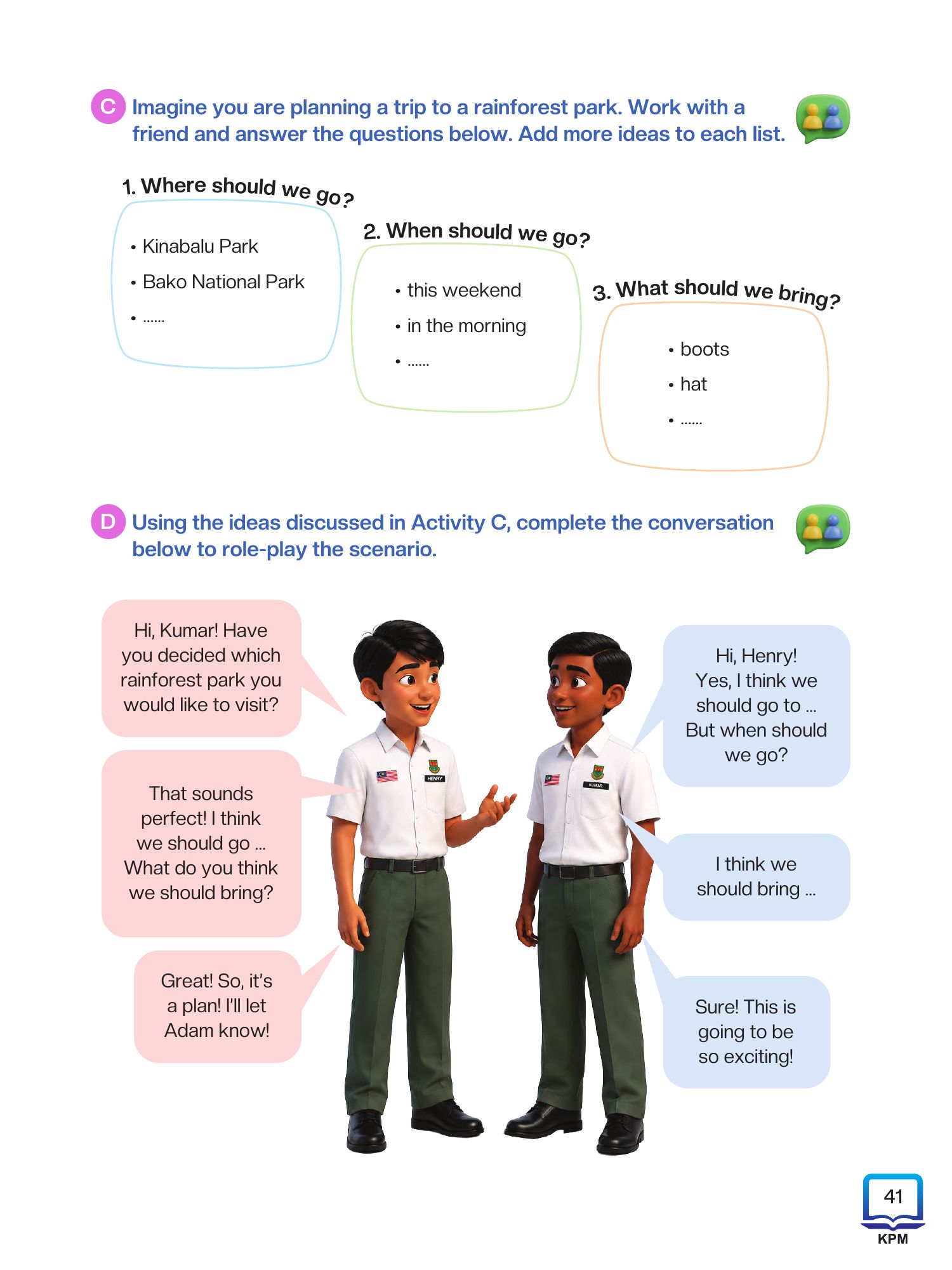
D Using the ideas discussed in Activity C, complete the conversation
below to role-play the scenario.
Hi, Kumar! Have
you decided which
rainforest park you
would like to visit?
That sounds
perfect! I think
we should go ...
What do you think
we should bring?
Great! So, it’s
a plan! I’ll let
Adam know!
Hi, Henry!
Yes, I think we
should go to ...
But when should
we go?
I think we
should bring ...
Sure! This is
going to be
so exciting!
41
UNIQUE FOREST LIFE
READING TEXT 1
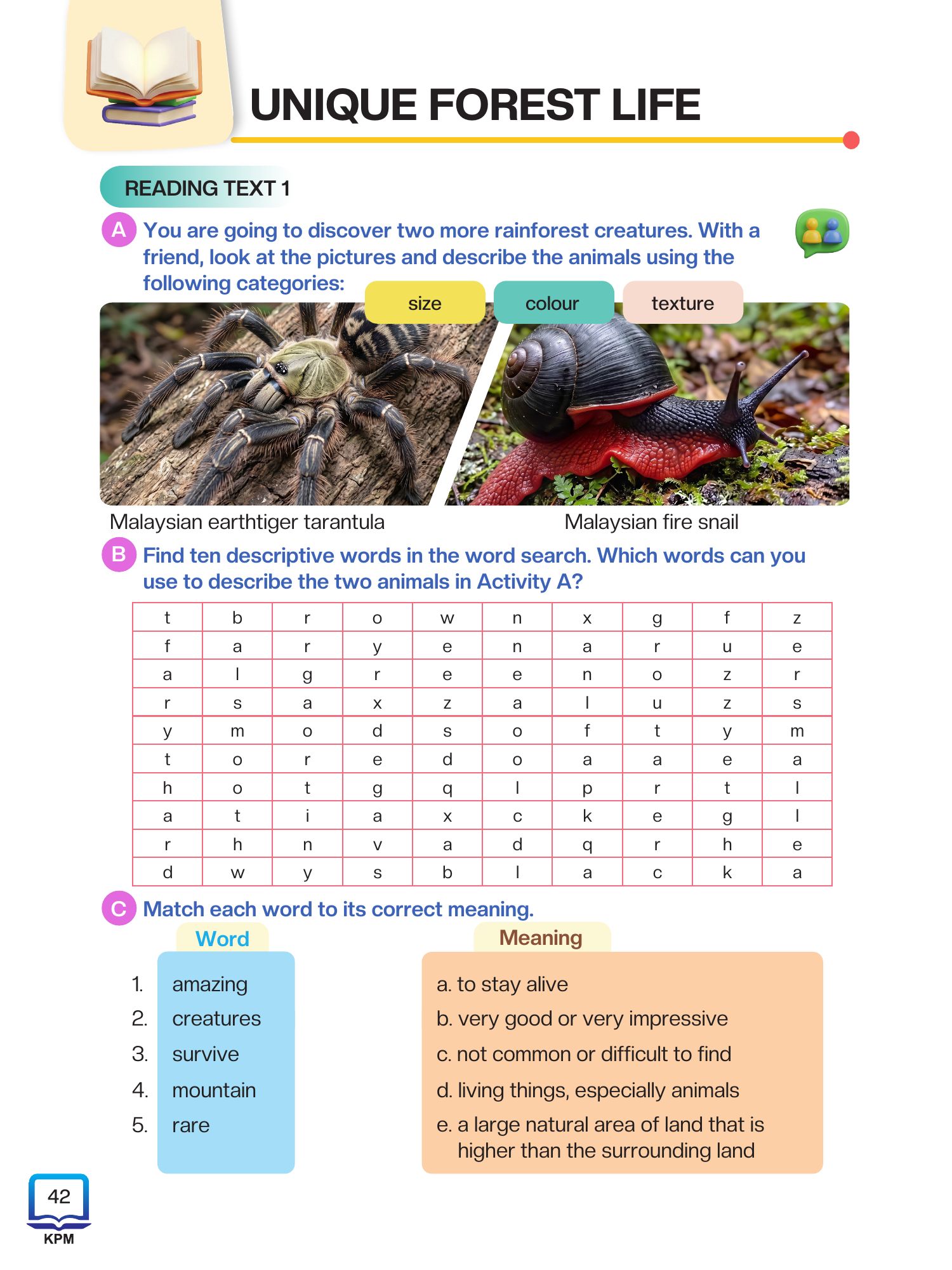
A You are going to discover two more rainforest creatures. With a
friend, look at the pictures and describe the animals using the
following categories:
size
colour
Malaysian earthtiger tarantula
texture
Malaysian fire snail
B Find ten descriptive words in the word search. Which words can you
use to describe the two animals in Activity A?
t
b
r
o
w
n
x
g
f
z
f
a
r
y
e
n
a
r
u
e
a
l
g
r
e
e
n
o
z
r
r
s
a
x
z
a
l
u
z
s
y
m
o
d
s
o
f
t
y
m
t
o
r
e
d
o
a
a
e
a
h
o
t
g
q
l
p
r
t
l
a
t
i
a
x
c
k
e
g
l
r
h
n
v
a
d
q
r
h
e
d
w
y
s
b
l
a
c
k
a
C Match each word to its correct meaning.
Meaning
Word
42
1.
amazing
a. to stay alive
2.
creatures
b. very good or very impressive
3.
survive
c. not common or difficult to find
4.
mountain
d. living things, especially animals
5.
rare
e. a large natural area of land that is
higher than the surrounding land
D Read the text to find out more about the two rainforest animals.
Then, answer the questions.
The Malaysian Earthtiger Tarantula and the Fire Snail
Malaysia’s rainforests are home to a wide variety of
amazing creatures. These lush green jungles are full of life,
making them some of the most important ecosystems in the
entire world.
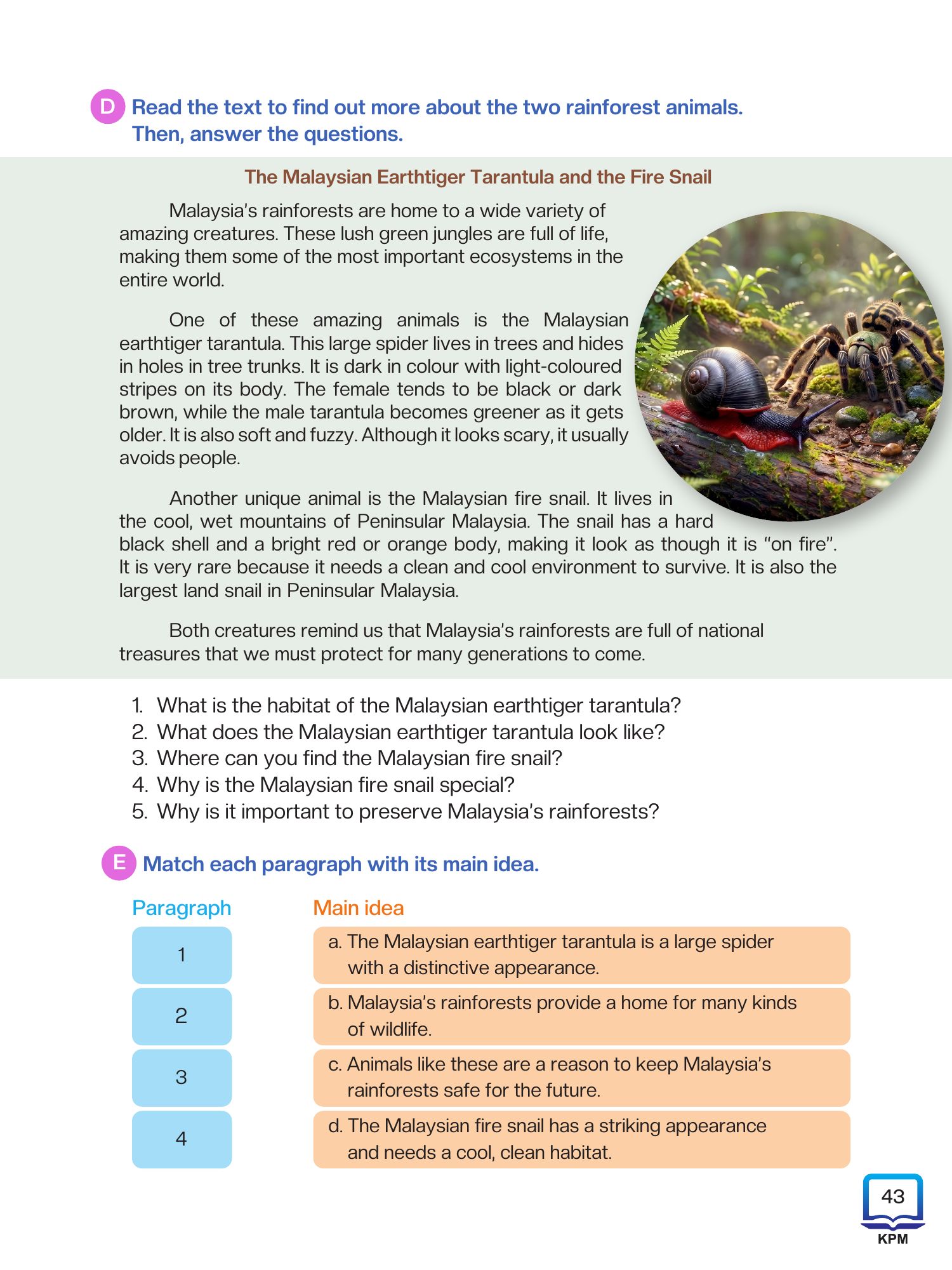
One of these amazing animals is the Malaysian
earthtiger tarantula. This large spider lives in trees and hides
in holes in tree trunks. It is dark in colour with light-coloured
stripes on its body. The female tends to be black or dark
brown, while the male tarantula becomes greener as it gets
older. It is also soft and fuzzy. Although it looks scary, it usually
avoids people.
Another unique animal is the Malaysian fire snail. It lives in
the cool, wet mountains of Peninsular Malaysia. The snail has a hard
black shell and a bright red or orange body, making it look as though it is “on fire”.
It is very rare because it needs a clean and cool environment to survive. It is also the
largest land snail in Peninsular Malaysia.
Both creatures remind us that Malaysia’s rainforests are full of national
treasures that we must protect for many generations to come.
1. What is the habitat of the Malaysian earthtiger tarantula?
2. What does the Malaysian earthtiger tarantula look like?
3. Where can you find the Malaysian fire snail?
4. Why is the Malaysian fire snail special?
5. Why is it important to preserve Malaysia’s rainforests?
E Match each paragraph with its main idea.
Paragraph
Main idea
1
a. The Malaysian earthtiger tarantula is a large spider
with a distinctive appearance.
2
b. Malaysia’s rainforests provide a home for many kinds
of wildlife.
3
c. Animals like these are a reason to keep Malaysia’s
rainforests safe for the future.
4
d. The Malaysian fire snail has a striking appearance
and needs a cool, clean habitat.
43
READING TEXT 2
A You have explored some unique rainforest animals.
Now think about rainforest plants. Read the questions and
discuss them with a friend.
1. Do any plants eat insects?
2. Do certain flowers smell like rotten meat?
3. Do you think every plant needs roots to grow?
B Discover some amazing rainforest plants. Read the magazine article and
find out if your ideas in Activity A were correct.
Amazing Plants of the
Southeast Asian Jungle
THE NATURE MAGAZINE
Deep in the green jungles of Southeast Asia, you can find two of the strangest
plants in the world. They are the giant Rafflesia and the clever Periuk kera.
These plants are not like other plants. They have special features and unusual
ways to survive in the wild.
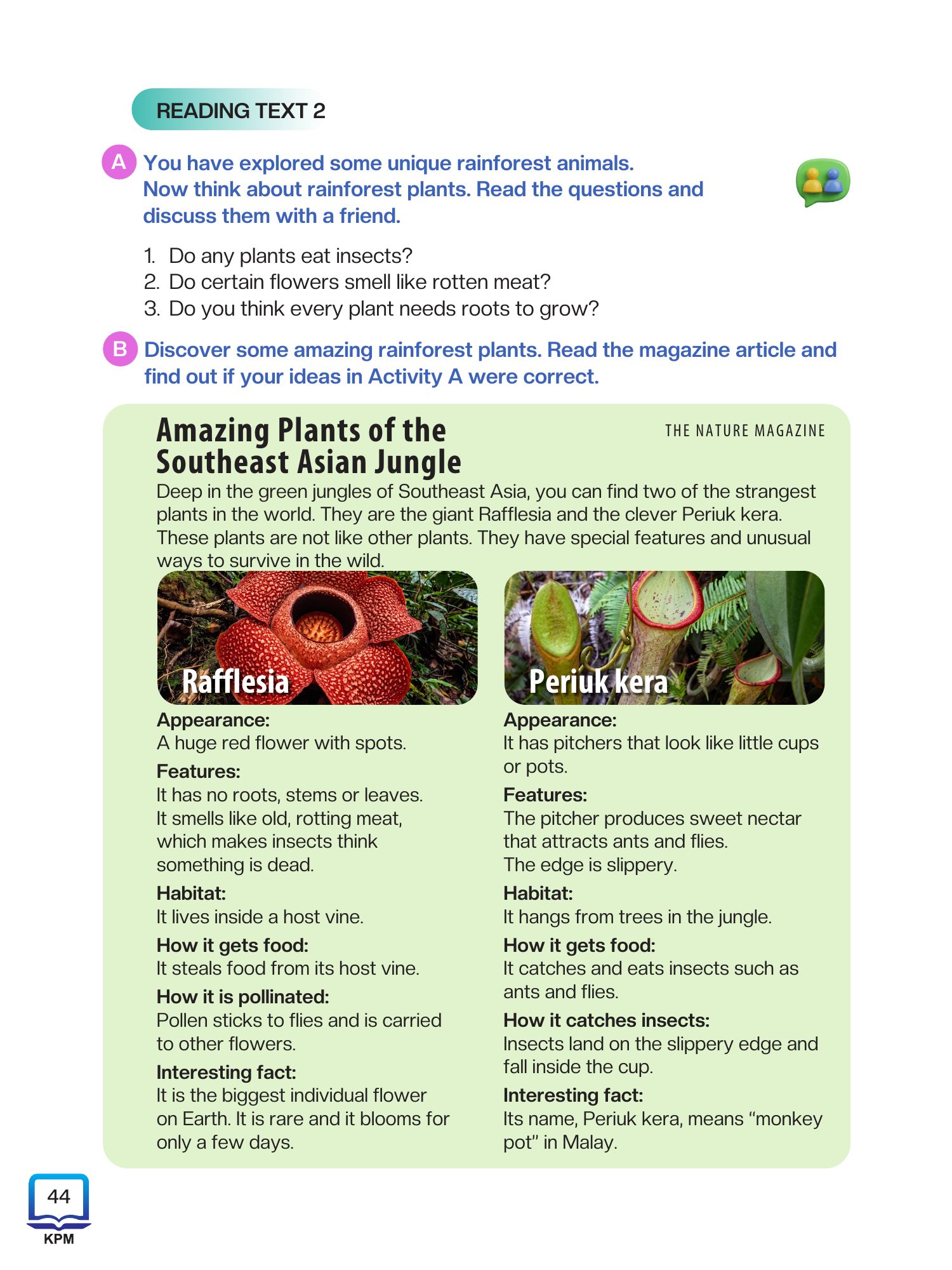
Rafflesia
Appearance:
A huge red flower with spots.
Features:
It has no roots, stems or leaves.
It smells like old, rotting meat,
which makes insects think
something is dead.
Habitat:
It lives inside a host vine.
How it gets food:
It steals food from its host vine.
How it is pollinated:
Pollen sticks to flies and is carried
to other flowers.
Interesting fact:
It is the biggest individual flower
on Earth. It is rare and it blooms for
only a few days.
44
Periuk kera
Appearance:
It has pitchers that look like little cups
or pots.
Features:
The pitcher produces sweet nectar
that attracts ants and flies.
The edge is slippery.
Habitat:
It hangs from trees in the jungle.
How it gets food:
It catches and eats insects such as
ants and flies.
How it catches insects:
Insects land on the slippery edge and
fall inside the cup.
Interesting fact:
Its name, Periuk kera, means “monkey
pot” in Malay.
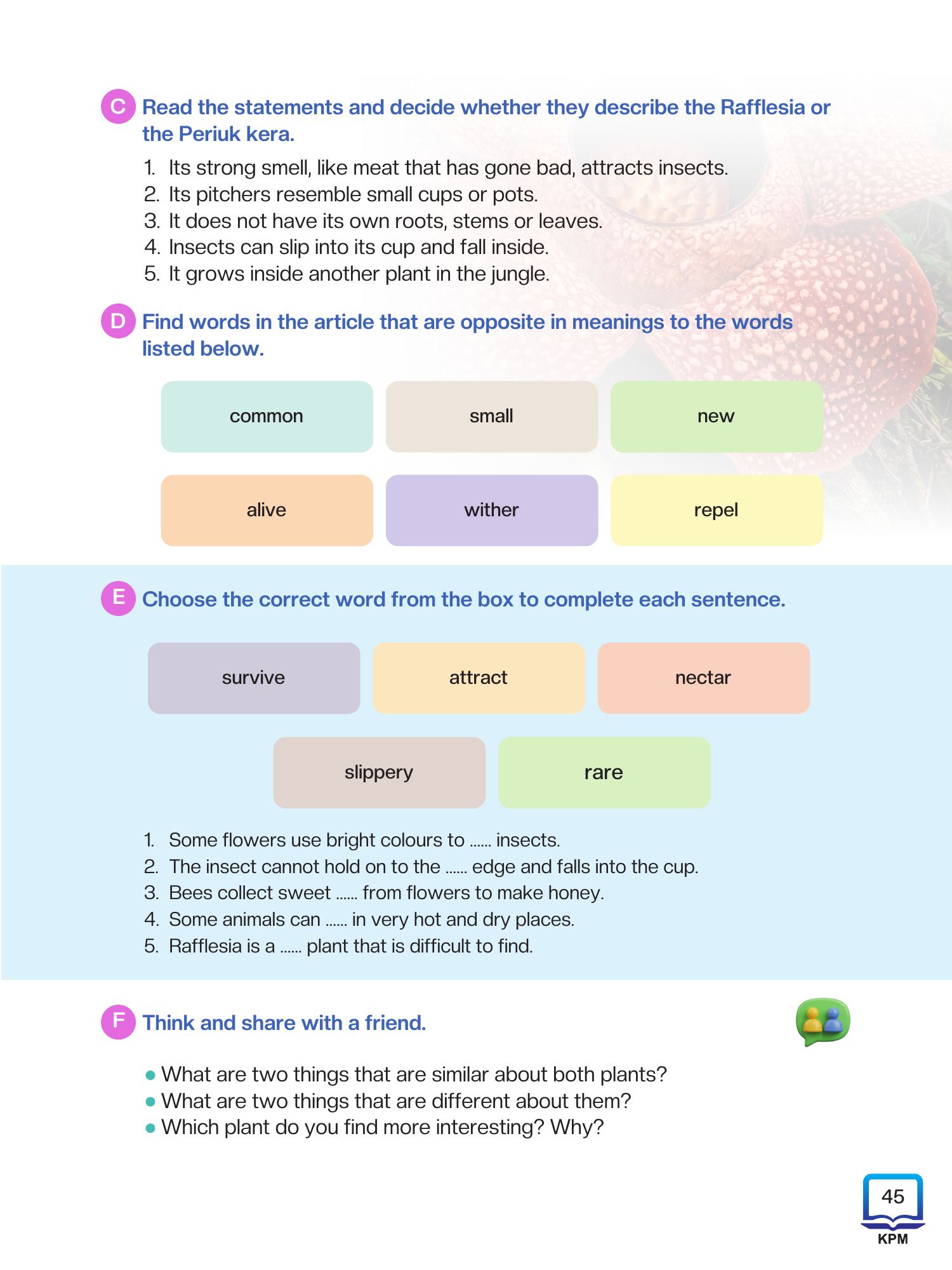
C Read the statements and decide whether they describe the Rafflesia or
the Periuk kera.
1. Its strong smell, like meat that has gone bad, attracts insects.
2. Its pitchers resemble small cups or pots.
3. It does not have its own roots, stems or leaves.
4. Insects can slip into its cup and fall inside.
5. It grows inside another plant in the jungle.
D Find words in the article that are opposite in meanings to the words
listed below.
common
small
new
alive
wither
repel
E Choose the correct word from the box to complete each sentence.
survive
attract
slippery
nectar
rare
1. Some flowers use bright colours to …… insects.
2. The insect cannot hold on to the …… edge and falls into the cup.
3. Bees collect sweet …… from flowers to make honey.
4. Some animals can …… in very hot and dry places.
5. Rafflesia is a …… plant that is difficult to find.
F Think and share with a friend.
• What are two things that are similar about both plants?
• What are two things that are different about them?
• Which plant do you find more interesting? Why?
45
RAINFOREST REFLECTIONS
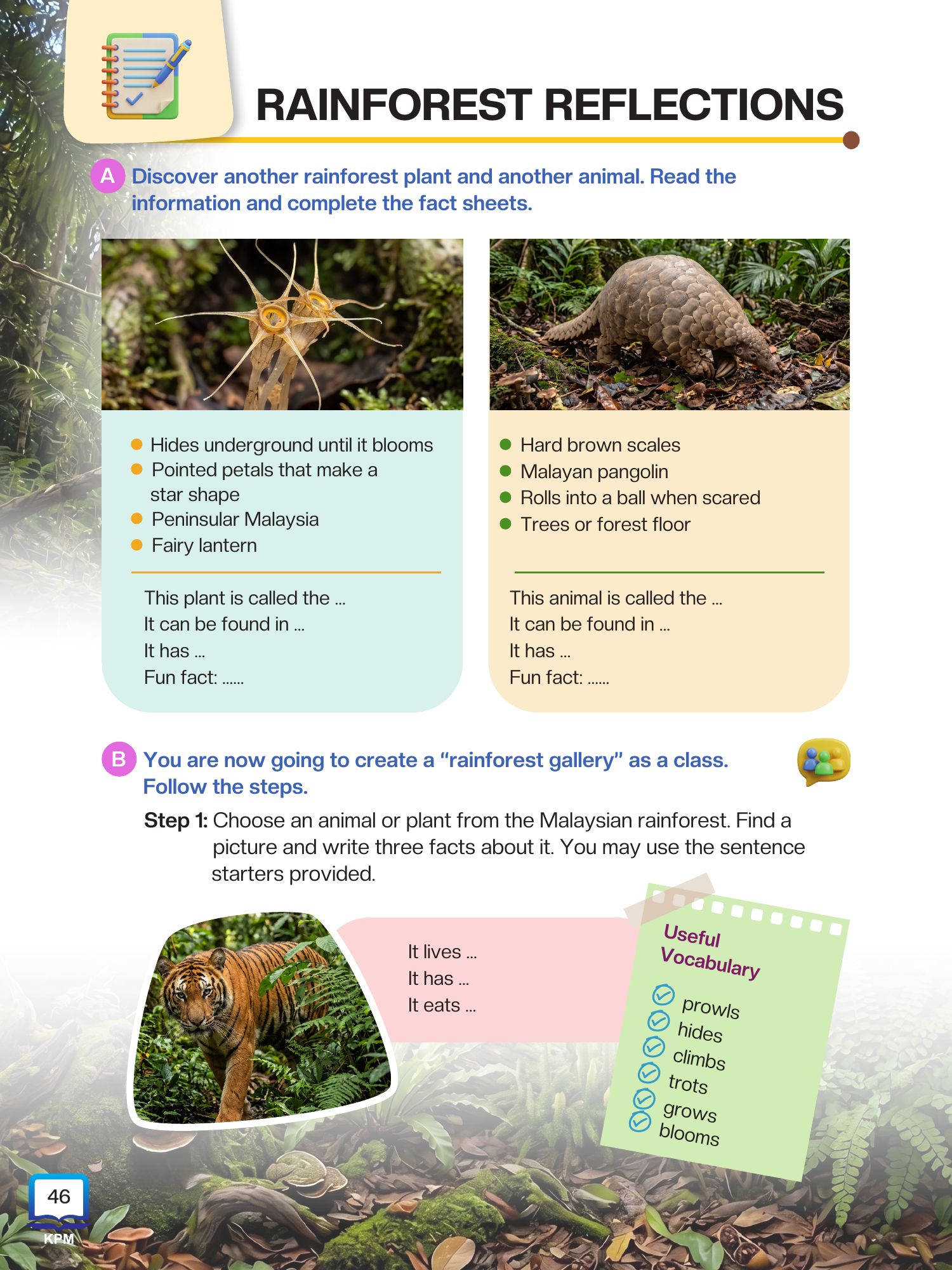
A Discover another rainforest plant and another animal. Read the
information and complete the fact sheets.
Hides underground until it blooms
Pointed petals that make a
star shape
Peninsular Malaysia
Fairy lantern
Hard brown scales
Malayan pangolin
Rolls into a ball when scared
Trees or forest floor
This plant is called the …
It can be found in …
It has …
Fun fact: ……
This animal is called the …
It can be found in …
It has …
Fun fact: ……
B You are now going to create a “rainforest gallery” as a class.
Follow the steps.
Step 1: Choose an animal or plant from the Malaysian rainforest. Find a
picture and write three facts about it. You may use the sentence
starters provided.
It lives …
It has …
It eats …
46
Useful
Vocab
u
lary
prowls
hides
climbs
trots
grows
blooms
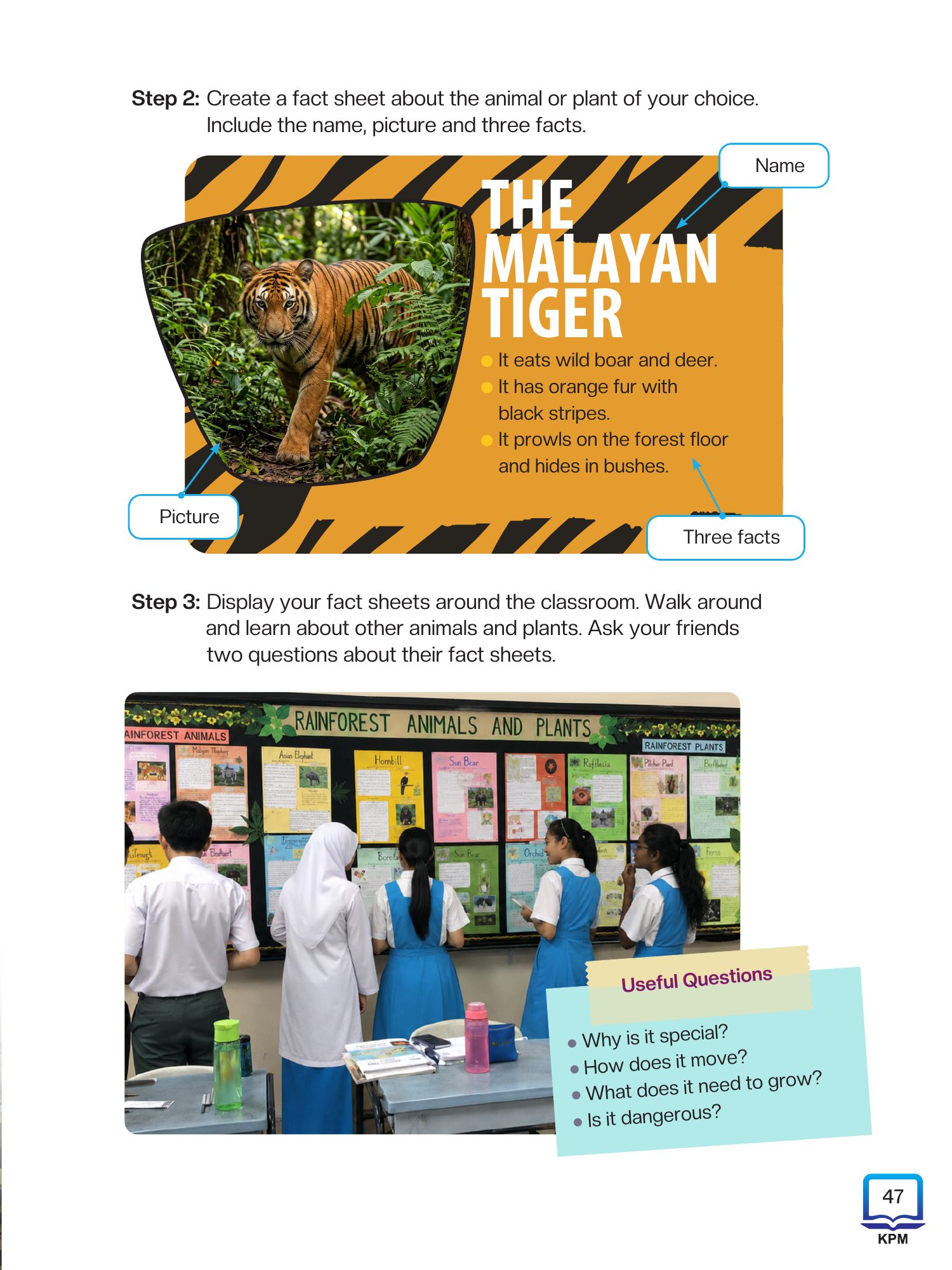
Step 2: Create a fact sheet about the animal or plant of your choice.
Include the name, picture and three facts.
THE
MALAYAN
TIGER
Name
It eats wild boar and deer.
It has orange fur with
black stripes.
It prowls on the forest floor
and hides in bushes.
Picture
Three facts
Step 3: Display your fact sheets around the classroom. Walk around
and learn about other animals and plants. Ask your friends
two questions about their fact sheets.
ons
Useful Questi
Why is it special?
e?
How does it mov
to grow?
What does it need
Is it dangerous?
47
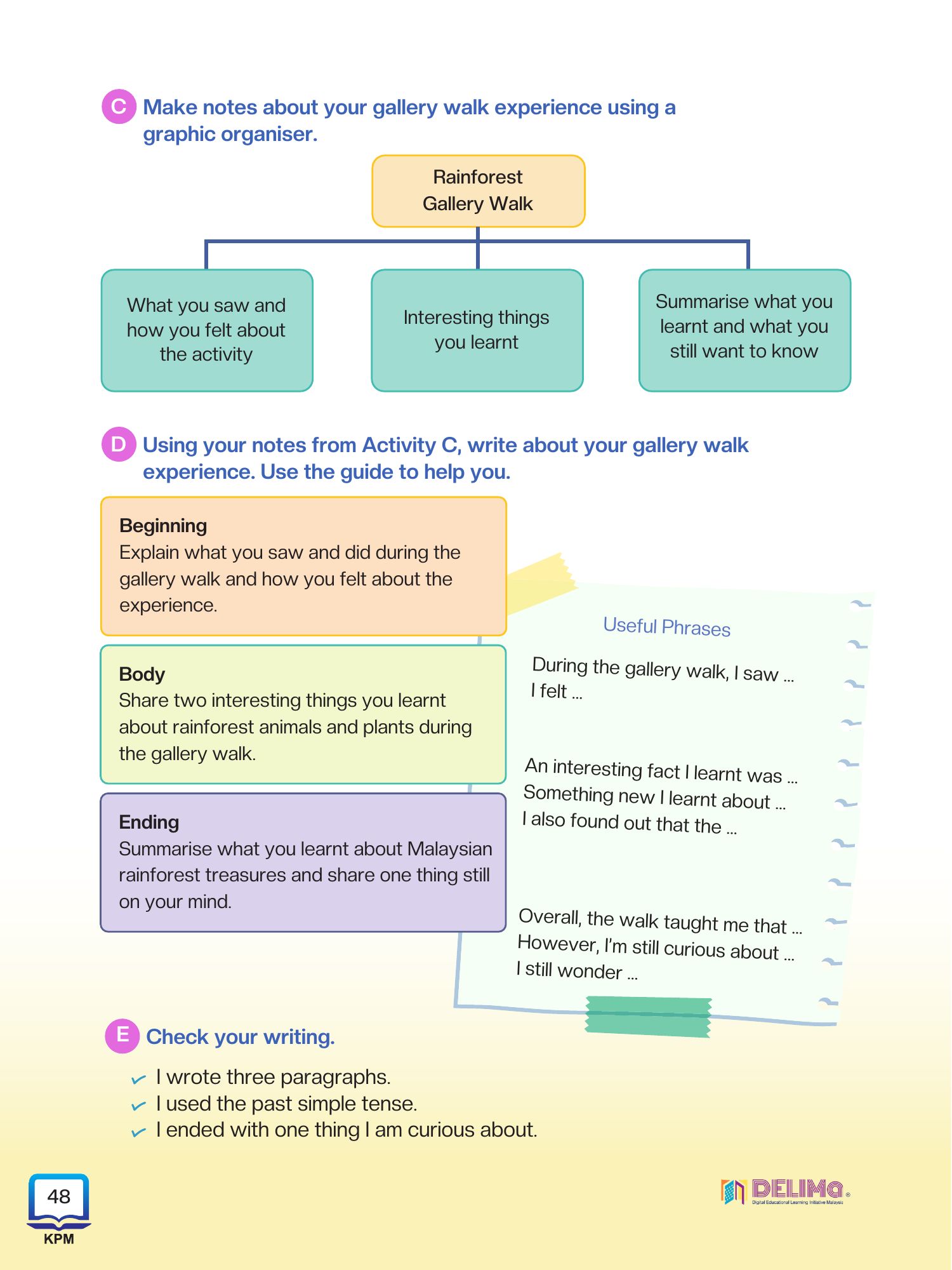
C Make notes about your gallery walk experience using a
graphic organiser.
Rainforest
Gallery Walk
What you saw and
how you felt about
the activity
Interesting things
you learnt
Summarise what you
learnt and what you
still want to know
D Using your notes from Activity C, write about your gallery walk
experience. Use the guide to help you.
Beginning
Explain what you saw and did during the
gallery walk and how you felt about the
experience.
Body
Share two interesting things you learnt
about rainforest animals and plants during
the gallery walk.
Ending
Summarise what you learnt about Malaysian
rainforest treasures and share one thing still
on your mind.
Useful Phrases
During the gallery walk, I saw
…
I felt …
An interesting fact I learnt wa
s …
Something new I learnt abou
I also found out that the …
Overall, the walk taught me
that …
However, I’m still curious ab
out …
I still wonder …
E Check your writing.
I wrote three paragraphs.
I used the past simple tense.
I ended with one thing I am curious about.
48
CREATIVE MIX
A You have explored some amazing rainforest plants
and animals. Now read the story to discover one
of its secrets. Then, answer the questions.
The Rainforest’s Secret
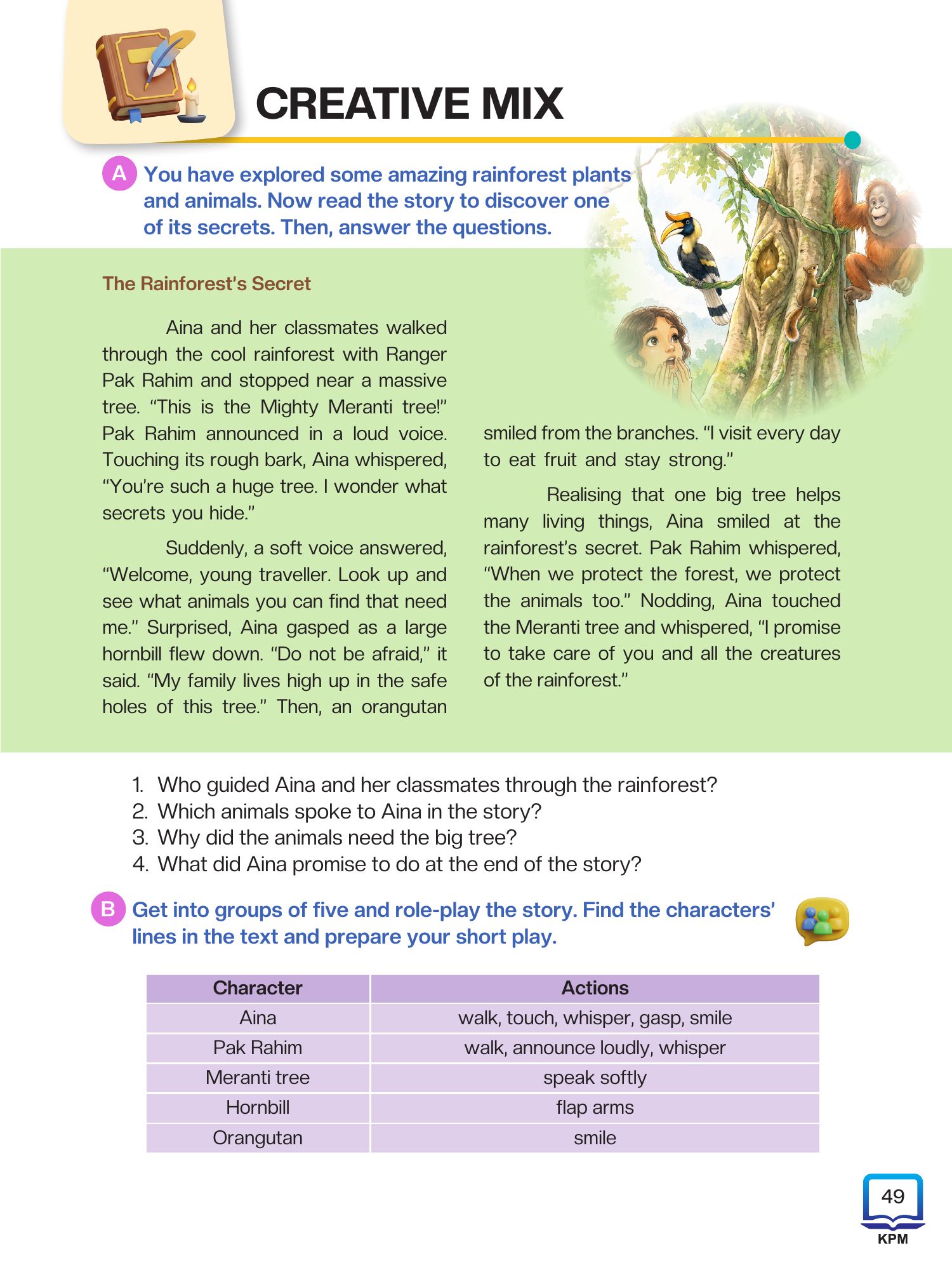
Aina and her classmates walked
through the cool rainforest with Ranger
Pak Rahim and stopped near a massive
tree. “This is the Mighty Meranti tree!”
Pak Rahim announced in a loud voice.
Touching its rough bark, Aina whispered,
“You’re such a huge tree. I wonder what
secrets you hide.”
Suddenly, a soft voice answered,
“Welcome, young traveller. Look up and
see what animals you can find that need
me.” Surprised, Aina gasped as a large
hornbill flew down. “Do not be afraid,” it
said. “My family lives high up in the safe
holes of this tree.” Then, an orangutan
smiled from the branches. “I visit every day
to eat fruit and stay strong.”
Realising that one big tree helps
many living things, Aina smiled at the
rainforest’s secret. Pak Rahim whispered,
“When we protect the forest, we protect
the animals too.” Nodding, Aina touched
the Meranti tree and whispered, “I promise
to take care of you and all the creatures
of the rainforest.”
1. Who guided Aina and her classmates through the rainforest?
2. Which animals spoke to Aina in the story?
3. Why did the animals need the big tree?
4. What did Aina promise to do at the end of the story?
B Get into groups of five and role-play the story. Find the characters’
lines in the text and prepare your short play.
Character
Actions
Aina
walk, touch, whisper, gasp, smile
Pak Rahim
walk, announce loudly, whisper
Meranti tree
speak softly
Hornbill
flap arms
Orangutan
smile
49
YOUR LEARNING JOURNEY
A Read the clues and choose the best answer.
Malaysian
fire snail
Periuk
kera
Malaysian earthtiger
tarantula
Rafflesia
1. I am a large, hairy spider. I usually avoid people.
2. I have no roots, stems or leaves. I smell like rotting meat.
3. I have a hard black shell and a bright red or orange body.
4. I look like a little green pot. I catch insects.
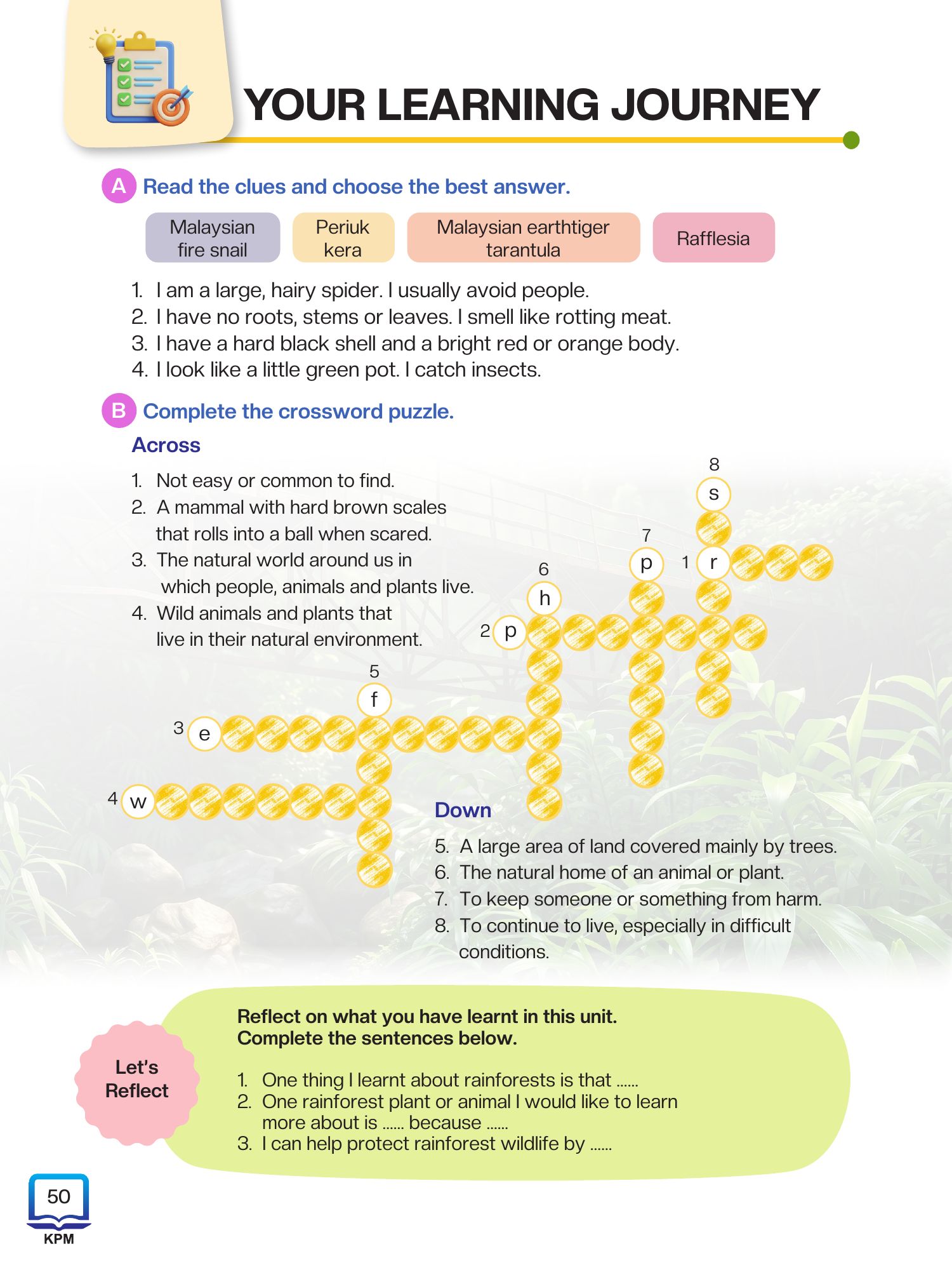
B Complete the crossword puzzle.
Across
1. Not easy or common to find.
2. A mammal with hard brown scales
that rolls into a ball when scared.
3. The natural world around us in
which people, animals and plants live.
4. Wild animals and plants that
2 p
live in their natural environment.
8
s
7
6
p
1
r
h
5
f
3
4 w
e
Down
5. A large area of land covered mainly by trees.
6. The natural home of an animal or plant.
7. To keep someone or something from harm.
8. To continue to live, especially in difficult
conditions.
Reflect on what you have learnt in this unit.
Complete the sentences below.
Let’s
Reflect
50
1. One thing I learnt about rainforests is that ……
2. One rainforest plant or animal I would like to learn
more about is …… because …...
3. I can help protect rainforest wildlife by …...