MAKIN G WISE
CHOICES
Wise Choices
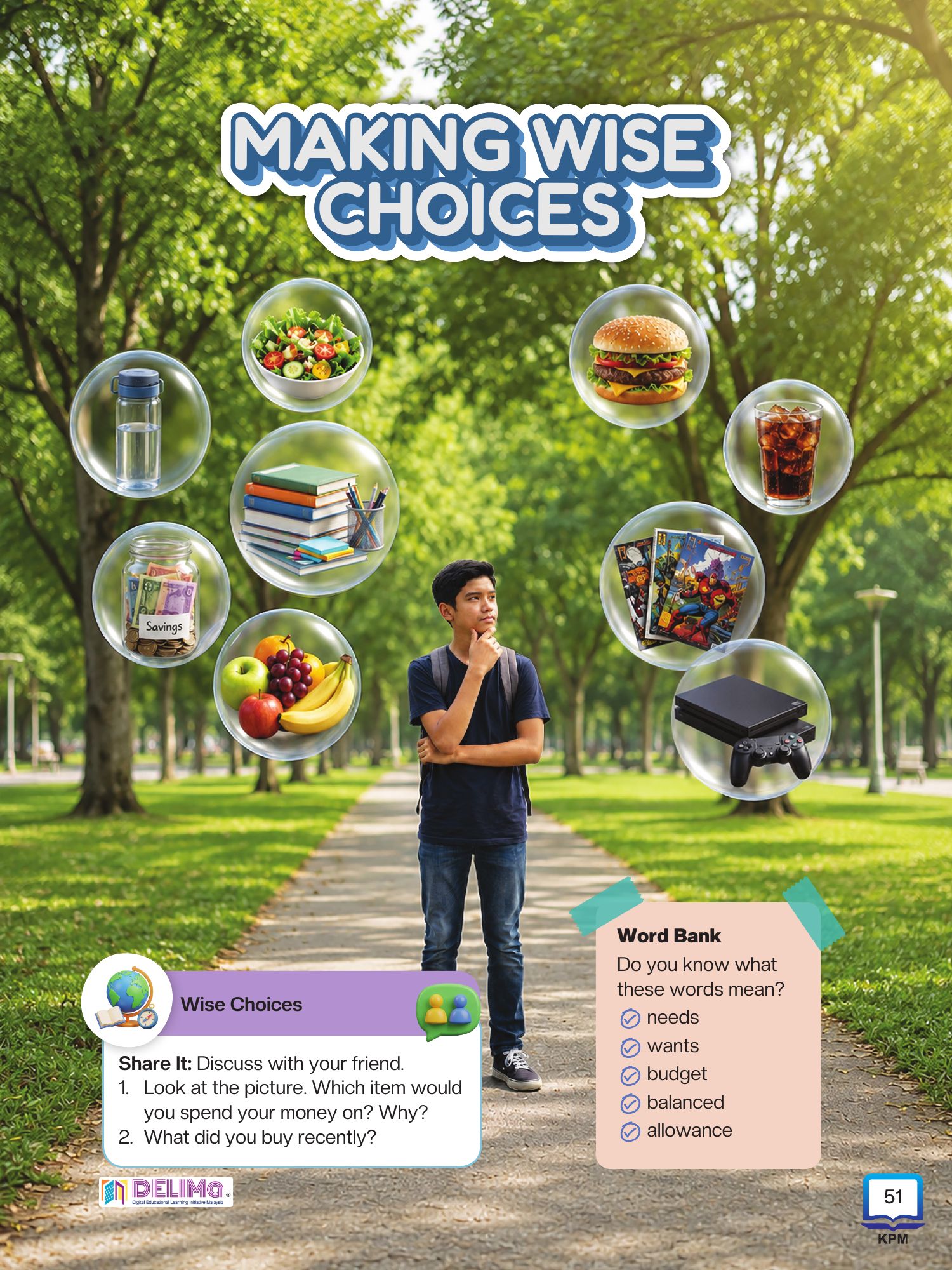
Share It: Discuss with your friend.
1. Look at the picture. Which item would
you spend your money on? Why?
2. What did you buy recently?
Word Bank
Do you know what
these words mean?
needs
wants
budget
balanced
allowance
51
MONEY MATTERS
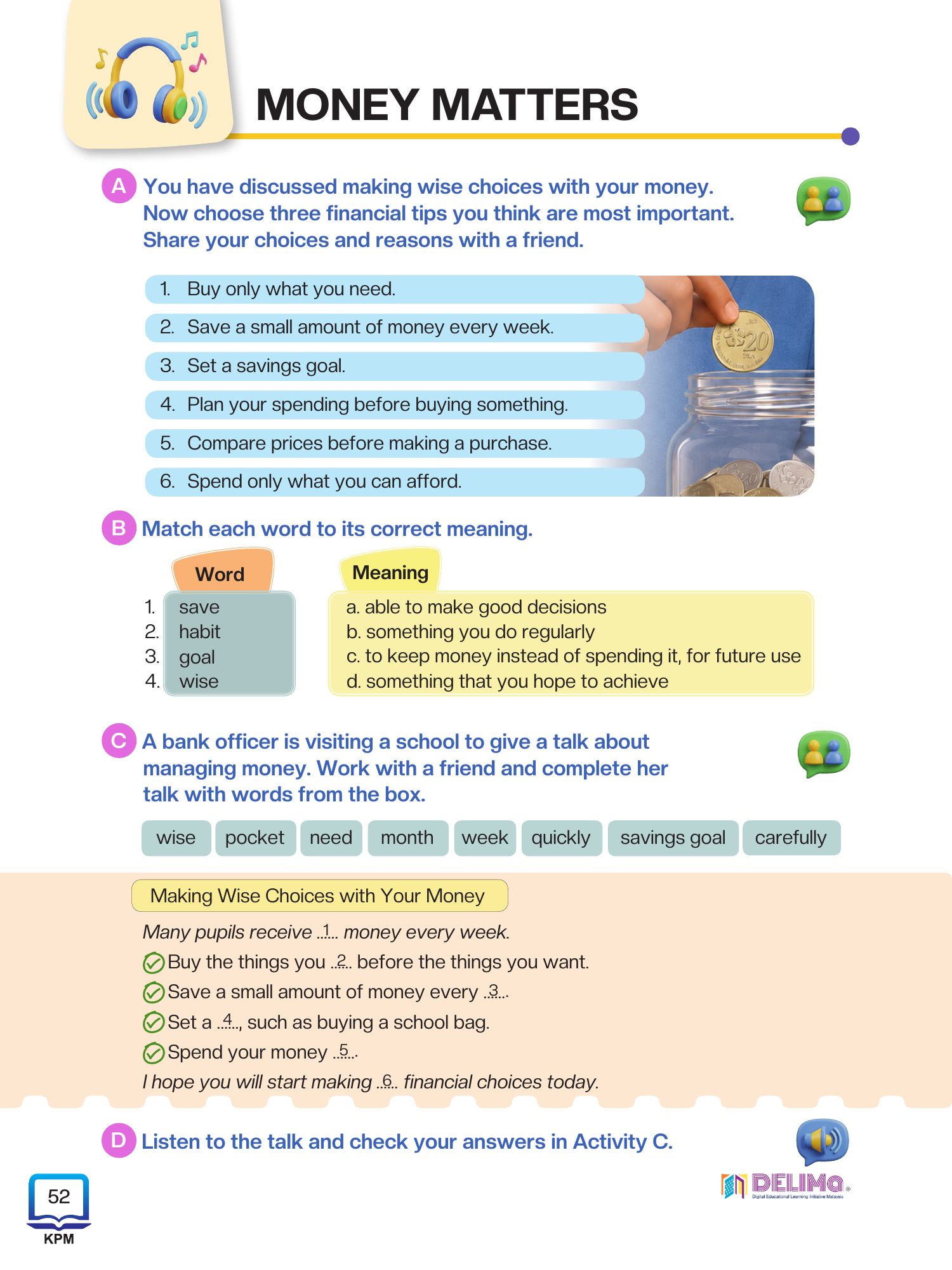
A You have discussed making wise choices with your money.
Now choose three financial tips you think are most important.
Share your choices and reasons with a friend.
1. Buy only what you need.
2. Save a small amount of money every week.
3. Set a savings goal.
4. Plan your spending before buying something.
5. Compare prices before making a purchase.
6. Spend only what you can afford.
B Match each word to its correct meaning.
Meaning
Word
1.
2.
3.
4.
a. able to make good decisions
b. something you do regularly
c. to keep money instead of spending it, for future use
d. something that you hope to achieve
save
habit
goal
wise
C A bank officer is visiting a school to give a talk about
managing money. Work with a friend and complete her
talk with words from the box.
wise
pocket
need
month
week
quickly
savings goal
Making Wise Choices with Your Money
1 money every week.
Many pupils receive ......
2 before the things you want.
Buy the things you ......
Save a small amount of money every ......
4 such as buying a school bag.
Set a ......,
Spend your money ......
6 financial choices today.
I hope you will start making ……
D Listen to the talk and check your answers in Activity C.
52
carefully
E Listen to the talk again. Choose the correct answer.
1. Before buying something, what
does Ms Jeya suggest pupils
ask themselves?
a) Why do I want it?
b) Do I really need it?
c) Will my friends like it?
3. Which of these is not
mentioned as a savings goal?
a) A school bag
b) A dictionary
c) A new phone
2. What does Ms Jeya say about
saving RM2 or RM5?
a) It can make a difference over time.
b) It is enough to buy a new bicycle.
c) It should be spent at the end
of the week.
4. What is the main purpose of
Ms Jeya’s talk?
a) To explain banking
b) To encourage pupils to
spend less
c) To build good money habits
F Based on the talk, decide whether each statement is True or False.
1. Ms Jeya says pupils should buy wants before needs.
2. Saving a small amount every week can make a difference over time.
3. A bicycle can be a savings goal.
4. Wise people spend all their money at once.
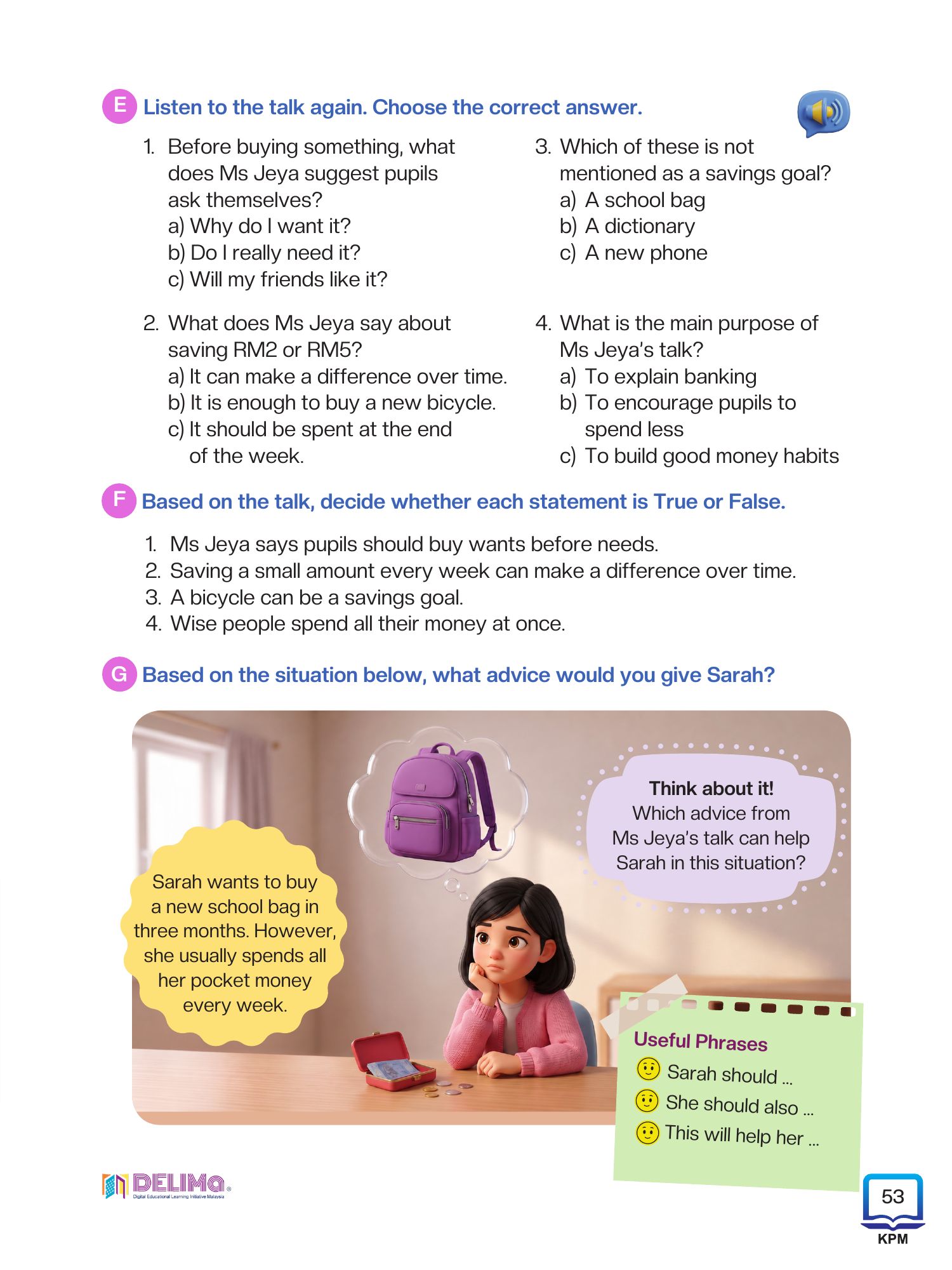
G Based on the situation below, what advice would you give Sarah?
Sarah wants to buy
a new school bag in
three months. However,
she usually spends all
her pocket money
every week.
Think about it!
Which advice from
Ms Jeya’s talk can help
Sarah in this situation?
Useful Phrases
Sarah should ...
She should also ...
This will help her ...
53
NEEDS OR WANTS
A You have learnt some good habits for managing money.
Now think about the decisions you make when you buy
something. Discuss the questions with a friend.
1. How do you decide whether to buy something?
2. Have you ever saved money to buy something? What was it?
3. Why is it important to know the difference between needs and wants?
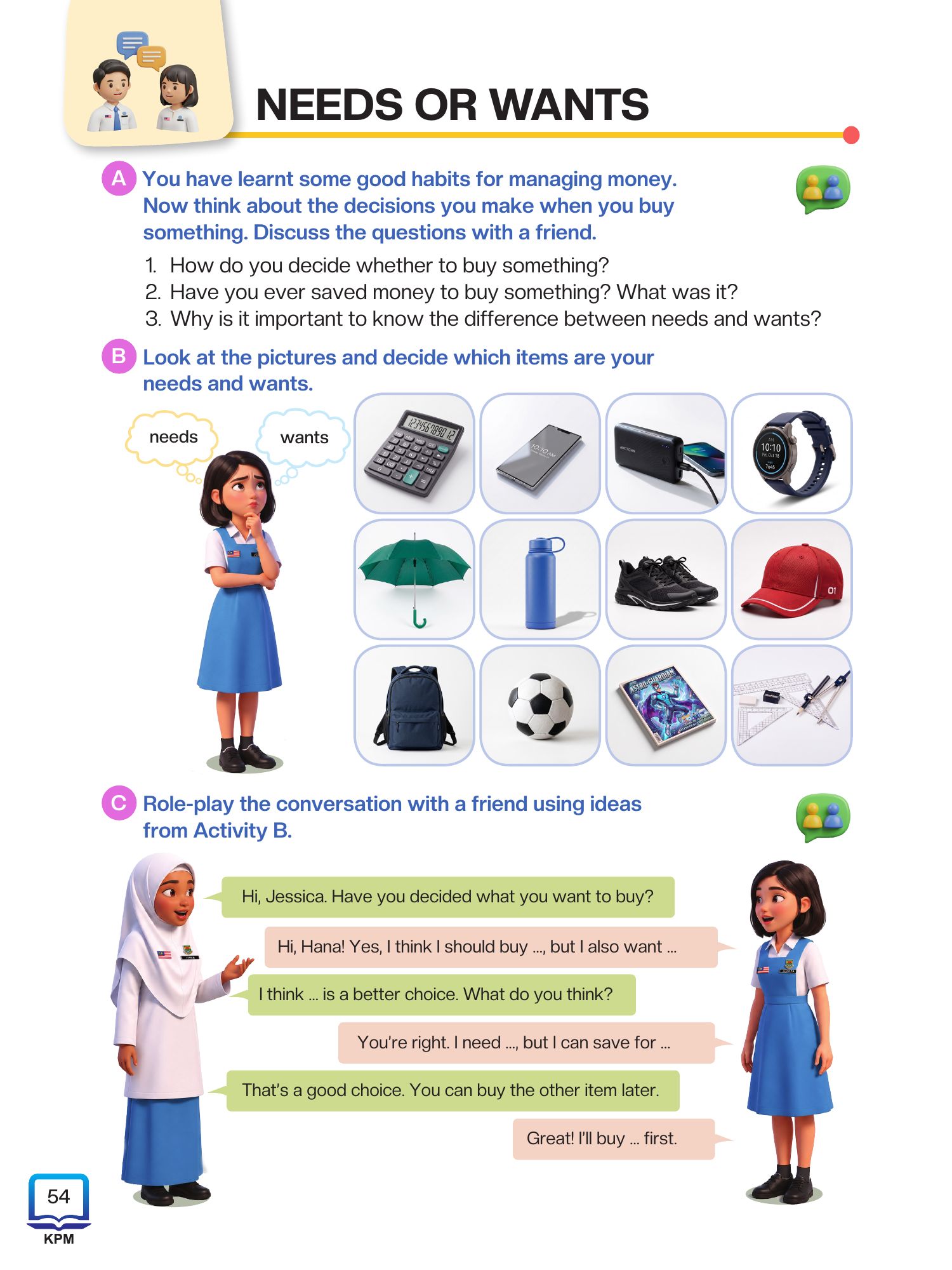
B Look at the pictures and decide which items are your
needs and wants.
needs
wants
C Role-play the conversation with a friend using ideas
from Activity B.
Hi, Jessica. Have you decided what you want to buy?
Hi, Hana! Yes, I think I should buy ..., but I also want ...
I think … is a better choice. What do you think?
You’re right. I need …, but I can save for …
That’s a good choice. You can buy the other item later.
Great! I’ll buy … first.
54
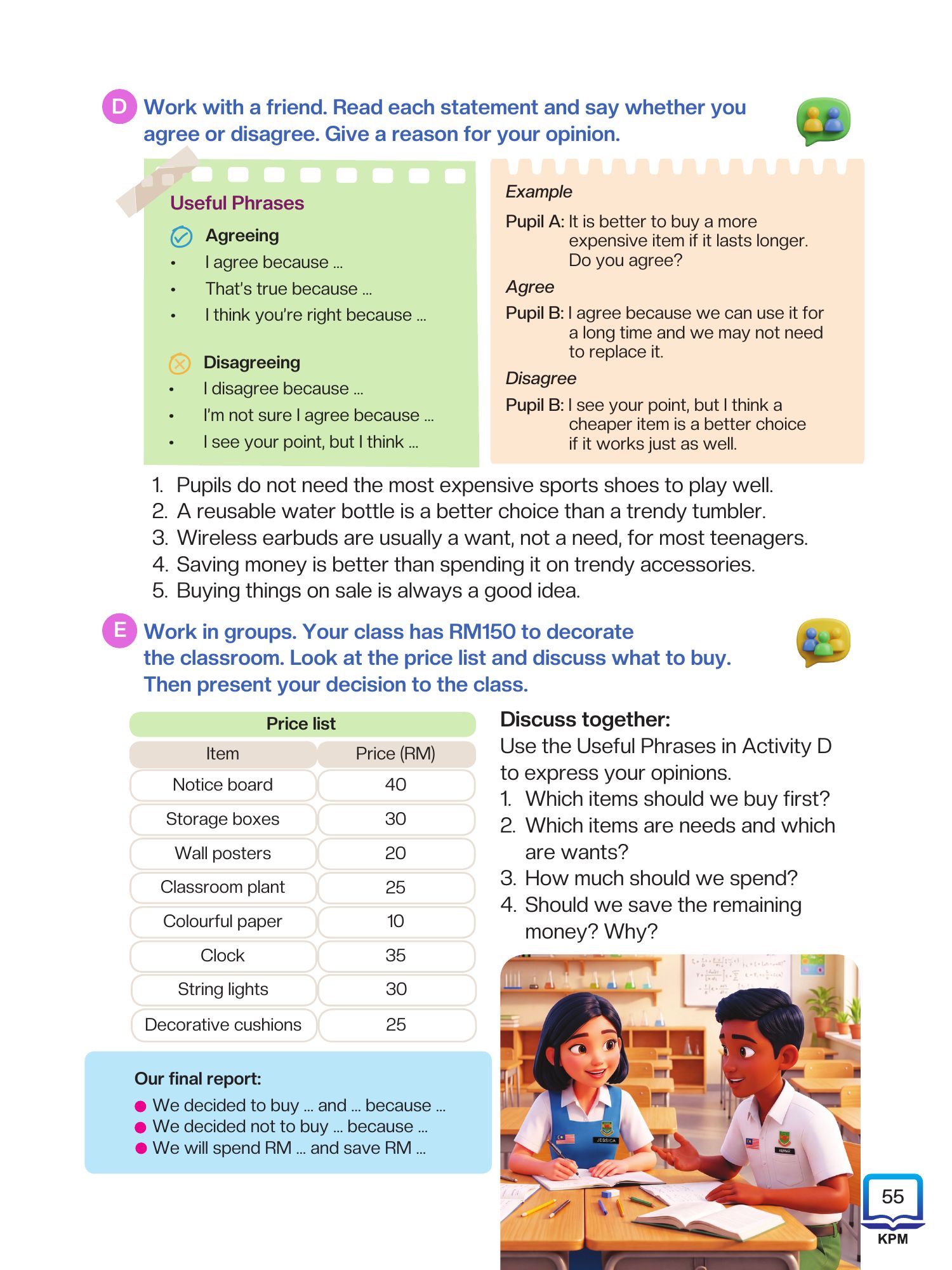
D Work with a friend. Read each statement and say whether you
agree or disagree. Give a reason for your opinion.
Example
Useful Phrases
•
•
•
Agreeing
I agree because ...
That’s true because ...
I think you’re right because ...
•
•
•
Disagreeing
I disagree because ...
I’m not sure I agree because ...
I see your point, but I think …
Pupil A: It is better to buy a more
expensive item if it lasts longer.
Do you agree?
Agree
Pupil B: I agree because we can use it for
a long time and we may not need
to replace it.
Disagree
Pupil B: I see your point, but I think a
cheaper item is a better choice
if it works just as well.
1. Pupils do not need the most expensive sports shoes to play well.
2. A reusable water bottle is a better choice than a trendy tumbler.
3. Wireless earbuds are usually a want, not a need, for most teenagers.
4. Saving money is better than spending it on trendy accessories.
5. Buying things on sale is always a good idea.
E Work in groups. Your class has RM150 to decorate
the classroom. Look at the price list and discuss what to buy.
Then present your decision to the class.
Price list
Item
Price (RM)
Notice board
40
Storage boxes
30
Wall posters
20
Classroom plant
25
Colourful paper
10
Clock
35
String lights
30
Decorative cushions
25
Discuss together:
Use the Useful Phrases in Activity D
to express your opinions.
1. Which items should we buy first?
2. Which items are needs and which
are wants?
3. How much should we spend?
4. Should we save the remaining
money? Why?
Our final report:
We decided to buy … and … because …
We decided not to buy … because …
We will spend RM … and save RM …
55
SAVING WITH PURPOSE
READING TEXT 1
A You have discussed the difference between needs and wants.
Now think about your own saving habits. Discuss the questions
with a friend.
1. Have you ever wanted to buy something but decided to save
your money instead?
2. What were you saving for?
3. Was it easy or difficult to save money?
B Read the story. Will Praveen buy what he wants? Find out how he makes
his choice.
A Gift from the Heart
Father’s Day was two months away. Praveen wanted to buy a special gift
for his father. One afternoon, he saw a badminton racquet at a sports shop.
A 30% sale was going on, and the racquet’s original price of RM90 was
reduced to RM63. The sale would last until Father’s Day, so he had time to save.
Praveen knew his father would enjoy using it because they often played badminton
together at the community hall.
Praveen did not have enough money, but he made a plan. He was going
to save part of his pocket money every week. Whenever he wanted to buy
snacks or treats, Praveen thought about the badminton racquet he wanted to
buy for his father. He decided to save his money instead. Every week, he was
happy to see his savings grow.
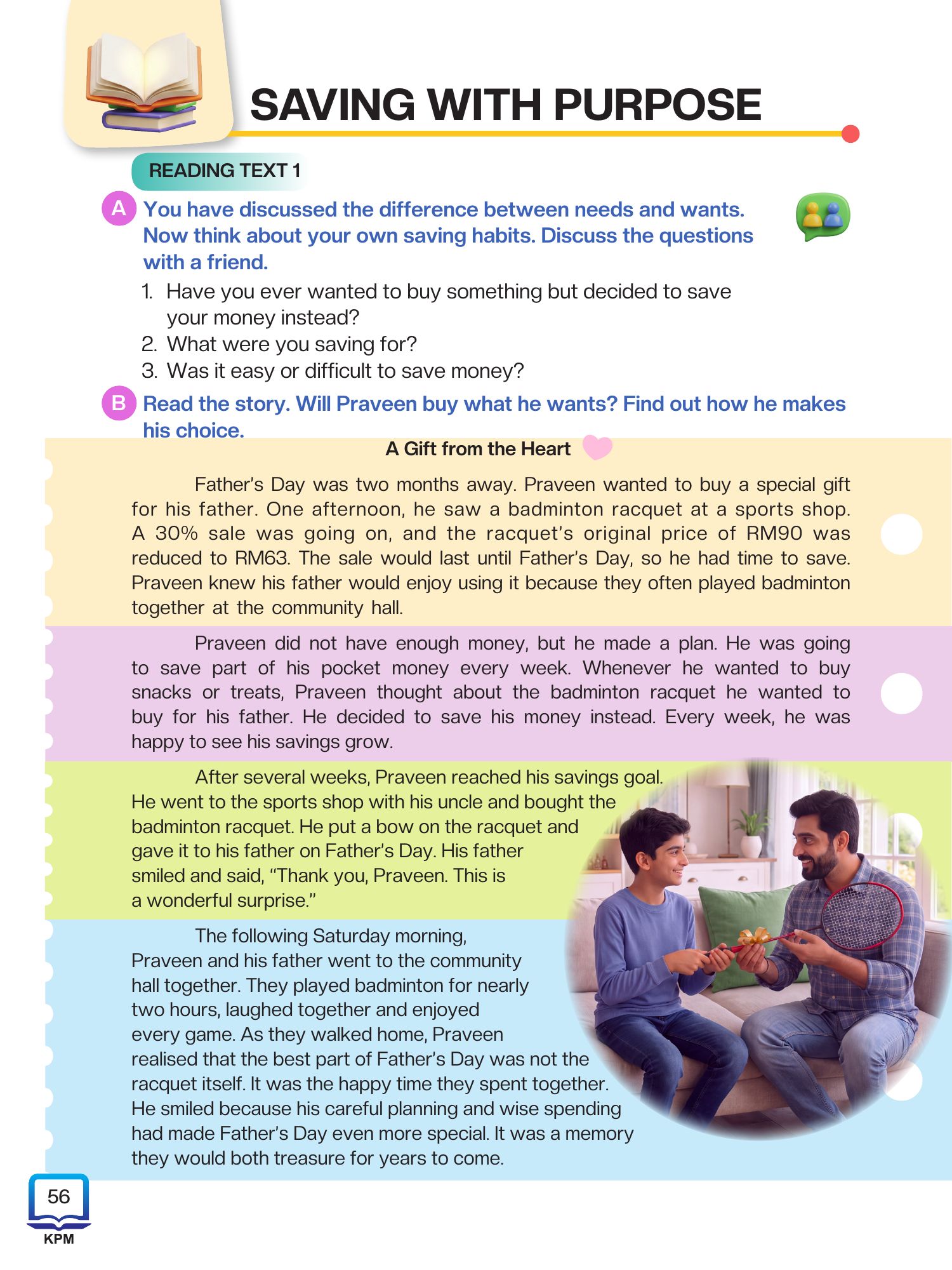
After several weeks, Praveen reached his savings goal.
He went to the sports shop with his uncle and bought the
badminton racquet. He put a bow on the racquet and
gave it to his father on Father’s Day. His father
smiled and said, “Thank you, Praveen. This is
a wonderful surprise.”
The following Saturday morning,
Praveen and his father went to the community
hall together. They played badminton for nearly
two hours, laughed together and enjoyed
every game. As they walked home, Praveen
realised that the best part of Father’s Day was not the
racquet itself. It was the happy time they spent together.
He smiled because his careful planning and wise spending
had made Father’s Day even more special. It was a memory
they would both treasure for years to come.
56
C Answer the questions about the story.
1. Why did Praveen want to buy a special gift for his father?
2. What did Praveen do to save money?
3. How long did it take Praveen to save enough money to buy the gift?
4. What made Father’s Day special for Praveen?
5. Do you think Praveen made a wise financial decision? Give one reason.
D Match each word to its meaning.
Word
Meaning
1. reduced
a. giving attention to what you do so that you
avoid mistakes or danger
2. savings
b. made smaller, less or lower in price
3. treats
c. money kept for future use
4. surprise
d. special things that you enjoy
5. careful
e. something that is unexpected
E Complete the table with the missing information.
Situation
Praveen wanted a special gift
for his father.
What happened next?
He decided to save some money to buy a
badminton racquet.
The racquet’s original price
was RM90.
Praveen did not have enough
money to buy
the racquet.
He went to the sports shop and bought the
badminton racquet.
Praveen gave the racquet to
his father.
F Think and reflect.
1. Why was buying the racquet during the sale a wise choice?
2. What does Praveen’s experience teach us about saving money?
3. What is one wise financial habit that you would like to practise?
Explain your answer.
57
READING TEXT 2
A You have explored wise choices about money. Now think about the
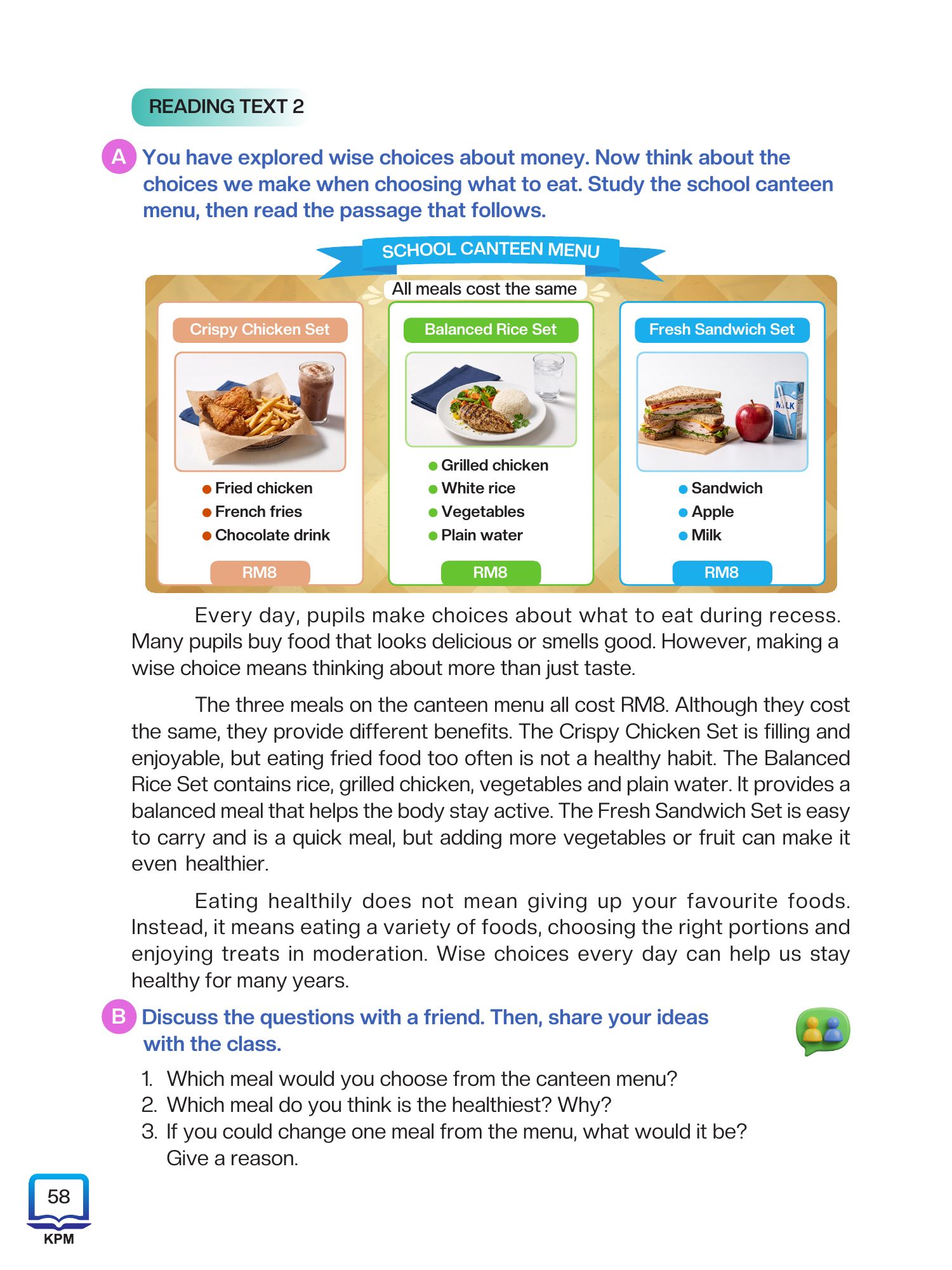
choices we make when choosing what to eat. Study the school canteen
menu, then read the passage that follows.
SCHOOL CANTEEN MENU
All meals cost the same
Crispy Chicken Set
Balanced Rice Set
Fresh Sandwich Set
Fried chicken
French fries
Chocolate drink
Grilled chicken
White rice
Vegetables
Plain water
Sandwich
Apple
Milk
RM8
RM8
RM8
Every day, pupils make choices about what to eat during recess.
Many pupils buy food that looks delicious or smells good. However, making a
wise choice means thinking about more than just taste.
The three meals on the canteen menu all cost RM8. Although they cost
the same, they provide different benefits. The Crispy Chicken Set is filling and
enjoyable, but eating fried food too often is not a healthy habit. The Balanced
Rice Set contains rice, grilled chicken, vegetables and plain water. It provides a
balanced meal that helps the body stay active. The Fresh Sandwich Set is easy
to carry and is a quick meal, but adding more vegetables or fruit can make it
even healthier.
Eating healthily does not mean giving up your favourite foods.
Instead, it means eating a variety of foods, choosing the right portions and
enjoying treats in moderation. Wise choices every day can help us stay
healthy for many years.
B Discuss the questions with a friend. Then, share your ideas
with the class.
1. Which meal would you choose from the canteen menu?
2. Which meal do you think is the healthiest? Why?
3. If you could change one meal from the menu, what would it be?
Give a reason.
58
C Read each statement and decide whether it is True or False.
1. Each meal set on the menu costs RM8.
2. The Crispy Chicken Set contains fried chicken and vegetables.
3. The Balanced Rice Set is a balanced choice because it includes
vegetables and plain water.
4. The Fresh Sandwich Set includes an orange and milk.
5. Eating fried food regularly is good for your health.
6. Making small changes to our eating habits can improve our
health over time.
D Read the school notice and find out what will happen on
Healthy Lunch Day.
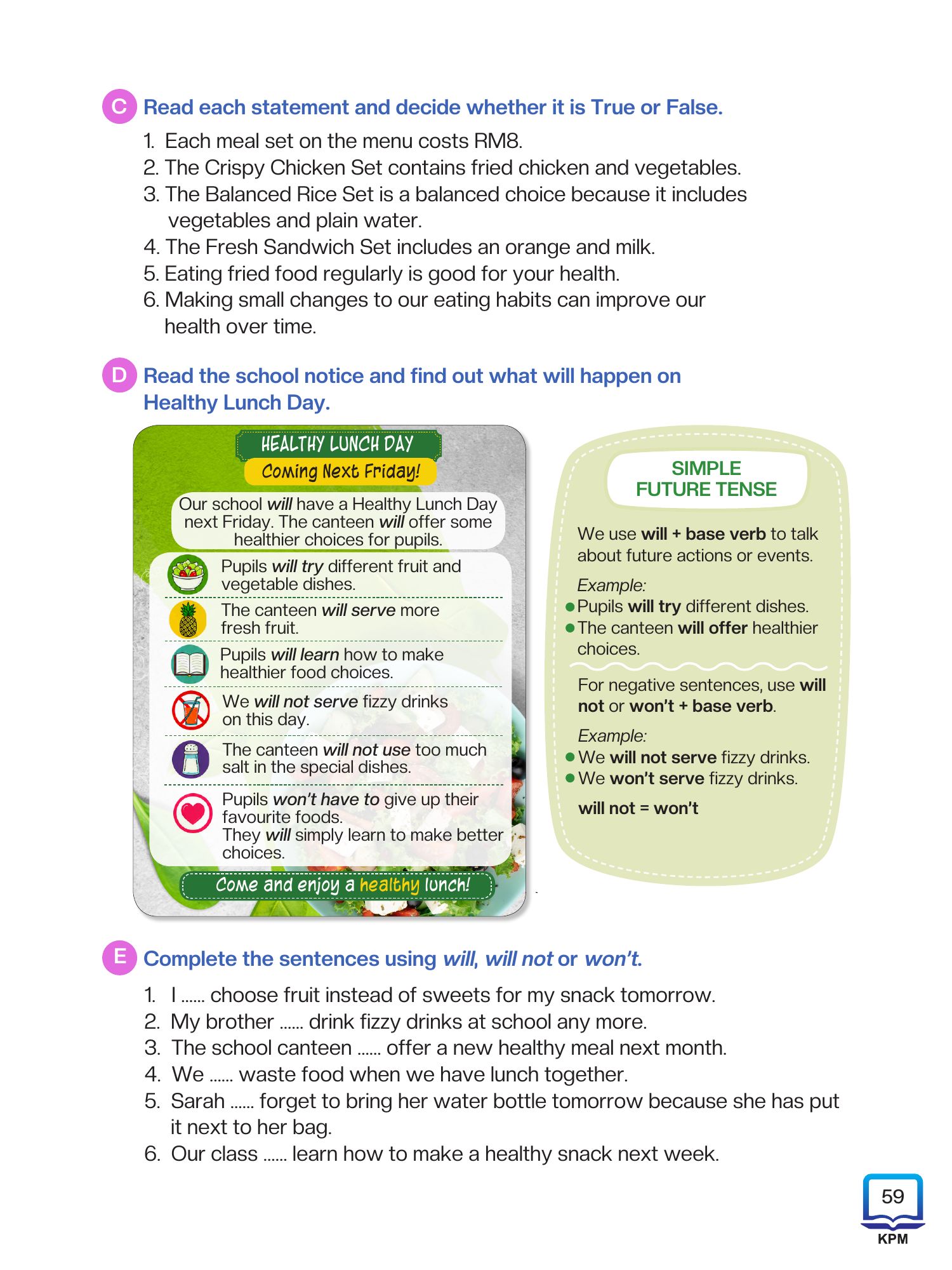
HEALTHY LUNCH DAY
Coming Next Friday!
Our school will have a Healthy Lunch Day
next Friday. The canteen will offer some
healthier choices for pupils.
Pupils will try different fruit and
vegetable dishes.
The canteen will serve more
fresh fruit.
Pupils will learn how to make
healthier food choices.
We will not serve fizzy drinks
on this day.
The canteen will not use too much
salt in the special dishes.
Pupils won’t have to give up their
favourite foods.
They will simply learn to make better
choices.
SIMPLE
FUTURE TENSE
We use will + base verb to talk
about future actions or events.
Example:
Pupils will try different dishes.
The canteen will offer healthier
choices.
For negative sentences, use will
not or won’t + base verb.
Example:
We will not serve fizzy drinks.
We won’t serve fizzy drinks.
will not = won’t
Come and enjoy a healthy lunch!
E Complete the sentences using will, will not or won’t.
1. I …… choose fruit instead of sweets for my snack tomorrow.
2. My brother …… drink fizzy drinks at school any more.
3. The school canteen …… offer a new healthy meal next month.
4. We …… waste food when we have lunch together.
5. Sarah …… forget to bring her water bottle tomorrow because she has put
it next to her bag.
6. Our class …… learn how to make a healthy snack next week.
59
SMART BUDGETING
A Think about your spending choices at the school canteen.
Then, read Gaby’s journal entry to find out how she plans to
save enough money to buy a new storybook. With a friend,
match the bold words to their meanings in the boxes below.
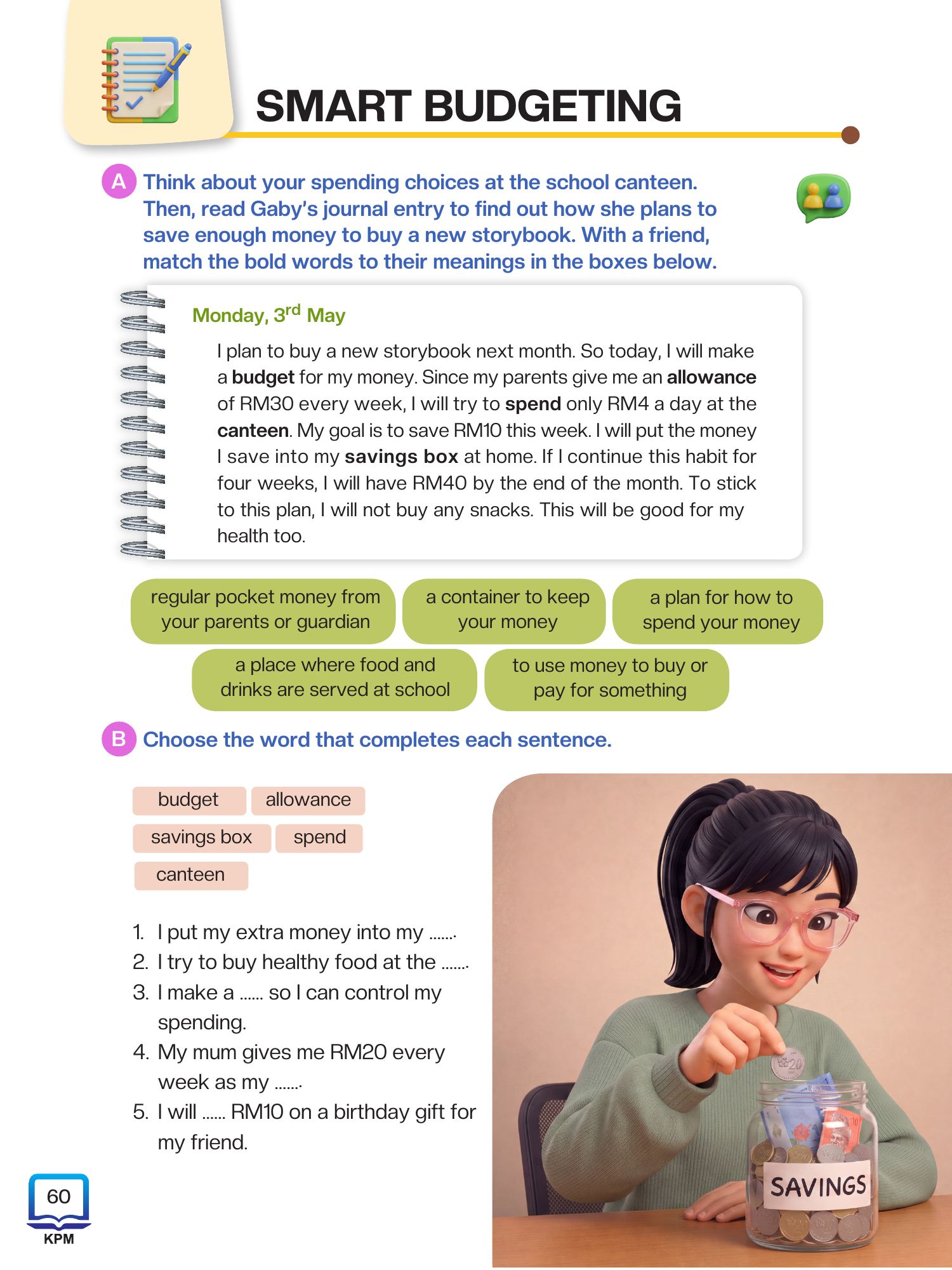
Monday, 3 rd May
I plan to buy a new storybook next month. So today, I will make
a budget for my money. Since my parents give me an allowance
of RM30 every week, I will try to spend only RM4 a day at the
canteen. My goal is to save RM10 this week. I will put the money
I save into my savings box at home. If I continue this habit for
four weeks, I will have RM40 by the end of the month. To stick
to this plan, I will not buy any snacks. This will be good for my
health too.
regular pocket money from
your parents or guardian
a container to keep
your money
a place where food and
drinks are served at school
to use money to buy or
pay for something
B Choose the word that completes each sentence.
budget
allowance
savings box
spend
canteen
1. I put my extra money into my …….
2. I try to buy healthy food at the …….
3. I make a …… so I can control my
spending.
4. My mum gives me RM20 every
week as my …….
5. I will …… RM10 on a birthday gift for
my friend.
60
a plan for how to
spend your money
C Write a short journal entry about your money plan for next week.
Use will, will not or won’t and use at least two vocabulary words
from Activity A.
Answer these questions in your writing:
1. What do you plan to buy?
2. How much does it cost?
3. How much allowance do you get?
4. How much will you spend each day?
5. How much money will you save?
6. How long will you need to achieve your target?
7. What won’t you buy to control your budget?
Journal writing is a great way to keep track of your habits.
One habit to watch is your spending. Writing down your spending
plans can help you manage your spending. It helps you see
your spending goals clearly so you can stick to your budget!
To write about your future plans, we can use will for decisions,
promises and future actions. We use will not or won’t for things
you decide not to do.
D Check your writing using the checklist.
Did I include a day and date at the top of my journal?
Did I use will, will not or won’t?
Did I use at least two words learnt from Activity A?
Did I answer all seven questions?
E Swap journal entries with a friend and answer the questions.
1. What item does your friend plan to buy?
2. How much money will he or she save?
3. What won’t your friend buy to stay within his or her budget?
4. Do you think your friend’s plan will work? Why or why not?
61
CREATIVE MIX
A After planning how to manage your money, read the story and discover
how a young boy finds a clever solution to a trading problem.
The Little Tokens That Changed Everything
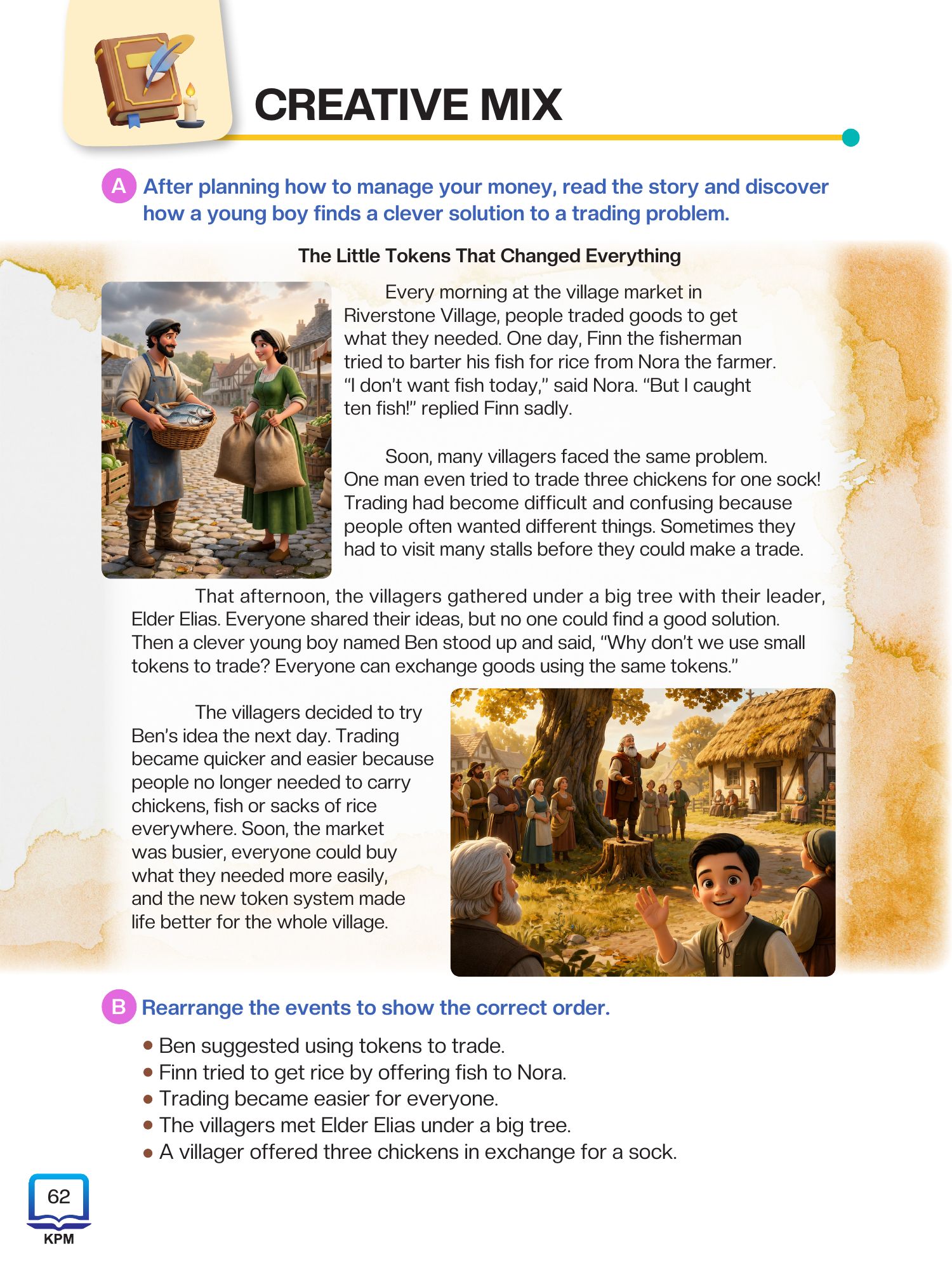
Every morning at the village market in
Riverstone Village, people traded goods to get
what they needed. One day, Finn the fisherman
tried to barter his fish for rice from Nora the farmer.
“I don’t want fish today,” said Nora. “But I caught
ten fish!” replied Finn sadly.
Soon, many villagers faced the same problem.
One man even tried to trade three chickens for one sock!
Trading had become difficult and confusing because
people often wanted different things. Sometimes they
had to visit many stalls before they could make a trade.
That afternoon, the villagers gathered under a big tree with their leader,
Elder Elias. Everyone shared their ideas, but no one could find a good solution.
Then a clever young boy named Ben stood up and said, “Why don’t we use small
tokens to trade? Everyone can exchange goods using the same tokens.”
The villagers decided to try
Ben’s idea the next day. Trading
became quicker and easier because
people no longer needed to carry
chickens, fish or sacks of rice
everywhere. Soon, the market
was busier, everyone could buy
what they needed more easily,
and the new token system made
life better for the whole village.
B Rearrange the events to show the correct order.
Ben suggested using tokens to trade.
Finn tried to get rice by offering fish to Nora.
Trading became easier for everyone.
The villagers met Elder Elias under a big tree.
A villager offered three chickens in exchange for a sock.
62
C Find words from the story that match the meanings below.
1. to exchange goods without using money
2. difficult to understand
3. a person who is responsible for a group
4. small objects used instead of money for payment
5. a set of rules or a way of doing things
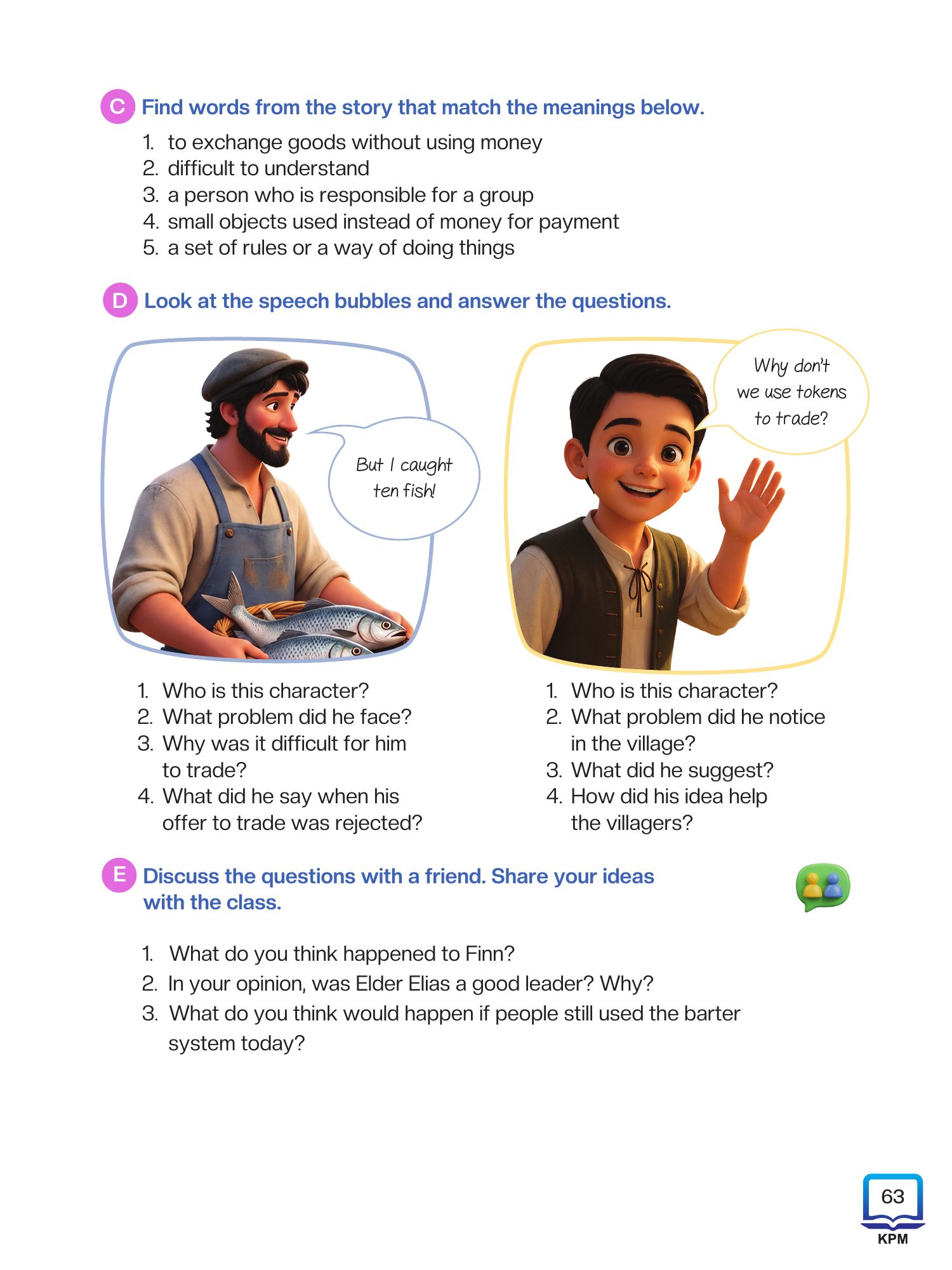
D Look at the speech bubbles and answer the questions.
Why don’t
we use tokens
to trade?
But I caught
ten fish!
1. Who is this character?
2. What problem did he face?
3. Why was it difficult for him
to trade?
4. What did he say when his
offer to trade was rejected?
1. Who is this character?
2. What problem did he notice
in the village?
3. What did he suggest?
4. How did his idea help
the villagers?
E Discuss the questions with a friend. Share your ideas
with the class.
1. What do you think happened to Finn?
2. In your opinion, was Elder Elias a good leader? Why?
3. What do you think would happen if people still used the barter
system today?
63
YOUR LEARNING JOURNEY
A You have learnt a lot about making wise choices. Now see how a school
makes wise choices too. Complete the notice with the words in the box.
SCHOOL CHARITY FAIR
Our school is organising a charity fair to raise money for a local
community centre. Each class will have a limited amount of money to
prepare its stall. Before buying anything, pupils should make a ...... and
...... the prices of different items. They should think ...... about what they
need and try not to ...... too much on decorations. Making ...... choices
will help each class use its money effectively.
budget
spend
wise
carefully
compare
B Read each riddle and guess the answer.
1
3
You do this often every day,
You usually do it in the same way.
Brushing your teeth is one you know,
Can you guess it? Give it a go!
Answer: h * * i *
2
You don’t expect me to appear,
Then suddenly, I am here!
I might make you laugh or smile,
Can you guess me? Give it a try!
Answer: s * * p * * * e
Let’s
Reflect
64
You use me to choose what to eat,
I show you food that looks a treat.
You can find me in the canteen,
Can you guess what I might mean?
Answer: m * * u
4
I help you plan before you spend,
So your money can last to the end.
I help you save and avoid overspending,
Can you guess what I am?
Answer: b * * * * *
Reflect on what you have learnt in this unit.
Complete the sentences below.
1. Before I buy something, I will ……
2. One healthy choice I will make is ……
3. One wise choice I will make this week is ……