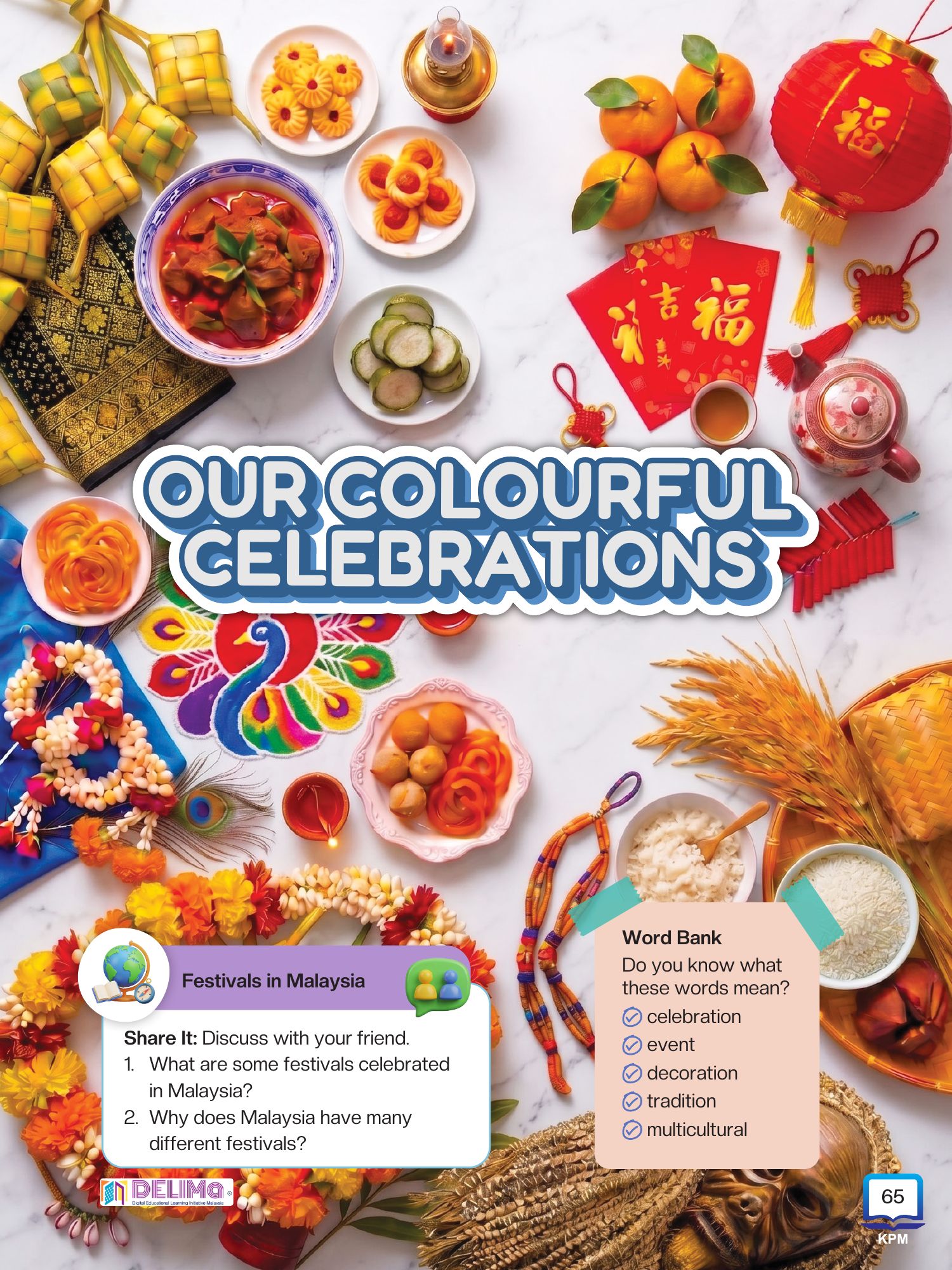
OUR COLOURFUL
CELEBRATIONS
Festivals in Malaysia
Share It: Discuss with your friend.
1. What are some festivals celebrated
in Malaysia?
2. Why does Malaysia have many
different festivals?
Word Bank
Do you know what
these words mean?
celebration
event
decoration
tradition
multicultural
65
LET’S CELEBRATE!
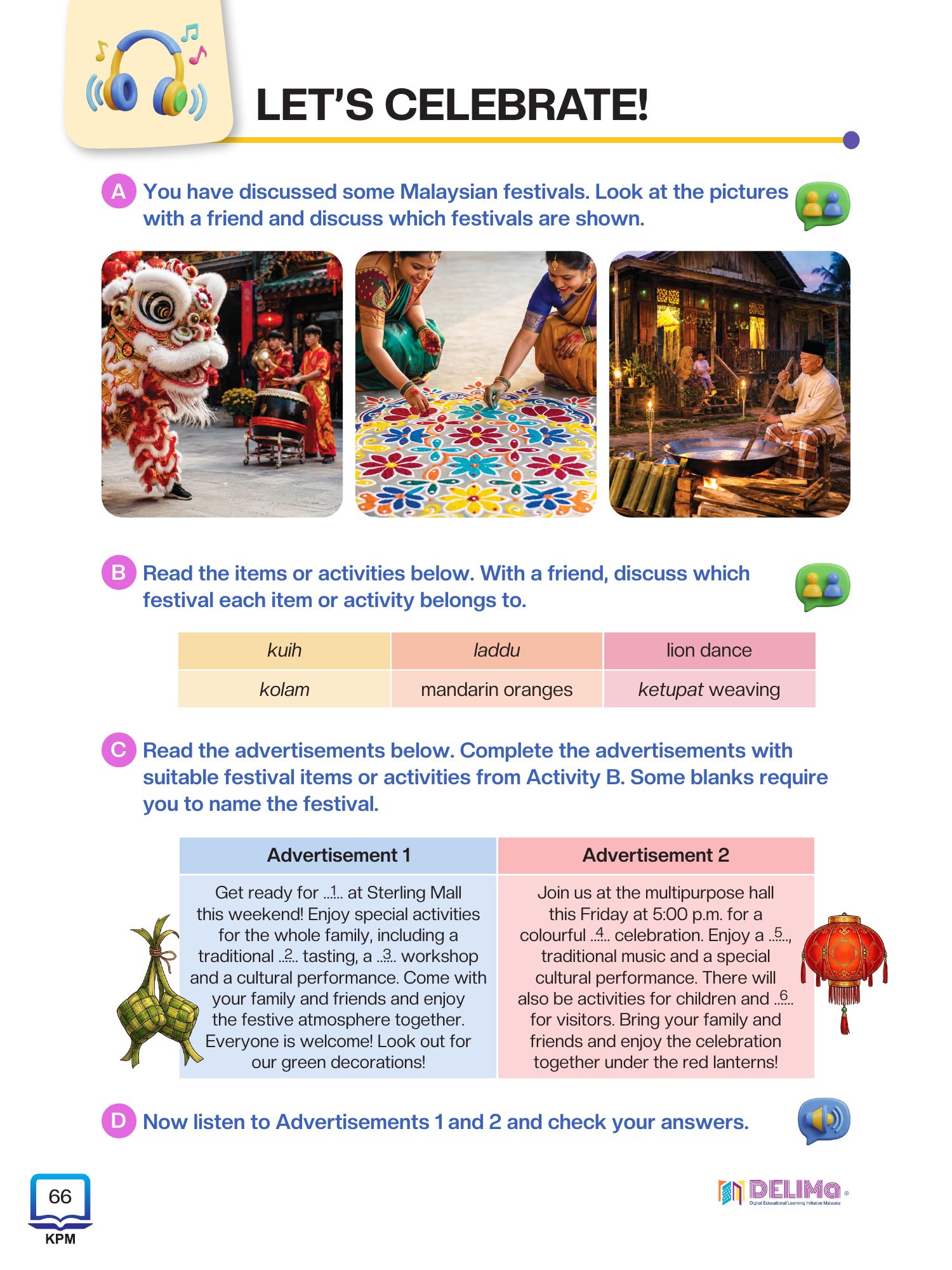
A You have discussed some Malaysian festivals. Look at the pictures
with a friend and discuss which festivals are shown.
B Read the items or activities below. With a friend, discuss which
festival each item or activity belongs to.
kuih
laddu
lion dance
kolam
mandarin oranges
ketupat weaving
C Read the advertisements below. Complete the advertisements with
suitable festival items or activities from Activity B. Some blanks require
you to name the festival.
Advertisement 1
Advertisement 2
1 at Sterling Mall
Get ready for ......
this weekend! Enjoy special activities
for the whole family, including a
2 tasting, a ......
3 workshop
traditional ......
and a cultural performance. Come with
your family and friends and enjoy
the festive atmosphere together.
Everyone is welcome! Look out for
our green decorations!
Join us at the multipurpose hall
this Friday at 5:00 p.m. for a
4 celebration. Enjoy a ......,
5
colourful ......
traditional music and a special
cultural performance. There will
6
also be activities for children and ......
for visitors. Bring your family and
friends and enjoy the celebration
together under the red lanterns!
D Now listen to Advertisements 1 and 2 and check your answers.
66
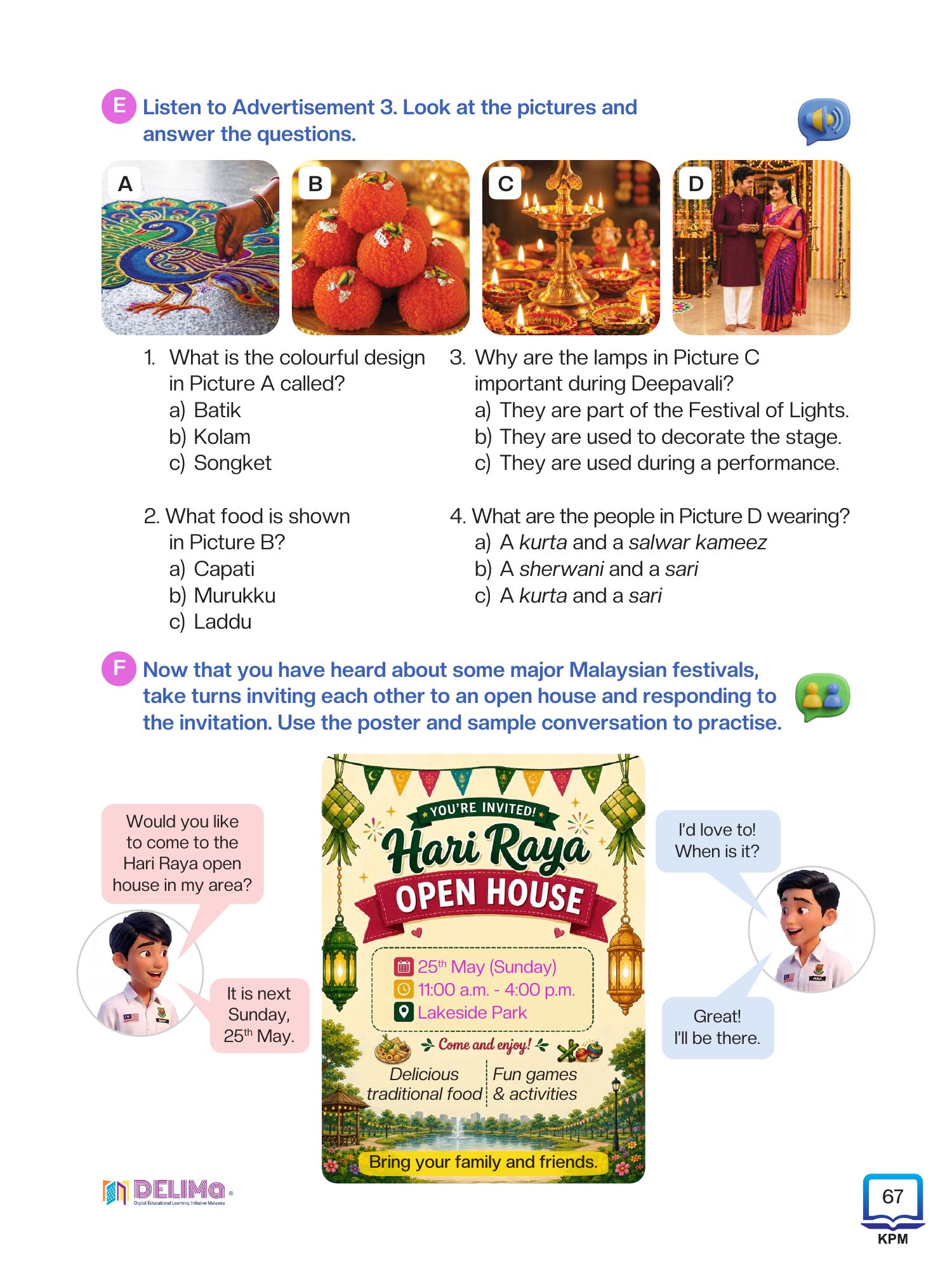
E Listen to Advertisement 3. Look at the pictures and
answer the questions.
A
B
C
D
1. What is the colourful design
in Picture A called?
a) Batik
b) Kolam
c) Songket
3. Why are the lamps in Picture C
important during Deepavali?
a) They are part of the Festival of Lights.
b) They are used to decorate the stage.
c) They are used during a performance.
2. What food is shown
in Picture B?
a) Capati
b) Murukku
c) Laddu
4. What are the people in Picture D wearing?
a) A kurta and a salwar kameez
b) A sherwani and a sari
c) A kurta and a sari
F Now that you have heard about some major Malaysian festivals,
take turns inviting each other to an open house and responding to
the invitation. Use the poster and sample conversation to practise.
Would you like
to come to the
Hari Raya open
house in my area?
It is next
Sunday,
25 th May.
I’d love to!
When is it?
25 th May (Sunday)
11:00 a.m. - 4:00 p.m.
Lakeside Park
Great!
I’ll be there.
Delicious
Fun games
traditional food & activities
Bring your family and friends.
67
OUR UNIQUE VALUES
A You have learnt about some celebrations across Malaysia’s communities.
Now let’s learn about some of our similarities and differences by looking
at cultural etiquette and traditions.
Cultural etiquette is the set of customs for polite behaviour in a culture.
A tradition is a belief, custom or a way of doing something passed down
from generation to generation.
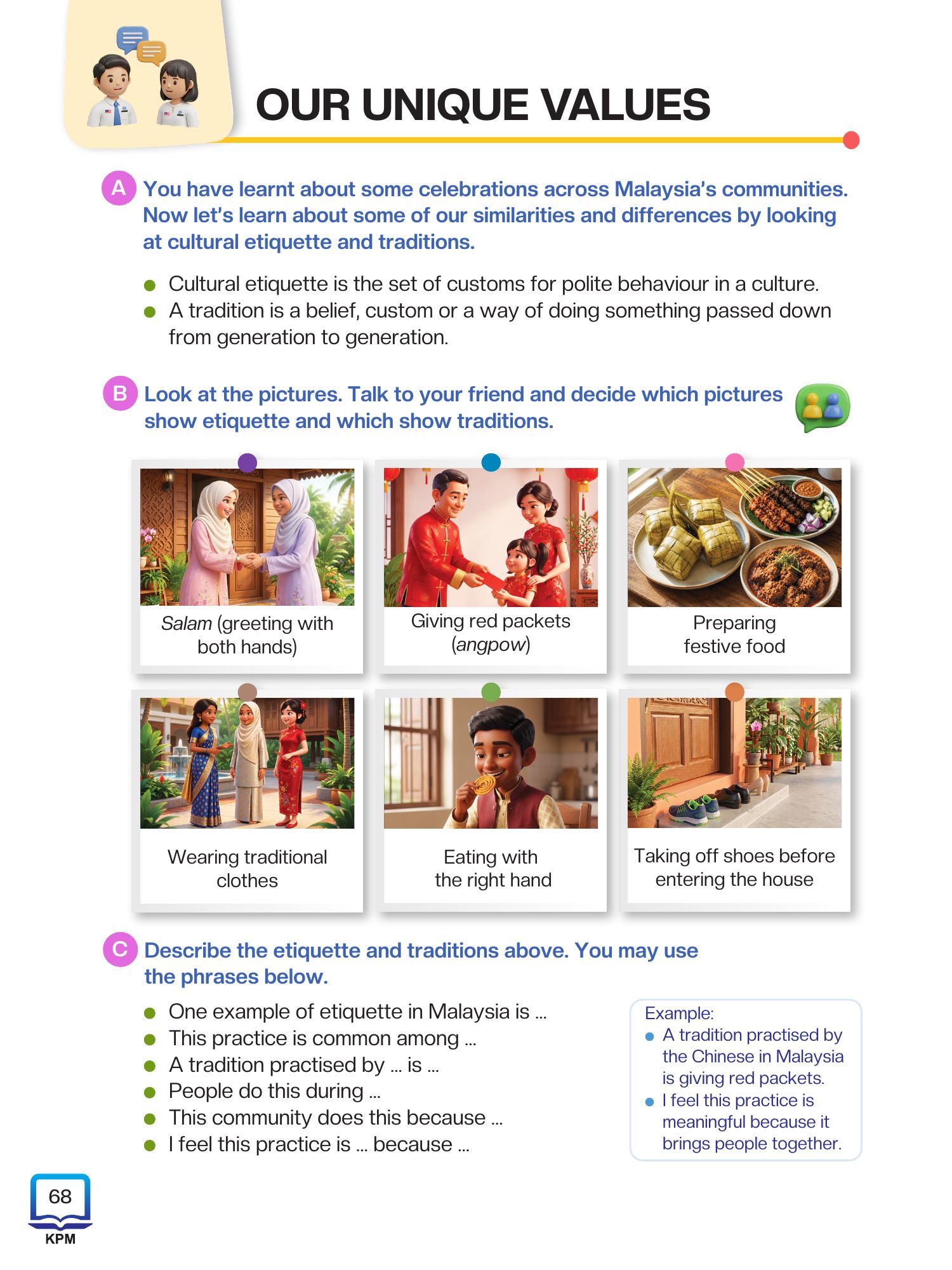
B Look at the pictures. Talk to your friend and decide which pictures
show etiquette and which show traditions.
Salam (greeting with
both hands)
Giving red packets
(angpow)
Preparing
festive food
Wearing traditional
clothes
Eating with
the right hand
Taking off shoes before
entering the house
C Describe the etiquette and traditions above. You may use
the phrases below.
One example of etiquette in Malaysia is …
This practice is common among …
A tradition practised by … is …
People do this during …
This community does this because …
I feel this practice is … because …
68
Example:
A tradition practised by
the Chinese in Malaysia
is giving red packets.
I feel this practice is
meaningful because it
brings people together.
D Discuss these questions with your friend. You may use the sample
sentence starters as a guide.
1. What is one tradition your family practises?
2. Why is this tradition important for your family?
3. Which Malaysian festival would you like to experience? Why?
Sample Sentence Starters
One tradition my family practises is ...
Every year, we like to ...
It is important because it helps us ...
It means a lot to us because ...
I would like to experience … because …
If I could choose a Malaysian festival to
experience, I would pick ... because ...
Useful
Vocabulary
gather
connect
experience
atmosphere
meaningful
memory
culture
E With a friend, discuss whether each practice is an example of
etiquette or a tradition. Give your reasons.
1. Giving duit raya during Hari Raya.
2. Lighting oil lamps for Deepavali.
3. Using both hands when giving or receiving gifts.
4. Bowing slightly when walking past elders.
5. Wearing cheongsam or samfoo during Chinese New Year.
6. Visiting family and attending open houses during festivals.
Sentence Frames for Discussion
Do you think this practice is an example of etiquette or a tradition?
I think ... is an example of ... because ...
For me, this practice is an example of ... since it is something that ...
I agree / disagree with you because ...
69
CULTURAL GEMS
READING TEXT 1
A You have talked about some major Malaysian festivals. Now read
more about one festival from an Orang Asli community in Malaysia.
Read the statements and discuss if they are True or False.
1. There is only one Orang Asli community in Malaysia.
2. All Orang Asli celebrate the same festivals.
3. Some Orang Asli festivals include music and dancing.
B Read the interview with a Mah Meri village elder.
Shu Ying
Diaman
Shu Ying
Diaman
Shu Ying
Diaman
Shu Ying
Diaman
Shu Ying
Diaman
Shu Ying
70
: Hello, Uncle Diaman. I’m Shu Ying. Thank you for talking with us today.
Can you tell us about Hari Moyang?
: Hello, Shu Ying. Sure! Hari Moyang is a special traditional celebration
of the Mah Meri people. We gather to honour our ancestors and ask
for protection, forgiveness and good fortune.
: That’s interesting! What happens during Hari Moyang?
: Many things happen! First, some men wear wooden masks and
costumes made from palm leaves, while some women wear
traditional clothes and headdresses made from woven leaves.
: What happens after that?
: We walk together from the village to the beach with traditional music.
When we arrive, we wait for the water to recede before
the Puja Pantai ceremony begins.
: What is Puja Pantai?
: Puja Pantai is a special ceremony held at the beach during
Hari Moyang. Towards the end of the ceremony, we perform
the Main Jo’oh dance. Many people dance in a circle to
traditional music.
: That sounds lovely! Why is Hari Moyang important
to your community?
: It keeps our culture alive. We want our children
and grandchildren to know our history. If we
do not celebrate, our traditions may be forgotten.
: Thank you, Uncle Diaman. I learnt a lot today!
C Read the words used in the interview. Work with a friend to match
each word to its correct meaning.
Word
Meaning
1.
ancestors
a. the beliefs, customs and way of life of a group of people
2.
ceremony
b. people related to you who lived a long time ago
3.
woven
c. made by crossing pieces of material across,
over and under each other
4.
culture
d. a public or religious occasion that includes a series of
formal or traditional actions
D Put the events of Hari Moyang in the correct order.
They leave the village and head towards the seaside.
Members of the Mah Meri community put on special
traditional clothing for the celebration.
They join a traditional dance called Main Jo’oh and
move together in a circle.
They wait for the tide to go out before the Puja Pantai
ceremony begins.
E Read the text again and answer the questions.
1. Who celebrates Hari Moyang?
2. Why do the villagers celebrate Hari Moyang?
3. What are the women’s headdresses made from?
4. Why do the villagers walk to the beach?
5. What happens towards the end of the Puja Pantai ceremony?
6. What might happen if the Mah Meri people stop celebrating
Hari Moyang?
F Read the paragraph. Discuss with a friend whether you agree or
disagree with it. Give reasons.
Everyone should learn about cultures that are different from their own.
Learning about other cultures helps us understand and respect other people.
It also helps us appreciate their traditions and why they are important.
71
READING TEXT 2
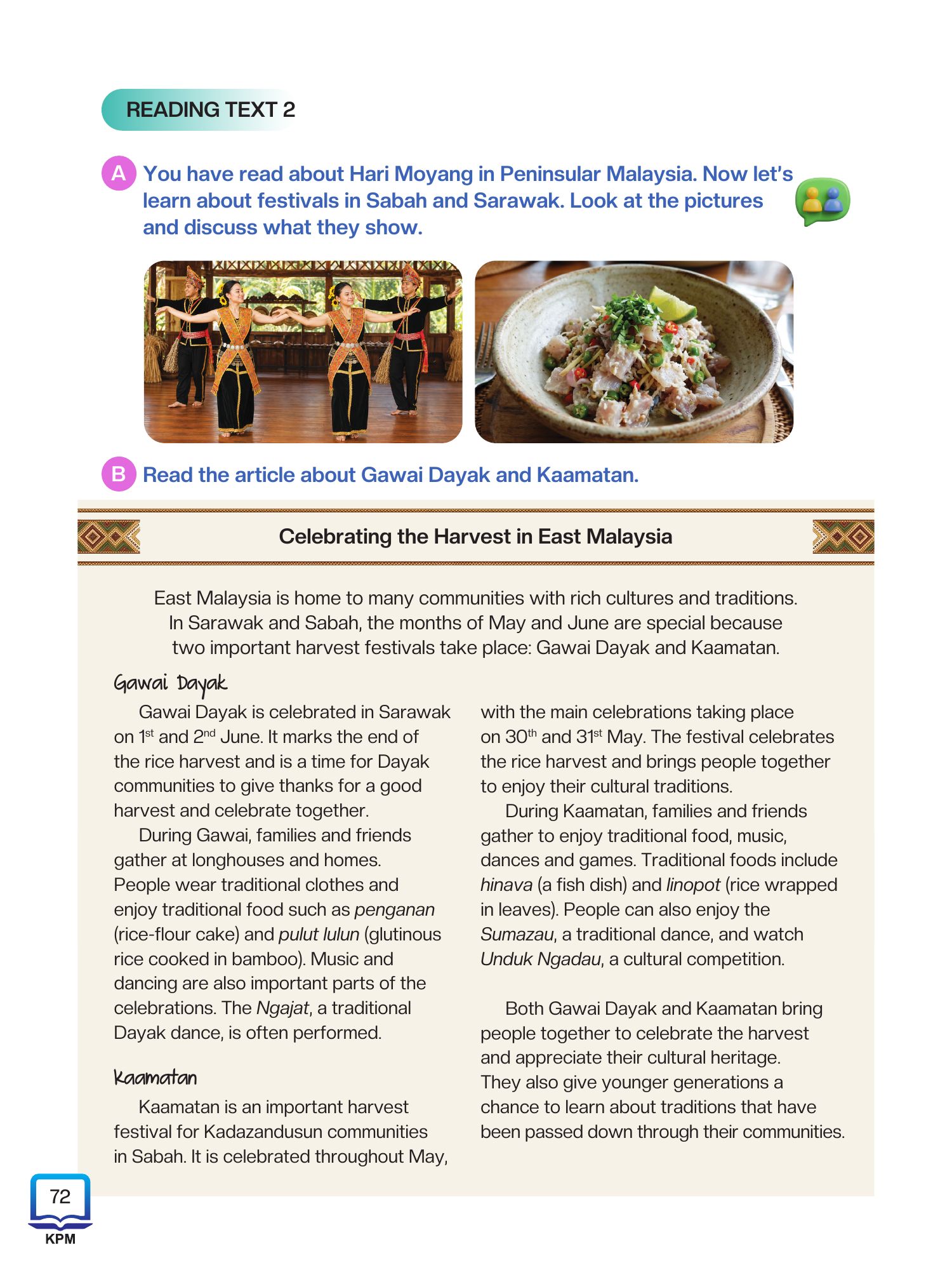
A You have read about Hari Moyang in Peninsular Malaysia. Now let’s
learn about festivals in Sabah and Sarawak. Look at the pictures
and discuss what they show.
B Read the article about Gawai Dayak and Kaamatan.
Celebrating the Harvest in East Malaysia
East Malaysia is home to many communities with rich cultures and traditions.
In Sarawak and Sabah, the months of May and June are special because
two important harvest festivals take place: Gawai Dayak and Kaamatan.
Gawai Dayak
Gawai Dayak is celebrated in Sarawak
on 1 st and 2 nd June. It marks the end of
the rice harvest and is a time for Dayak
communities to give thanks for a good
harvest and celebrate together.
During Gawai, families and friends
gather at longhouses and homes.
People wear traditional clothes and
enjoy traditional food such as penganan
(rice-flour cake) and pulut lulun (glutinous
rice cooked in bamboo). Music and
dancing are also important parts of the
celebrations. The Ngajat, a traditional
Dayak dance, is often performed.
Kaamatan
Kaamatan is an important harvest
festival for Kadazandusun communities
in Sabah. It is celebrated throughout May,
72
with the main celebrations taking place
on 30 th and 31 st May. The festival celebrates
the rice harvest and brings people together
to enjoy their cultural traditions.
During Kaamatan, families and friends
gather to enjoy traditional food, music,
dances and games. Traditional foods include
hinava (a fish dish) and linopot (rice wrapped
in leaves). People can also enjoy the
Sumazau, a traditional dance, and watch
Unduk Ngadau, a cultural competition.
Both Gawai Dayak and Kaamatan bring
people together to celebrate the harvest
and appreciate their cultural heritage.
They also give younger generations a
chance to learn about traditions that have
been passed down through their communities.
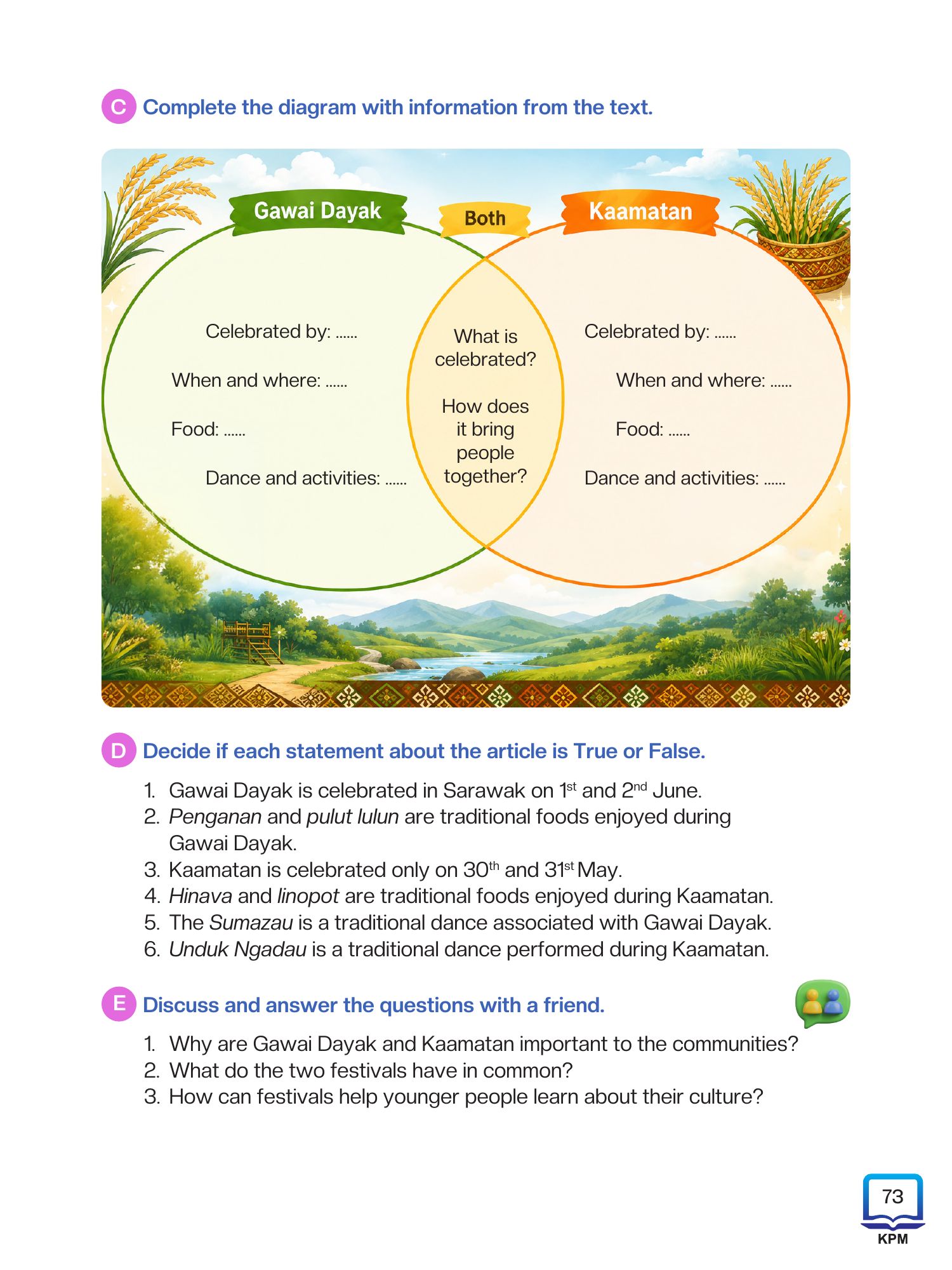
C Complete the diagram with information from the text.
Celebrated by: ……
When and where: …...
Food: ……
Dance and activities: .…..
What is
celebrated?
How does
it bring
people
together?
Celebrated by: ……
When and where: …...
Food: ……
Dance and activities: .…..
D Decide if each statement about the article is True or False.
1. Gawai Dayak is celebrated in Sarawak on 1 st and 2 nd June.
2. Penganan and pulut lulun are traditional foods enjoyed during
Gawai Dayak.
3. Kaamatan is celebrated only on 30 th and 31 st May.
4. Hinava and linopot are traditional foods enjoyed during Kaamatan.
5. The Sumazau is a traditional dance associated with Gawai Dayak.
6. Unduk Ngadau is a traditional dance performed during Kaamatan.
E Discuss and answer the questions with a friend.
1. Why are Gawai Dayak and Kaamatan important to the communities?
2. What do the two festivals have in common?
3. How can festivals help younger people learn about their culture?
73
FESTIVE MOMENTS
A Celebrations are full of activity! So how do we describe what
people are doing during these celebrations? Read the explanation of
the present continuous tense and complete the sentences.
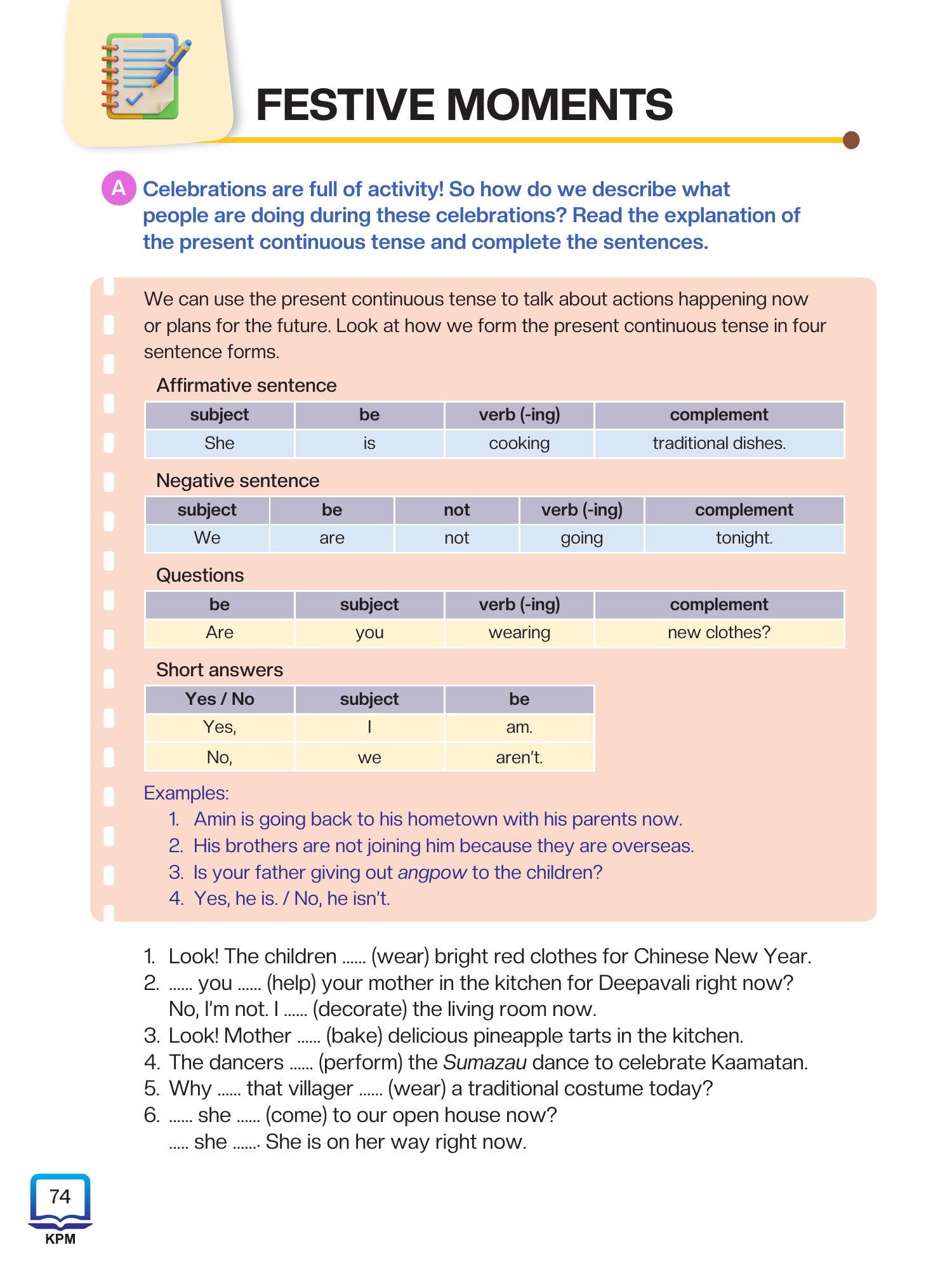
We can use the present continuous tense to talk about actions happening now
or plans for the future. Look at how we form the present continuous tense in four
sentence forms.
Affirmative sentence
subject
be
verb (-ing)
complement
She
is
cooking
traditional dishes.
Negative sentence
subject
be
not
verb (-ing)
complement
We
are
not
going
tonight.
Questions
be
subject
verb (-ing)
complement
Are
you
wearing
new clothes?
Yes / No
subject
be
Yes,
I
am.
No,
we
aren’t.
Short answers
Examples:
1. Amin is going back to his hometown with his parents now.
2. His brothers are not joining him because they are overseas.
3. Is your father giving out angpow to the children?
4. Yes, he is. / No, he isn’t.
1. Look! The children …… (wear) bright red clothes for Chinese New Year.
2. …… you …… (help) your mother in the kitchen for Deepavali right now?
No, I’m not. I …… (decorate) the living room now.
3. Look! Mother …… (bake) delicious pineapple tarts in the kitchen.
4. The dancers …… (perform) the Sumazau dance to celebrate Kaamatan.
5. Why …… that villager …… (wear) a traditional costume today?
6. …… she …… (come) to our open house now?
….. she ……. She is on her way right now.
74
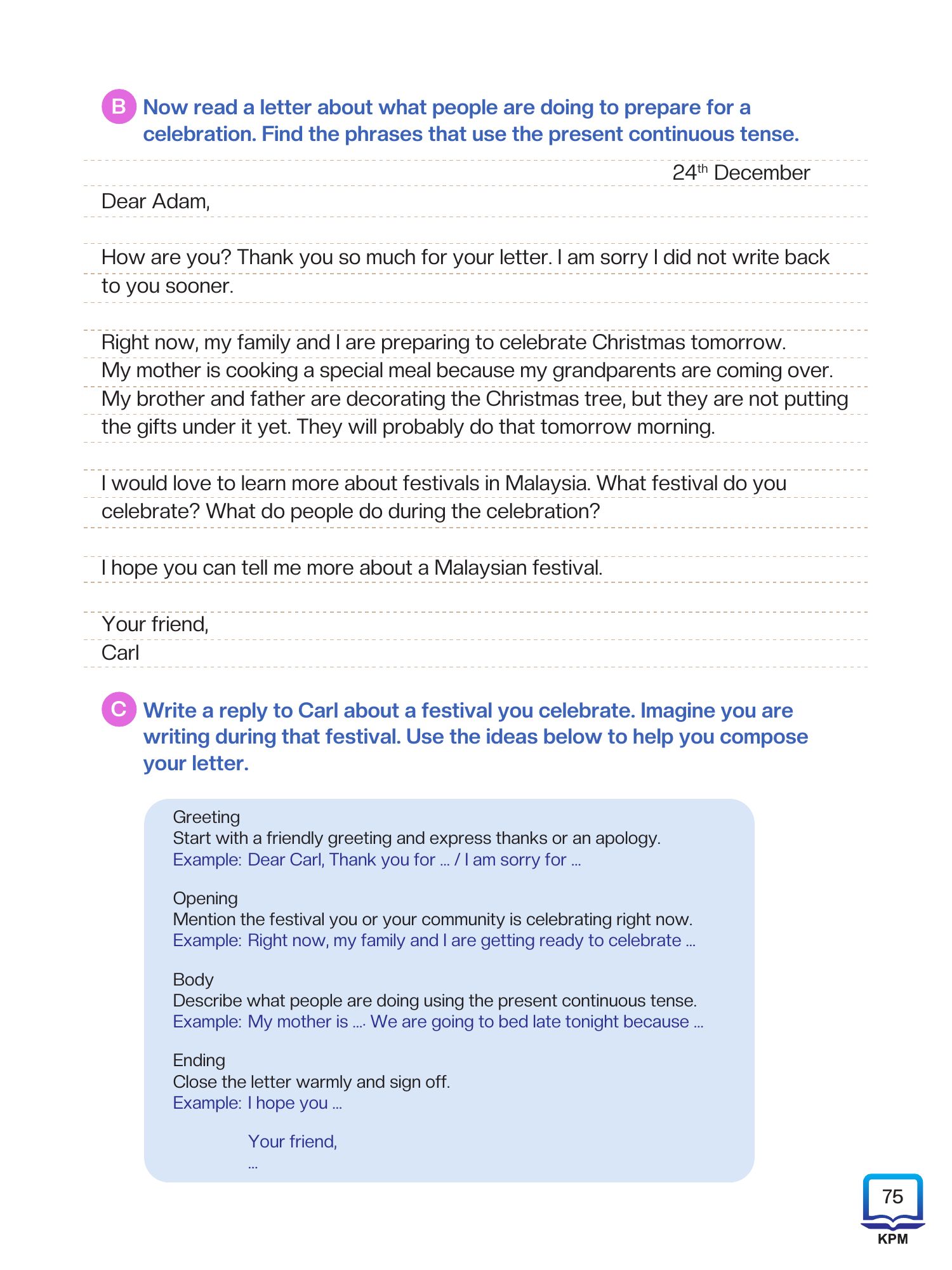
B Now read a letter about what people are doing to prepare for a
celebration. Find the phrases that use the present continuous tense.
24 th December
Dear Adam,
How are you? Thank you so much for your letter. I am sorry I did not write back
to you sooner.
Right now, my family and I are preparing to celebrate Christmas tomorrow.
My mother is cooking a special meal because my grandparents are coming over.
My brother and father are decorating the Christmas tree, but they are not putting
the gifts under it yet. They will probably do that tomorrow morning.
I would love to learn more about festivals in Malaysia. What festival do you
celebrate? What do people do during the celebration?
I hope you can tell me more about a Malaysian festival.
Your friend,
Carl
C Write a reply to Carl about a festival you celebrate. Imagine you are
writing during that festival. Use the ideas below to help you compose
your letter.
Greeting
Start with a friendly greeting and express thanks or an apology.
Example: Dear Carl, Thank you for ... / I am sorry for …
Opening
Mention the festival you or your community is celebrating right now.
Example: Right now, my family and I are getting ready to celebrate …
Body
Describe what people are doing using the present continuous tense.
Example: My mother is …. We are going to bed late tonight because …
Ending
Close the letter warmly and sign off.
Example: I hope you …
Your friend,
…
75
CREATIVE MIX
A You have explored Malaysia’s many celebrations. Now let’s talk
about what makes Malaysia special. Discuss these questions
with your friend.
1. What do you like about Malaysia?
2. Name some beautiful places in Malaysia that you have visited.
B Read the stanza and answer the questions with your friend.
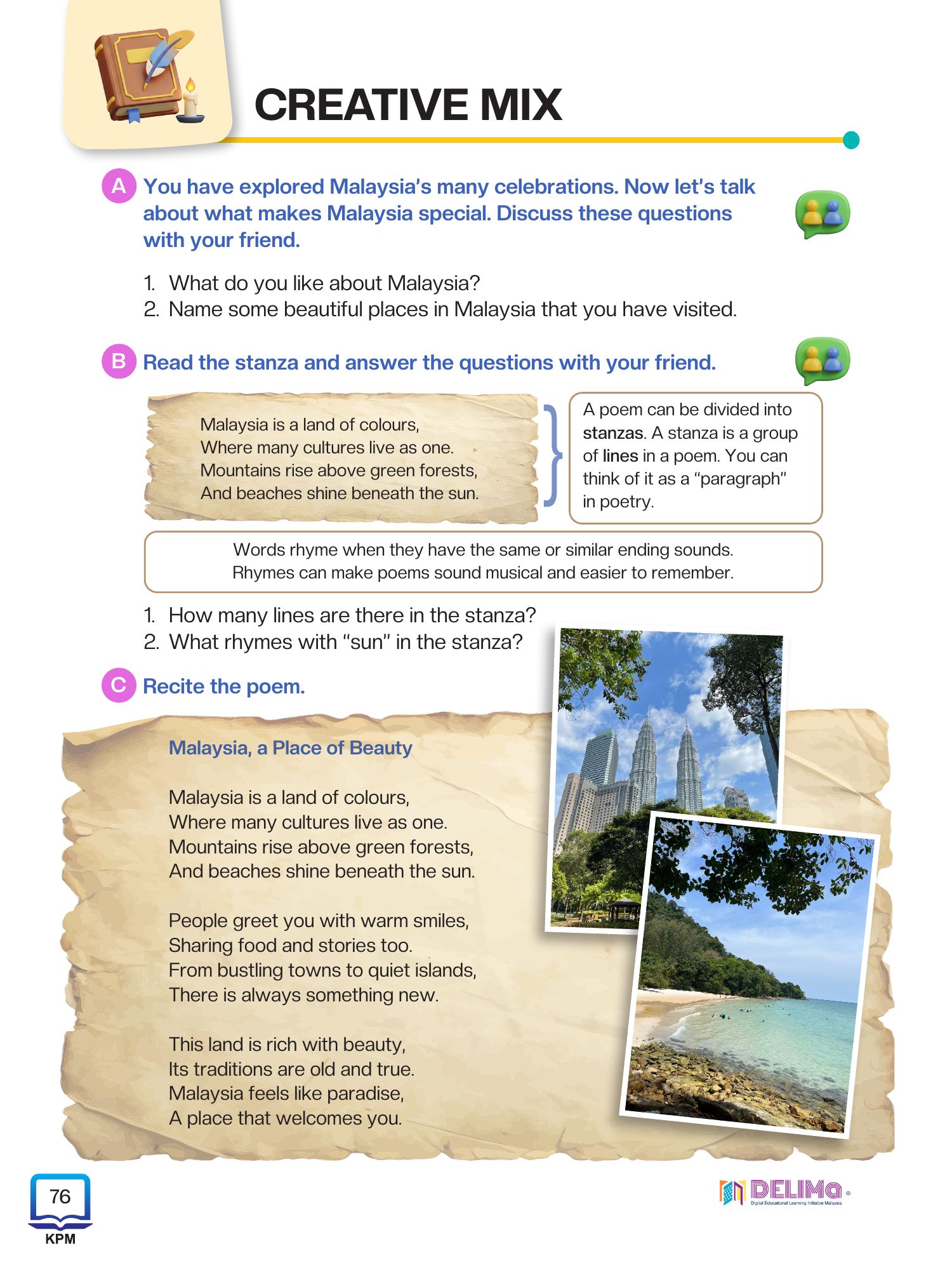
Malaysia is a land of colours,
Where many cultures live as one.
Mountains rise above green forests,
And beaches shine beneath the sun.
A poem can be divided into
stanzas. A stanza is a group
of lines in a poem. You can
think of it as a “paragraph”
in poetry.
Words rhyme when they have the same or similar ending sounds.
Rhymes can make poems sound musical and easier to remember.
1. How many lines are there in the stanza?
2. What rhymes with “sun” in the stanza?
C Recite the poem.
Malaysia, a Place of Beauty
Malaysia is a land of colours,
Where many cultures live as one.
Mountains rise above green forests,
And beaches shine beneath the sun.
People greet you with warm smiles,
Sharing food and stories too.
From bustling towns to quiet islands,
There is always something new.
This land is rich with beauty,
Its traditions are old and true.
Malaysia feels like paradise,
A place that welcomes you.
76
D Answer the questions based on the poem.
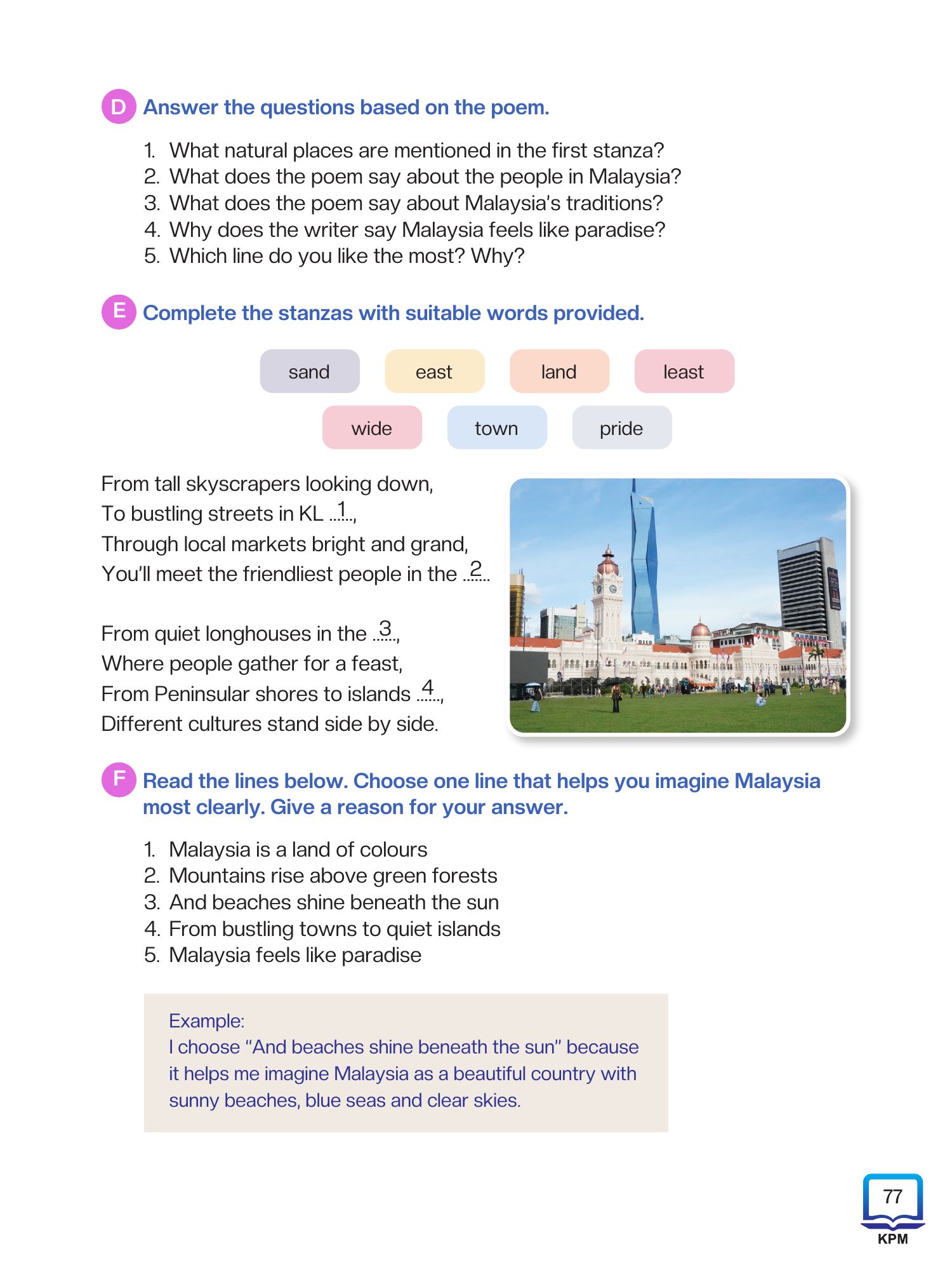
1. What natural places are mentioned in the first stanza?
2. What does the poem say about the people in Malaysia?
3. What does the poem say about Malaysia’s traditions?
4. Why does the writer say Malaysia feels like paradise?
5. Which line do you like the most? Why?
E Complete the stanzas with suitable words provided.
sand
east
wide
land
town
least
pride
From tall skyscrapers looking down,
1
To bustling streets in KL ……,
Through local markets bright and grand,
2
You’ll meet the friendliest people in the …….
3
From quiet longhouses in the ……,
Where people gather for a feast,
4
From Peninsular shores to islands ……,
Different cultures stand side by side.
F Read the lines below. Choose one line that helps you imagine Malaysia
most clearly. Give a reason for your answer.
1. Malaysia is a land of colours
2. Mountains rise above green forests
3. And beaches shine beneath the sun
4. From bustling towns to quiet islands
5. Malaysia feels like paradise
Example:
I choose “And beaches shine beneath the sun” because
it helps me imagine Malaysia as a beautiful country with
sunny beaches, blue seas and clear skies.
77
YOUR LEARNING JOURNEY
A Test your memory! Rearrange the letters to form words you have learnt.
Use the meanings as clues.
Jumbled Word
Meaning
1.
STREVAH
the time of year when crops are gathered
2.
CSEATNORS
people related to you who lived a long time ago
3.
RAEGNTIONE
all the people in a society or a particular family who are about
the same age
4.
DROITNATI
a belief, custom or a way of doing something passed down
from generation to generation
5.
RGAEHTIE
the traditions and history of a country or society that are
considered an important part of its character
6.
TUERCUL
the beliefs, customs and way of life of a group of people
B Rearrange the words to form correct sentences about what is happening
during festivals.
1. is / preparing / Mother / a / meal. / special / festival
2. dancers / The / performing / are / dance. / a cultural
3. family / open / house / hosting / an / My / is / today.
4. she / is / When / going / to the open house?
5. not / are / They / fireworks. / watching
6. the oil lamps. / is / lighting / My father
7. not / is / My sister / with the decorations. / helping
8. the children / Are / traditional games? / playing
Reflect on what you have learnt in this unit.
Complete the sentences below.
Let’s
Reflect
78
1. One new thing I learnt about a festival was ……
2. A tradition I practise is …...
3. I would like to know more about ……
4. My favourite topic in this unit was ……