EXPLO RING
NATURE
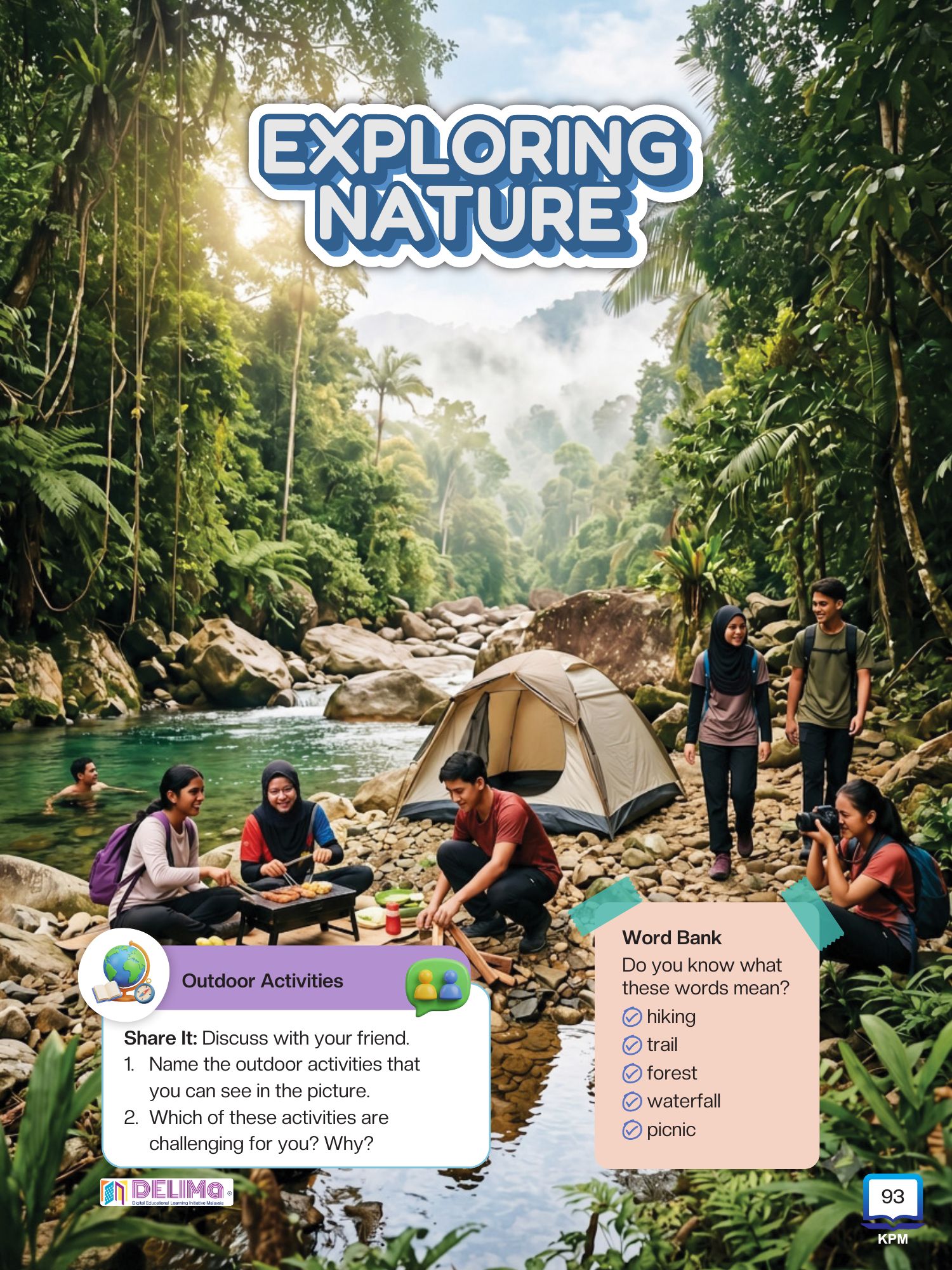
Outdoor Activities
Share It: Discuss with your friend.
1. Name the outdoor activities that
you can see in the picture.
2. Which of these activities are
challenging for you? Why?
Word Bank
Do you know what
these words mean?
hiking
trail
forest
waterfall
picnic
93
APPRECIATING NATURE
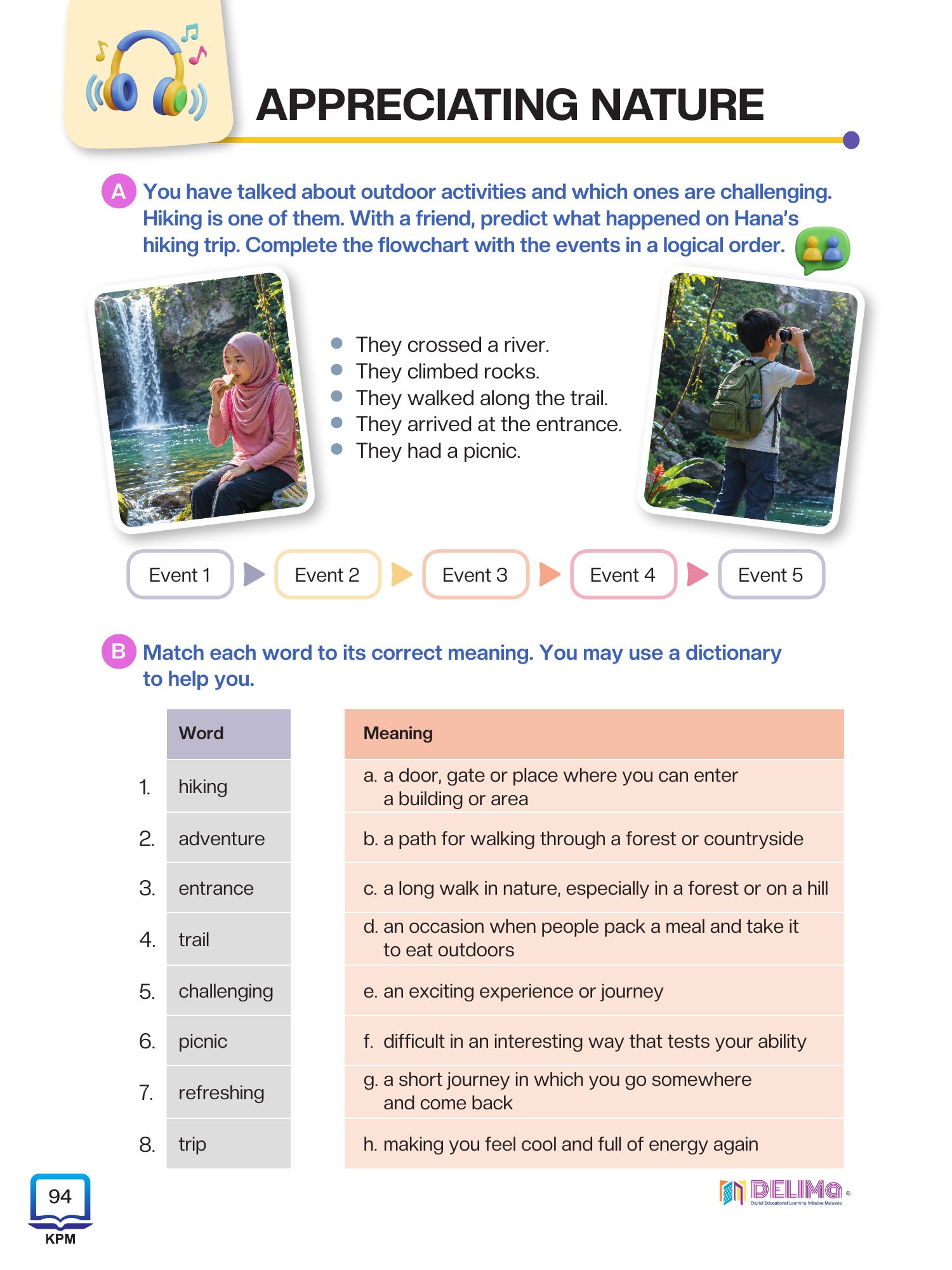
A You have talked about outdoor activities and which ones are challenging.
Hiking is one of them. With a friend, predict what happened on Hana’s
hiking trip. Complete the flowchart with the events in a logical order.
They crossed a river.
They climbed rocks.
They walked along the trail.
They arrived at the entrance.
They had a picnic.
Event 1
Event 2
Event 3
Event 4
Event 5
B Match each word to its correct meaning. You may use a dictionary
to help you.
94
Word
Meaning
1.
hiking
a. a door, gate or place where you can enter
a building or area
2.
adventure
b. a path for walking through a forest or countryside
3.
entrance
c. a long walk in nature, especially in a forest or on a hill
4.
trail
d. an occasion when people pack a meal and take it
to eat outdoors
5.
challenging
e. an exciting experience or journey
6.
picnic
f. difficult in an interesting way that tests your ability
7.
refreshing
g. a short journey in which you go somewhere
and come back
8.
trip
h. making you feel cool and full of energy again
C Based on the previous activities, complete Hana’s notes about
her hiking trip with suitable words.
My Hiking Adventure
1 adventure with my family at Sungai Chiling Waterfall
Last weekend, I went on a ……
in Selangor. We drove there early in the morning.
3 . The air was cool, and I could
2 we walked along the forest ……
When we arrived at the ……,
hear birds singing everywhere.
After about 30 minutes, we reached a river. We crossed the river carefully. This was the
4 part of the hike. Then, we continued walking to the ……
5 . My brother and I climbed
most ……
6
onto some large …… to take photos.
7 near the water. I ate sandwiches while sitting on a big flat stone.
Later, we had a small ……
8 . Before we left, we made sure we took all our rubbish
The water was cold, but it felt ……
home with us.
I really enjoyed the trip because I love spending time outdoors with my family.
D Listen to Hana talk about her hiking trip and check your answers in
Activities A and C.
E Listen again and answer the questions.
1. Where did Hana and her family go?
2. What did Hana hear as she walked along the trail?
3. How long did they walk before they reached the river?
4. Which part of the hike did Hana find the most challenging?
5. Why did Hana enjoy the trip?
F With a friend, discuss the questions.
1. What outdoor activity do you like? Explain your choice.
2. Why does spending time in nature make us feel happy and healthy?
3. What are two easy rules to keep the forests and rivers clean?
4. How can too many visitors at a nature park hurt the animals and plants?
5. Why should we protect the animals and plants in the forest?
Useful Phrases
Use these sentence frames to speak with your friend.
My favourite outdoor activity is ... because ...
It makes me feel ... because ...
We must ... so that ...
Too many visitors could ...
If we don’t protect ..., they might ...
It is our responsibility to ...
95
PACK AND PLAN
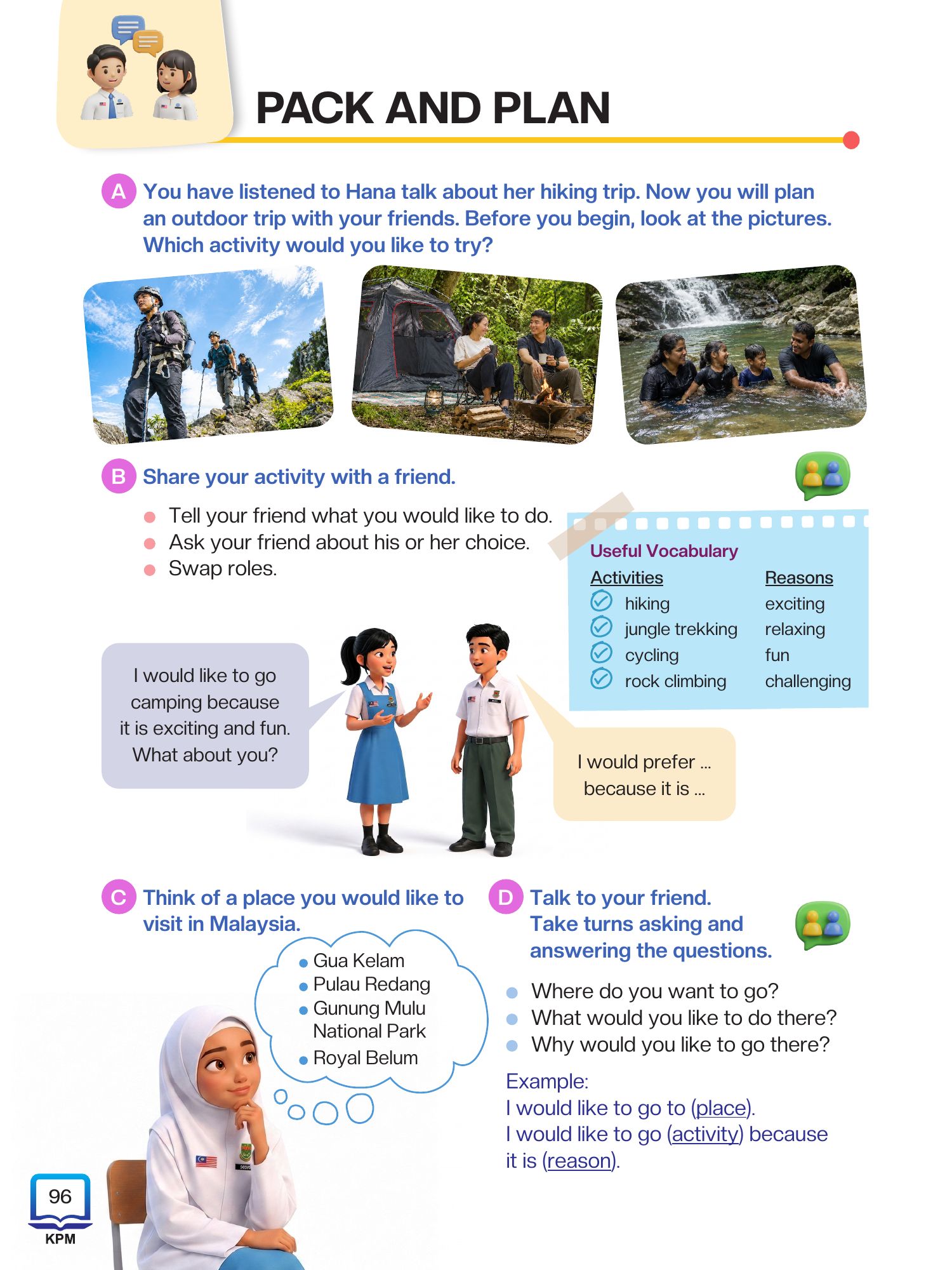
A You have listened to Hana talk about her hiking trip. Now you will plan
an outdoor trip with your friends. Before you begin, look at the pictures.
Which activity would you like to try?
B Share your activity with a friend.
Tell your friend what you would like to do.
Ask your friend about his or her choice.
Swap roles.
I would like to go
camping because
it is exciting and fun.
What about you?
Reasons
exciting
relaxing
fun
challenging
I would prefer ...
because it is ...
C Think of a place you would like to
visit in Malaysia.
Gua Kelam
Pulau Redang
Gunung Mulu
National Park
Royal Belum
96
Useful Vocabulary
Activities
hiking
jungle trekking
cycling
rock climbing
D Talk to your friend.
Take turns asking and
answering the questions.
Where do you want to go?
What would you like to do there?
Why would you like to go there?
Example:
I would like to go to (place).
I would like to go (activity) because
it is (reason).
E Think of an outdoor activity in Malaysia. Make quick notes on
the points below.
Where to go
What to do
Who to invite
How to get there
When to start
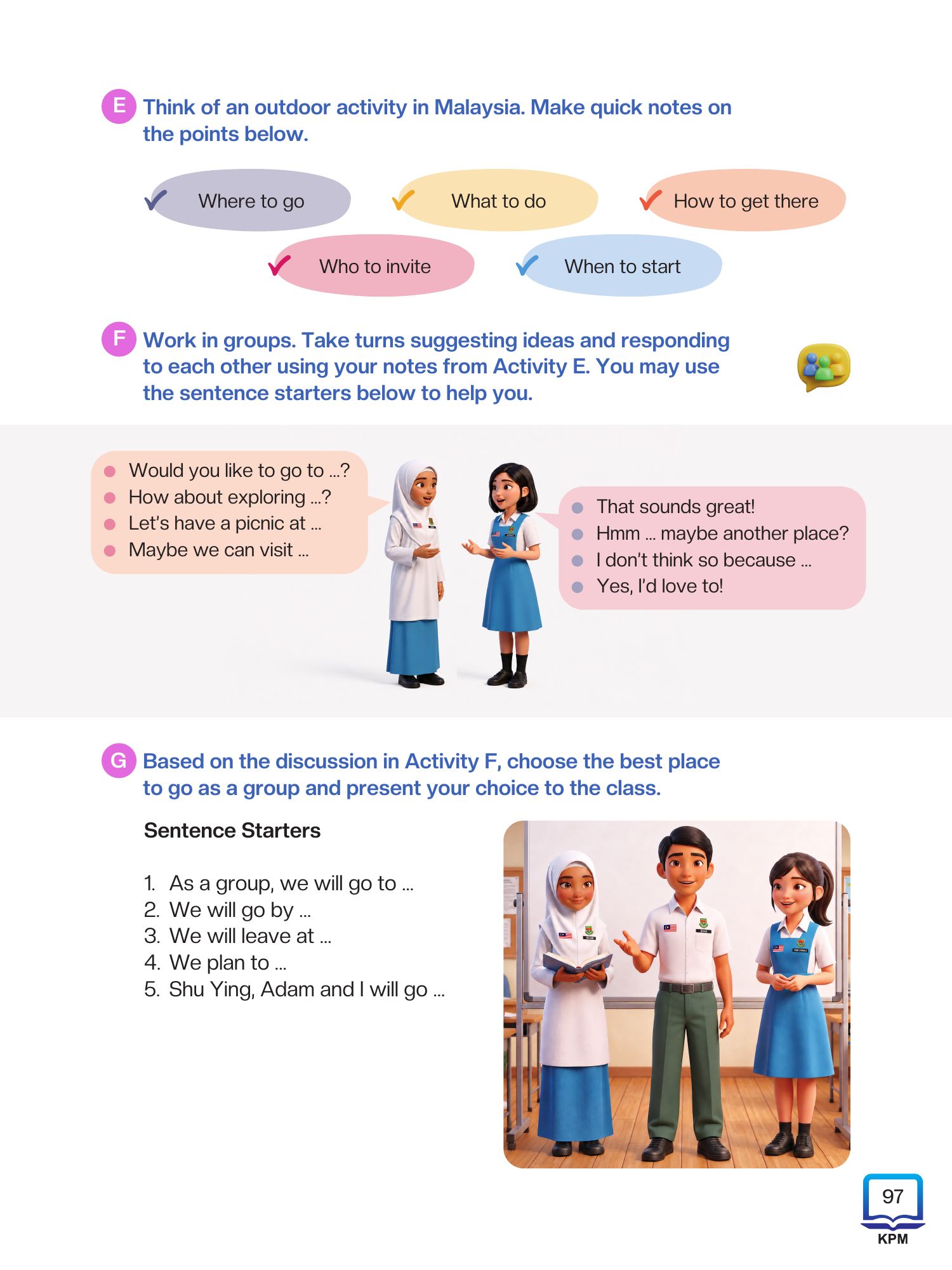
F Work in groups. Take turns suggesting ideas and responding
to each other using your notes from Activity E. You may use
the sentence starters below to help you.
Would you like to go to …?
How about exploring …?
Let’s have a picnic at …
Maybe we can visit …
That sounds great!
Hmm … maybe another place?
I don’t think so because …
Yes, I’d love to!
G Based on the discussion in Activity F, choose the best place
to go as a group and present your choice to the class.
Sentence Starters
1. As a group, we will go to ...
2. We will go by ...
3. We will leave at ...
4. We plan to ...
5. Shu Ying, Adam and I will go ...
97
MEMORABLE EXPERIENCES
READING TEXT 1
A You have chosen a place in Malaysia that you would like to visit.
A wildlife park is another place you could explore. Before you read
about one, discuss the questions with a friend.
1. What might you see at a wildlife park?
2. What can you do at a wildlife park?
B Read Jessica’s diary entry about her visit to Lok Kawi Wildlife Park.
A Day at Lok Kawi Wildlife Park
Saturday, 12 th August
My family and I visited Lok Kawi Wildlife Park in Sabah today, and it was one of
my favourite weekend trips this year. When we arrived, I heard children laughing
and birds calling loudly from the trees. The weather was warm, but the air felt fresh
as we walked into the park.
We began our visit by exploring the animal enclosures. My younger brother was
excited to see the elephants. He kept pointing at the elephants and talking about
them. My father took many photos of the orangutans, especially one that was
swinging slowly on a rope. I enjoyed watching the colourful birds at the aviary.
They flew close to us, and I felt amazed.
Later, we stopped at a rest area near the botanical garden. My mother said,
“How about having our picnic here?” I agreed because the place was very quiet
and shady. After eating, we walked along the shaded path to the children’s zone.
My sister enjoyed the small playground, while I enjoyed taking photos of the plants.
For me, the best part of the trip was spending time outdoors with my family.
I told everyone, “Next time, we should try the nature walk in the park!” It was
a simple yet happy day.
98
C Answer the questions.
1. Where is Lok Kawi Wildlife Park located?
2. What sounds did the writer hear at the start of the visit?
3. Which animal was the younger brother interested in?
4. Why did the family decide to have a picnic near the botanical garden?
5. What suggestion did the writer make at the end of the trip?
D Find the words in the diary that match the meanings below.
Meaning
Word
Example: pleasantly clean, pure or cool
1.
a large enclosure for keeping birds in
2.
relating to plants
3.
an area surrounded by fences or walls
4.
a small road or track for people to walk on
5.
protected from direct sunlight by trees
fresh
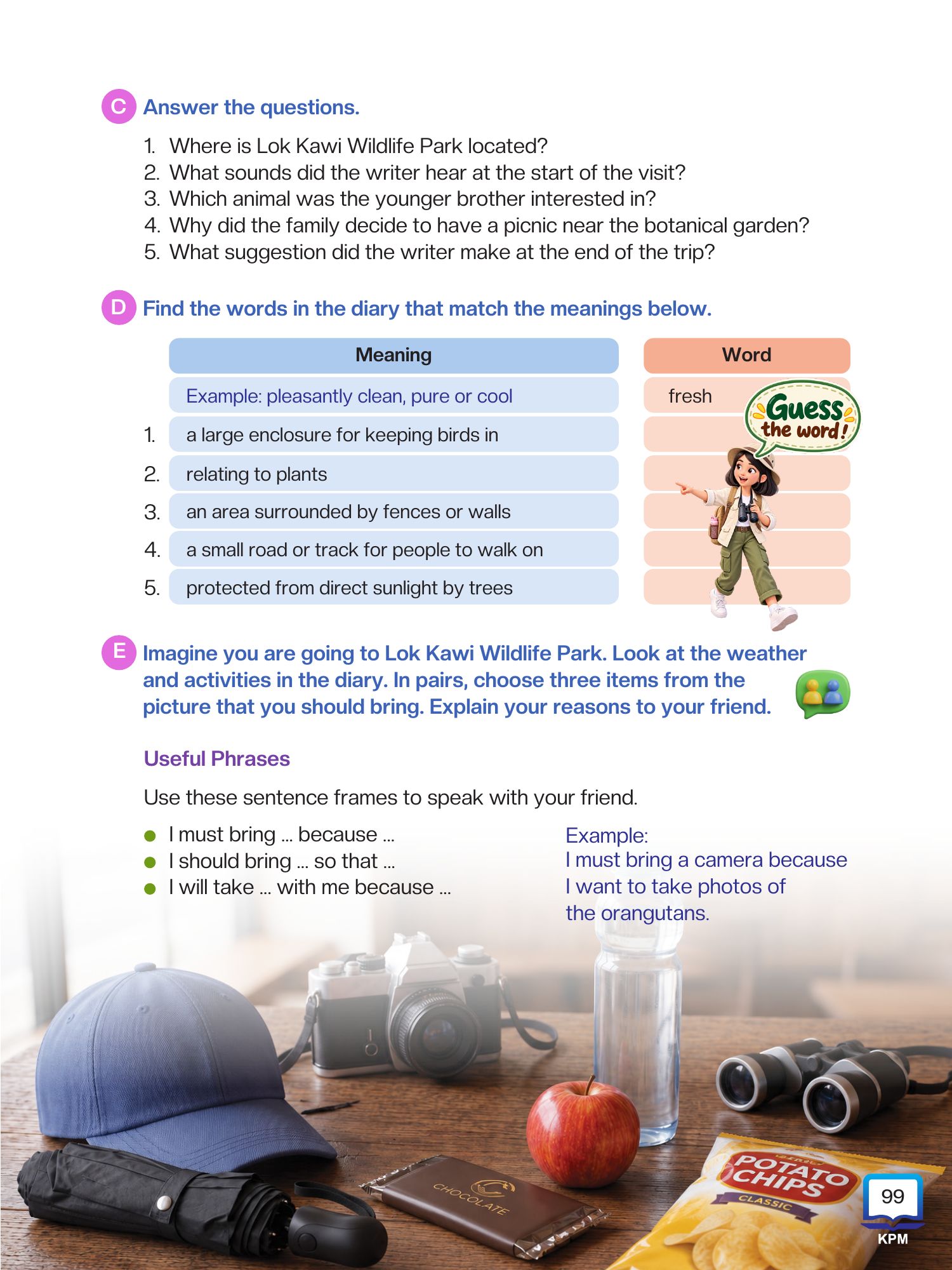
E Imagine you are going to Lok Kawi Wildlife Park. Look at the weather
and activities in the diary. In pairs, choose three items from the
picture that you should bring. Explain your reasons to your friend.
Useful Phrases
Use these sentence frames to speak with your friend.
I must bring ... because ...
I should bring ... so that ...
I will take ... with me because ...
Example:
I must bring a camera because
I want to take photos of
the orangutans.
99
READING TEXT 2
A You have read Jessica’s diary entry about Lok Kawi Wildlife Park.
Another visitor wrote about the same park online.
Read the review below.
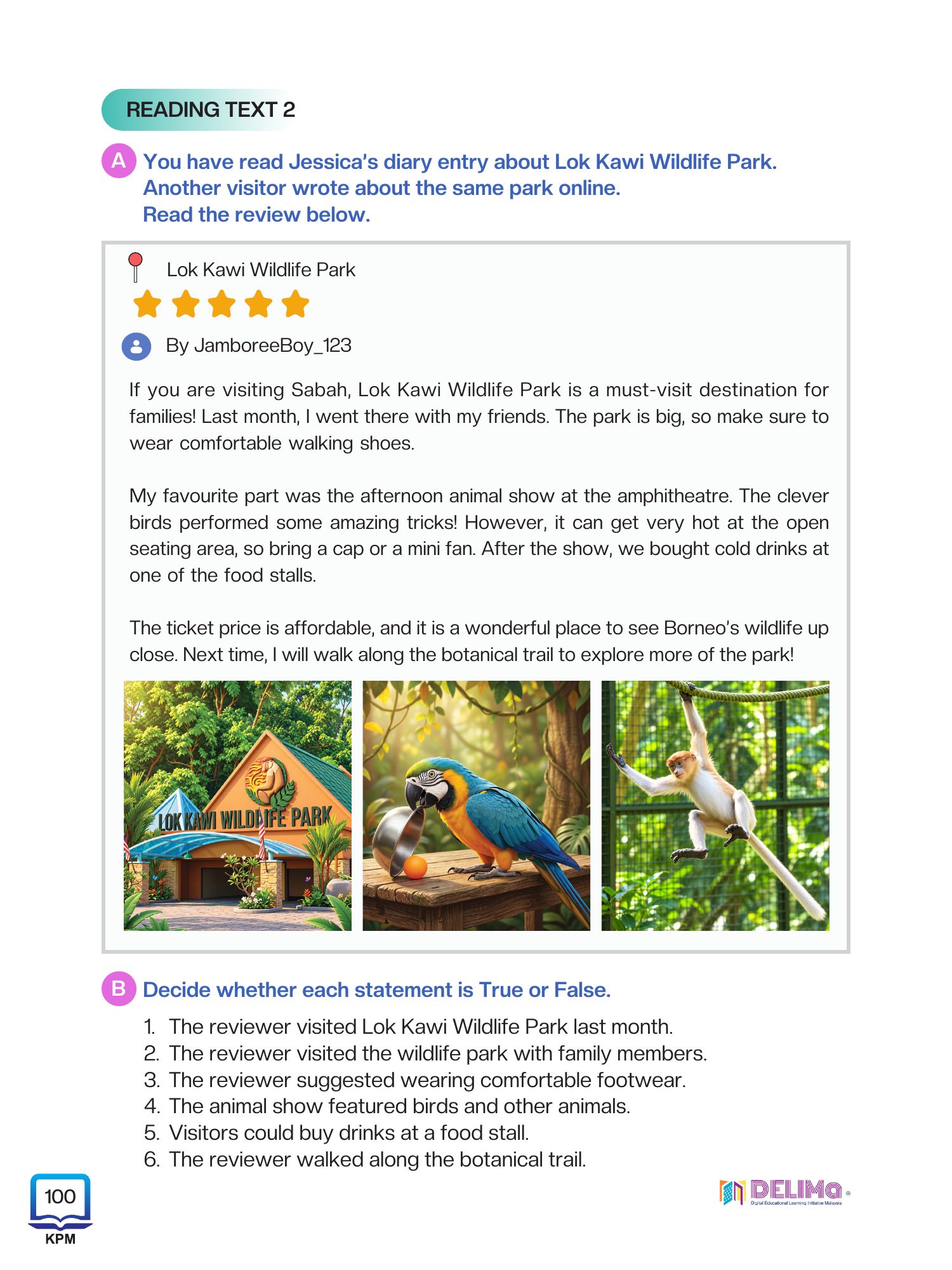
Lok Kawi Wildlife Park
By JamboreeBoy_123
If you are visiting Sabah, Lok Kawi Wildlife Park is a must-visit destination for
families! Last month, I went there with my friends. The park is big, so make sure to
wear comfortable walking shoes.
My favourite part was the afternoon animal show at the amphitheatre. The clever
birds performed some amazing tricks! However, it can get very hot at the open
seating area, so bring a cap or a mini fan. After the show, we bought cold drinks at
one of the food stalls.
The ticket price is affordable, and it is a wonderful place to see Borneo’s wildlife up
close. Next time, I will walk along the botanical trail to explore more of the park!
B Decide whether each statement is True or False.
1. The reviewer visited Lok Kawi Wildlife Park last month.
2. The reviewer visited the wildlife park with family members.
3. The reviewer suggested wearing comfortable footwear.
4. The animal show featured birds and other animals.
5. Visitors could buy drinks at a food stall.
6. The reviewer walked along the botanical trail.
100
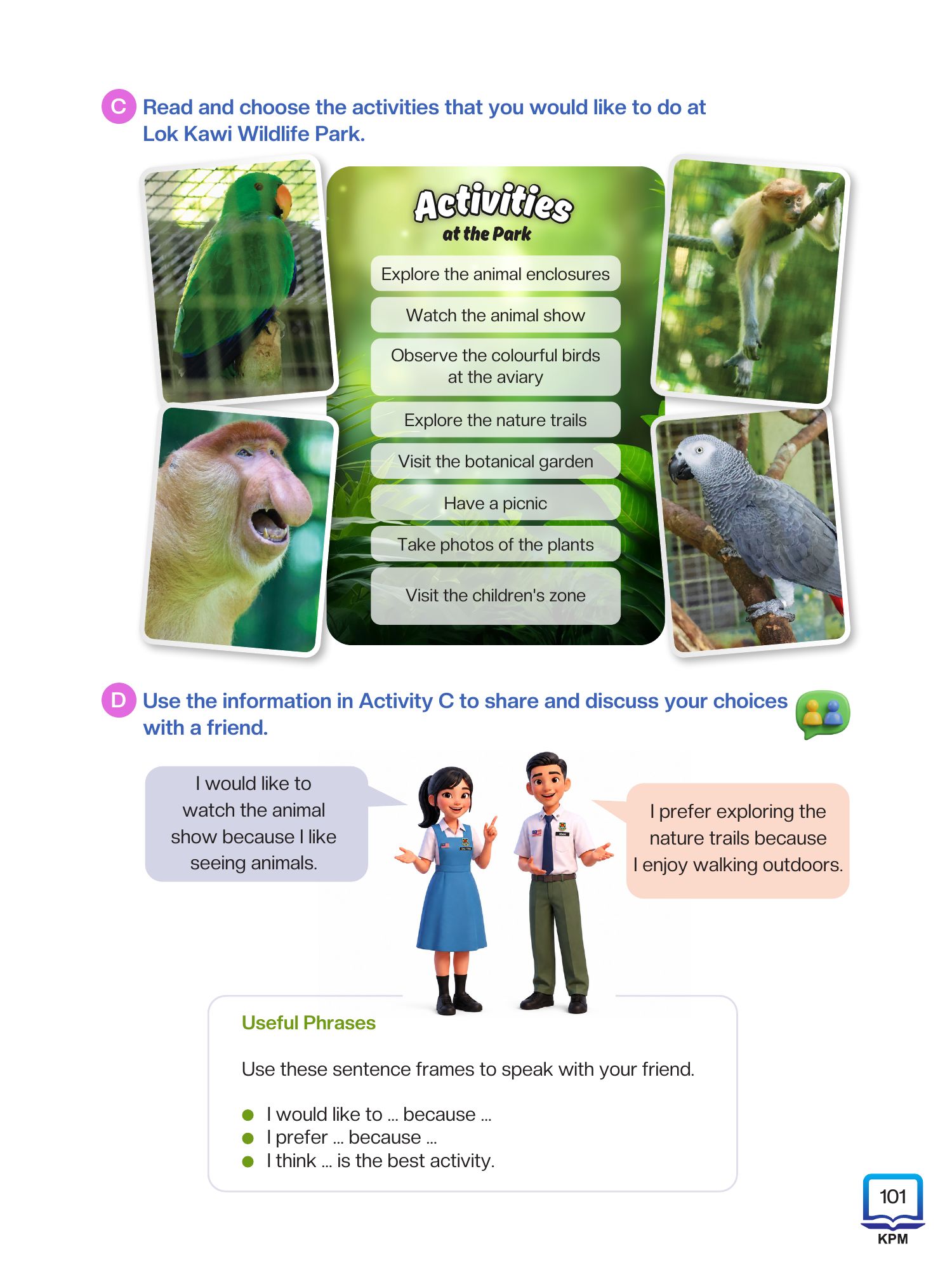
C Read and choose the activities that you would like to do at
Lok Kawi Wildlife Park.
A ctivities
Explore the animal enclosures
Watch the animal show
Observe the colourful birds
at the aviary
Explore the nature trails
Visit the botanical garden
Have a picnic
Take photos of the plants
Visit the children's zone
D Use the information in Activity C to share and discuss your choices
with a friend.
I would like to
watch the animal
show because I like
seeing animals.
I prefer exploring the
nature trails because
I enjoy walking outdoors.
Useful Phrases
Use these sentence frames to speak with your friend.
I would like to ... because ...
I prefer ... because ...
I think ... is the best activity.
101
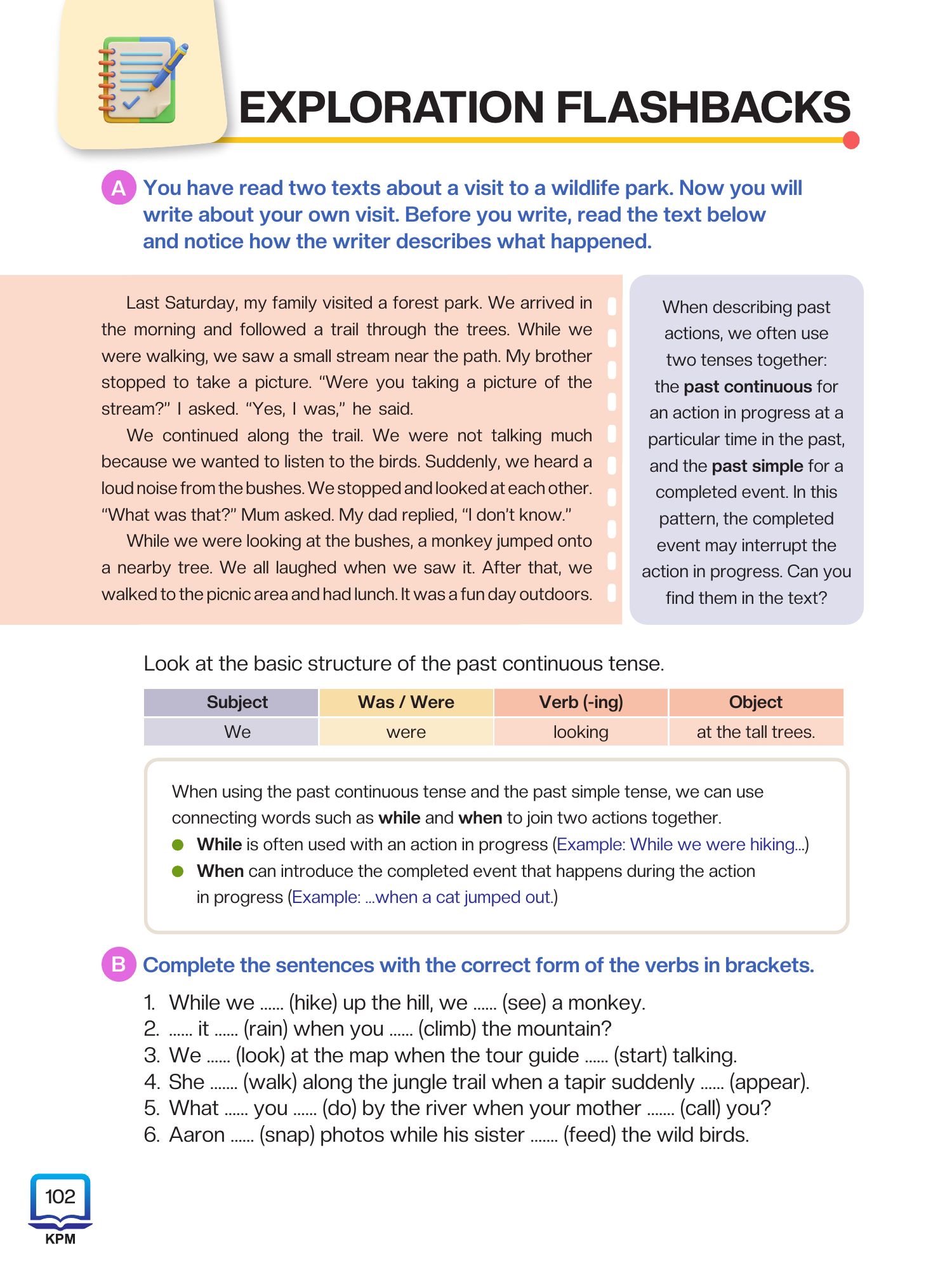
EXPLORATION FLASHBACKS
A You have read two texts about a visit to a wildlife park. Now you will
write about your own visit. Before you write, read the text below
and notice how the writer describes what happened.
Last Saturday, my family visited a forest park. We arrived in
the morning and followed a trail through the trees. While we
were walking, we saw a small stream near the path. My brother
stopped to take a picture. “Were you taking a picture of the
stream?” I asked. “Yes, I was,” he said.
We continued along the trail. We were not talking much
because we wanted to listen to the birds. Suddenly, we heard a
loud noise from the bushes. We stopped and looked at each other.
“What was that?” Mum asked. My dad replied, “I don’t know.”
While we were looking at the bushes, a monkey jumped onto
a nearby tree. We all laughed when we saw it. After that, we
walked to the picnic area and had lunch. It was a fun day outdoors.
When describing past
actions, we often use
two tenses together:
the past continuous for
an action in progress at a
particular time in the past,
and the past simple for a
completed event. In this
pattern, the completed
event may interrupt the
action in progress. Can you
find them in the text?
Look at the basic structure of the past continuous tense.
Subject
Was / Were
Verb (-ing)
Object
We
were
looking
at the tall trees.
When using the past continuous tense and the past simple tense, we can use
connecting words such as while and when to join two actions together.
While is often used with an action in progress (Example: While we were hiking...)
When can introduce the completed event that happens during the action
in progress (Example: ...when a cat jumped out.)
B Complete the sentences with the correct form of the verbs in brackets.
1. While we …… (hike) up the hill, we …… (see) a monkey.
2. ...... it ...... (rain) when you …… (climb) the mountain?
3. We ...... (look) at the map when the tour guide …… (start) talking.
4. She ……. (walk) along the jungle trail when a tapir suddenly ...... (appear).
5. What ...... you …… (do) by the river when your mother ……. (call) you?
6. Aaron …… (snap) photos while his sister ……. (feed) the wild birds.
102
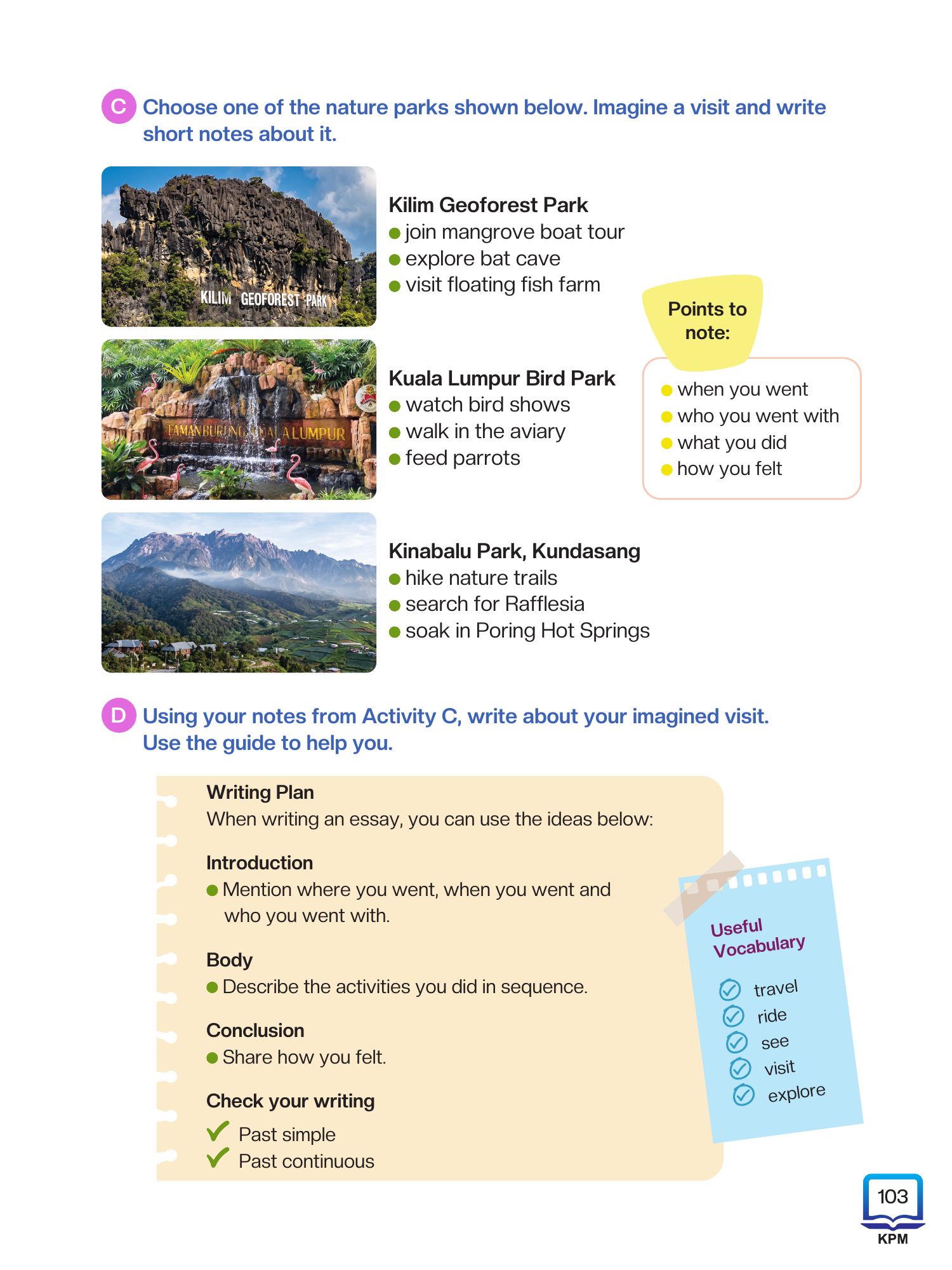
C Choose one of the nature parks shown below. Imagine a visit and write
short notes about it.
Kilim Geoforest Park
join mangrove boat tour
explore bat cave
visit floating fish farm
Points to
note:
Kuala Lumpur Bird Park
watch bird shows
walk in the aviary
feed parrots
when you went
who you went with
what you did
how you felt
Kinabalu Park, Kundasang
hike nature trails
search for Rafflesia
soak in Poring Hot Springs
D Using your notes from Activity C, write about your imagined visit.
Use the guide to help you.
Writing Plan
When writing an essay, you can use the ideas below:
Introduction
Mention where you went, when you went and
who you went with.
Body
Describe the activities you did in sequence.
Conclusion
Share how you felt.
Check your writing
Useful
ry
Vocabula
travel
ride
see
visit
explore
Past simple
Past continuous
103
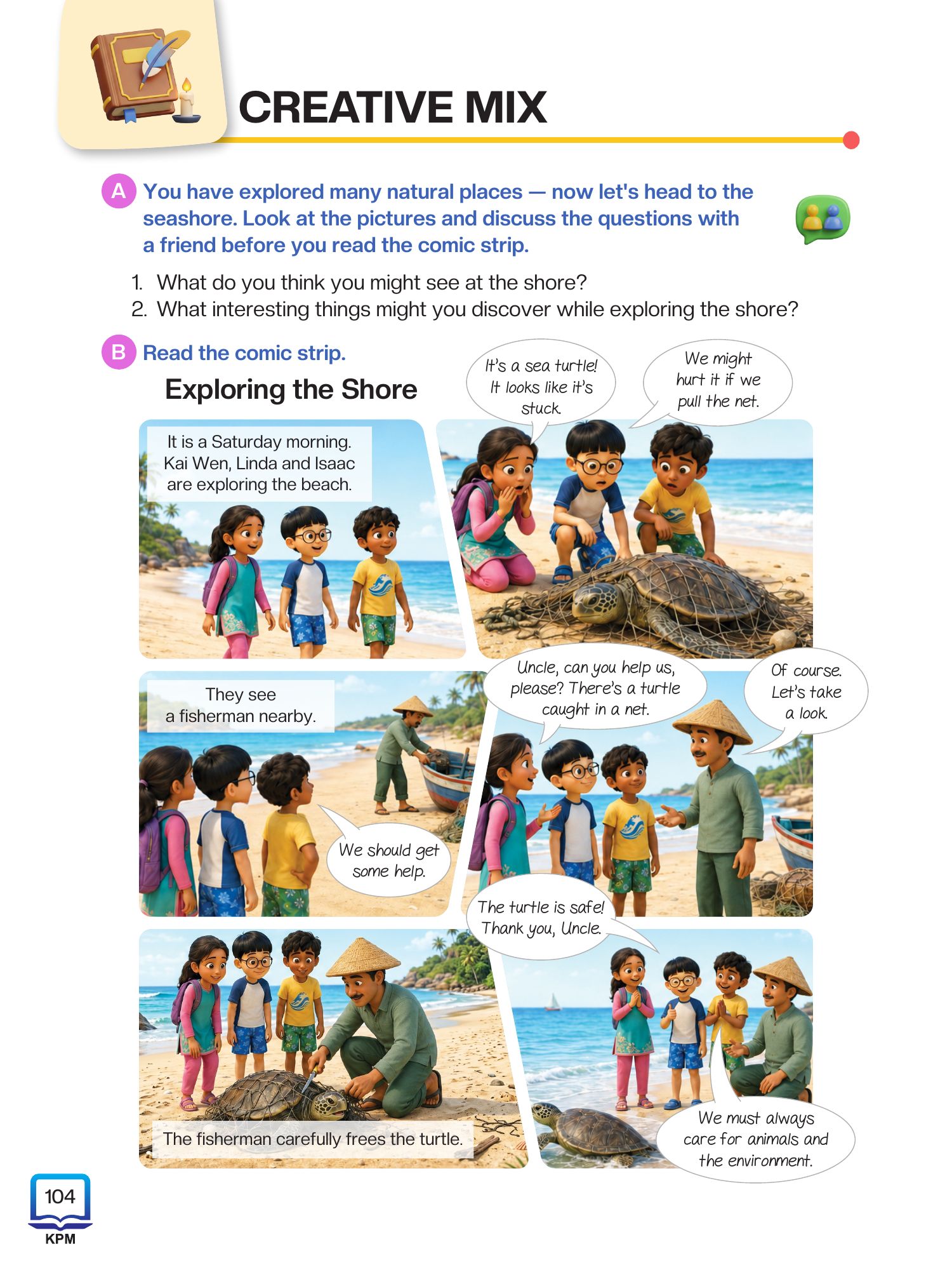
CREATIVE MIX
A You have explored many natural places — now let's head to the
seashore. Look at the pictures and discuss the questions with
a friend before you read the comic strip.
1. What do you think you might see at the shore?
2. What interesting things might you discover while exploring the shore?
B Read the comic strip.
Exploring the Shore
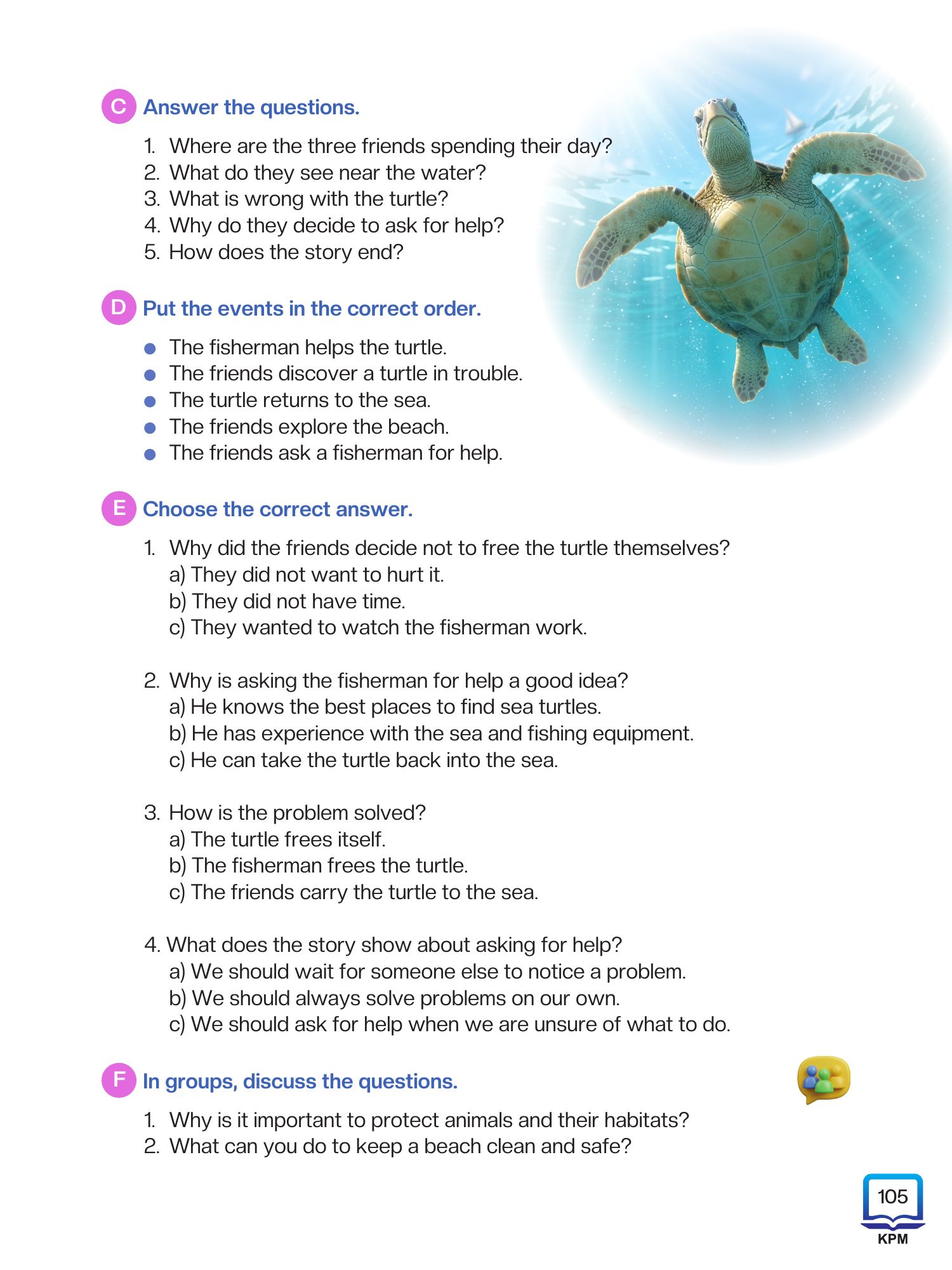
It’s a sea turtle!
It looks like it’s
stuck.
We might
hurt it if we
pull the net.
It is a Saturday morning.
Kai Wen, Linda and Isaac
are exploring the beach.
Uncle, can you help us,
please? There’s a turtle
caught in a net.
They see
a fisherman nearby.
Of course.
Let’s take
a look.
We should get
some help.
The turtle is safe!
Thank you, Uncle.
The fisherman carefully frees the turtle.
104
We must always
care for animals and
the environment.
C Answer the questions.
1. Where are the three friends spending their day?
2. What do they see near the water?
3. What is wrong with the turtle?
4. Why do they decide to ask for help?
5. How does the story end?
D Put the events in the correct order.
The fisherman helps the turtle.
The friends discover a turtle in trouble.
The turtle returns to the sea.
The friends explore the beach.
The friends ask a fisherman for help.
E Choose the correct answer.
1. Why did the friends decide not to free the turtle themselves?
a) They did not want to hurt it.
b) They did not have time.
c) They wanted to watch the fisherman work.
2. Why is asking the fisherman for help a good idea?
a) He knows the best places to find sea turtles.
b) He has experience with the sea and fishing equipment.
c) He can take the turtle back into the sea.
3. How is the problem solved?
a) The turtle frees itself.
b) The fisherman frees the turtle.
c) The friends carry the turtle to the sea.
4. What does the story show about asking for help?
a) We should wait for someone else to notice a problem.
b) We should always solve problems on our own.
c) We should ask for help when we are unsure of what to do.
F In groups, discuss the questions.
1. Why is it important to protect animals and their habitats?
2. What can you do to keep a beach clean and safe?
105
YOUR LEARNING JOURNEY
A You have explored many places in nature in this unit. Now match each
nature place to the most suitable activity.
Place in Malaysia
Activity
1.
Kilim Geoforest Park, Kedah
a. Explore the animal enclosures.
2.
Lok Kawi Wildlife Park, Sabah
b. Hike on nature trails.
3. Sg. Chiling Waterfall, Selangor
4. Pulau Redang, Terengganu
c. Take a boat tour through the mangroves.
d. Snorkel around the beautiful coral reefs.
B Complete the dialogue by choosing the correct phrase from the box.
That sounds great
Yes, I’d love to go
Maybe we can go somewhere else
Would you like to go to
I don’t think so because
1 Lake Kenyir in Terengganu this Saturday?
Aileen : ......
2 . We can go to Gua Bewah and Gua Taat there.
Sweeta : ......
3
Nurul
: ...... going to the caves could be dangerous.
The ground can be wet and slippery.
4
Aileen : You’re right. ......?
Nurul
: How about Lasir Waterfall for a nice picnic instead?
5 . The waterfall area is pretty and much safer for us.
Sweeta : ......
C
Guess the words that match the descriptions.
1. w * l d l * f *
2. * v * * r y
3. r * f r * s h * n g
4. * n c l * s * r *
5. p * t h
6. h * k * n g
Animals, birds and insects that live in their natural environments.
A large enclosure for keeping birds in.
Making you feel cool and full of energy again.
An area surrounded by fences or walls.
A small road or track for people to walk on.
A long walk in nature, especially in a forest or on a hill.
Reflect on what you have learnt in this unit.
Complete the sentences below.
Let’s
Reflect
106
1. A place in nature I would like to visit is ……
2. An outdoor activity in nature I would like to do is ……
3. One new thing I learnt about nature or wildlife is ……
4. One thing I enjoyed learning about in this unit was ……