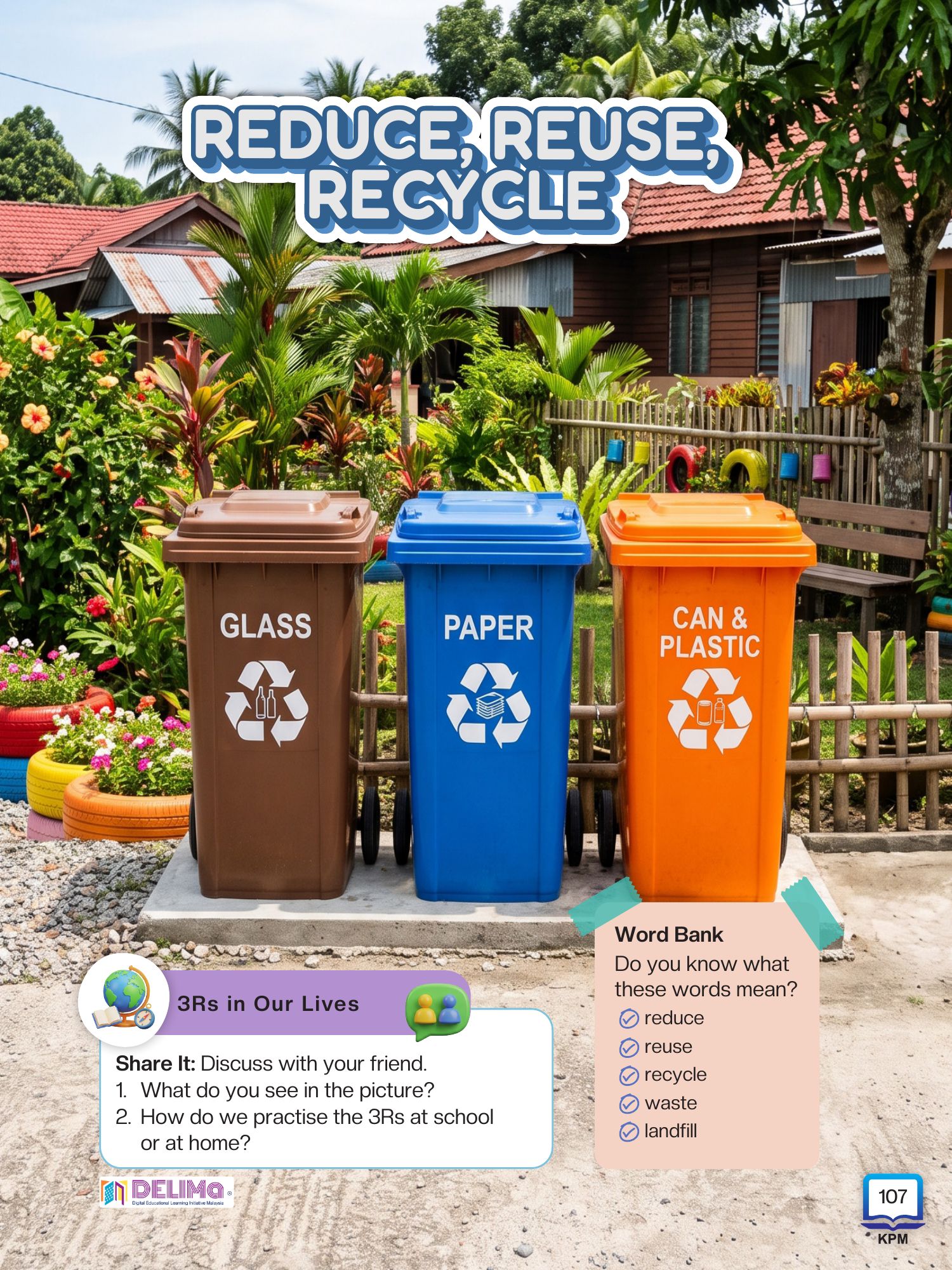
REDUC E, REUSE,
RECYCLE
3Rs in Our Lives
Share It: Discuss with your friend.
1. What do you see in the picture?
2. How do we practise the 3Rs at school
or at home?
Word Bank
Do you know what
these words mean?
reduce
reuse
recycle
waste
landfill
107
GO GREEN
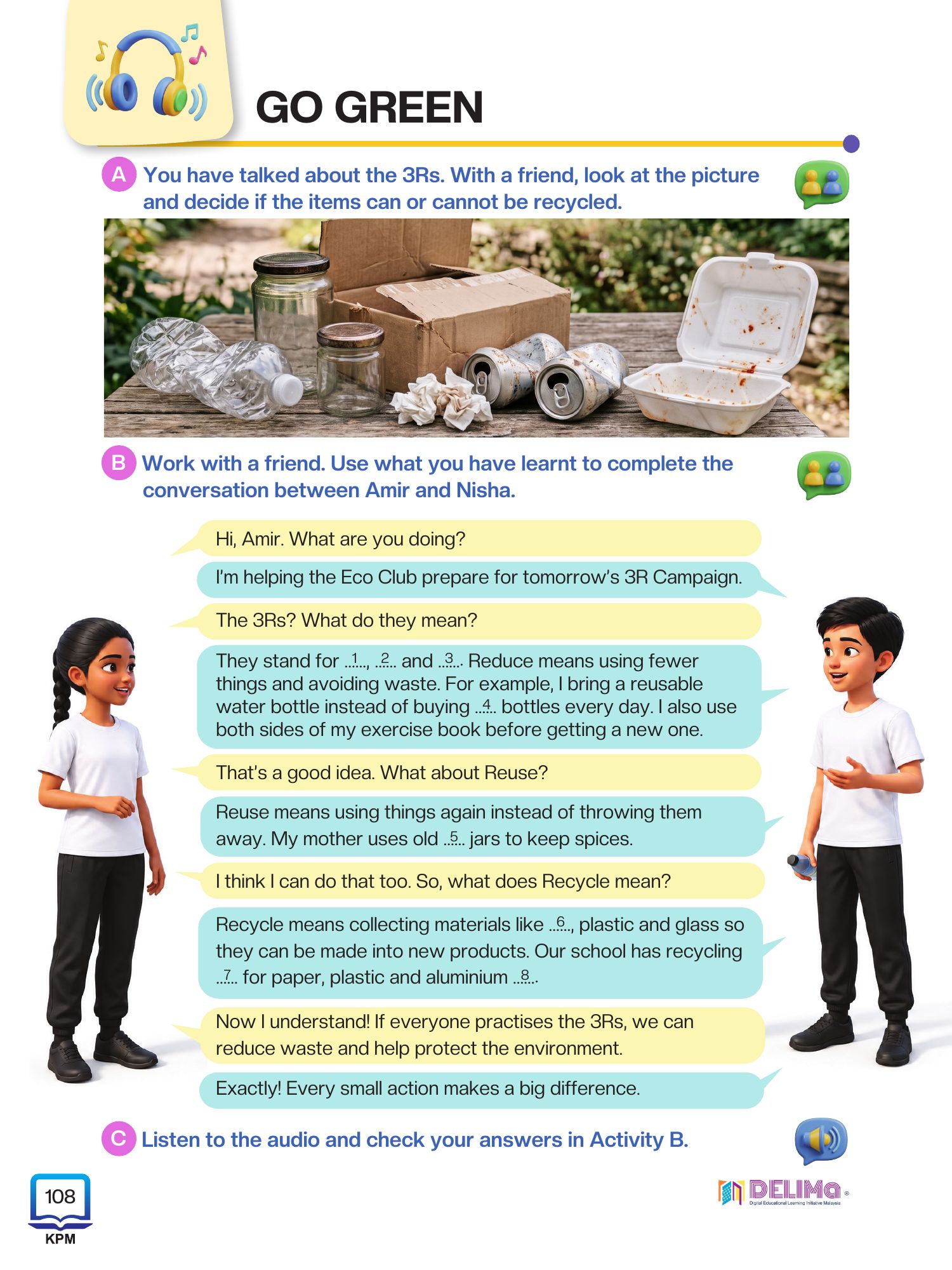
A You have talked about the 3Rs. With a friend, look at the picture
and decide if the items can or cannot be recycled.
B Work with a friend. Use what you have learnt to complete the
conversation between Amir and Nisha.
Hi, Amir. What are you doing?
I’m helping the Eco Club prepare for tomorrow’s 3R Campaign.
The 3Rs? What do they mean?
1 ……
2 and ……
3 . Reduce means using fewer
They stand for ……,
things and avoiding waste. For example, I bring a reusable
4 bottles every day. I also use
water bottle instead of buying ……
both sides of my exercise book before getting a new one.
That’s a good idea. What about Reuse?
Reuse means using things again instead of throwing them
5 jars to keep spices.
away. My mother uses old ……
I think I can do that too. So, what does Recycle mean?
6 plastic and glass so
Recycle means collecting materials like ……,
they can be made into new products. Our school has recycling
7 for paper, plastic and aluminium ……
……
Now I understand! If everyone practises the 3Rs, we can
reduce waste and help protect the environment.
Exactly! Every small action makes a big difference.
C Listen to the audio and check your answers in Activity B.
108
D Listen to the audio again and choose the best answers.
1.
What is Amir helping the
Eco Club prepare for?
a) A recycling campaign
b) A 3R campaign
c) A school campaign
2. What does Nisha say
after Amir explains how he
reduces waste?
a) “I think I can do that too.”
b) “So, what does
Recycle mean?”
c) “That’s a good idea.”
3. What does Nisha want to
know after Amir explains
what Reuse means?
a) What Recycle means
b) What Reduce means
c) What the 3Rs stand for
4. Where does Amir say the recycling
bins are?
a) At their school
b) At the Eco Club meeting place
c) At the 3R campaign venue
5. What does Nisha understand about
practising the 3Rs?
a) It can help people reuse glass jars
and other things.
b) It can reduce waste and protect the
environment.
c) It can help schools collect paper,
plastic and aluminium cans.
6. What does Amir say every
small action can make?
a) A big difference
b) A clean environment
c) A better future
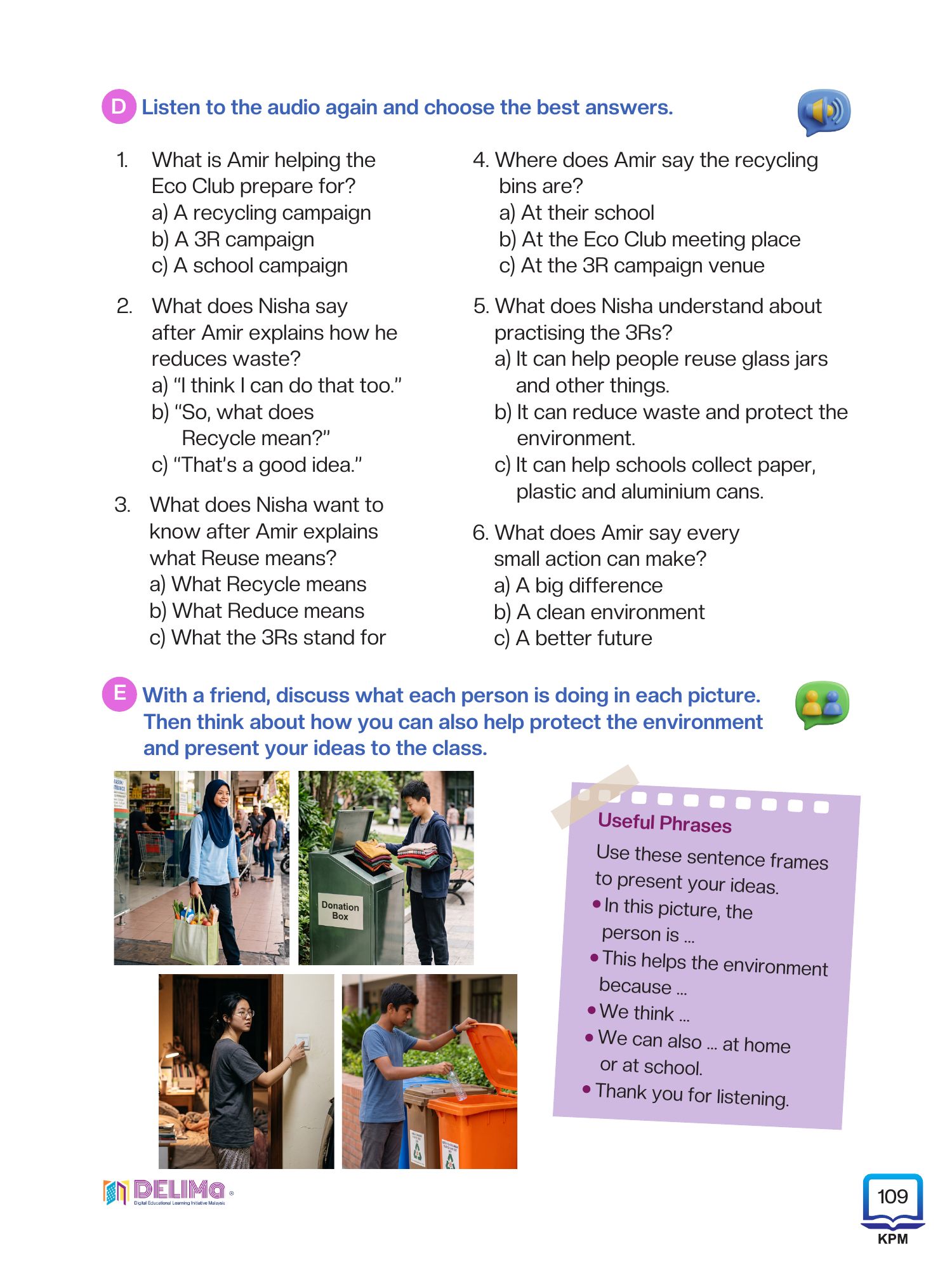
E With a friend, discuss what each person is doing in each picture.
Then think about how you can also help protect the environment
and present your ideas to the class.
Useful Phrases
Use these sentence fra
mes
to present your ideas.
• In this picture, the
person is …
• This helps the environ
ment
because …
• We think …
• We can also … at home
or at school.
• Thank you for listenin
g.
109
REUSE IN ACTION
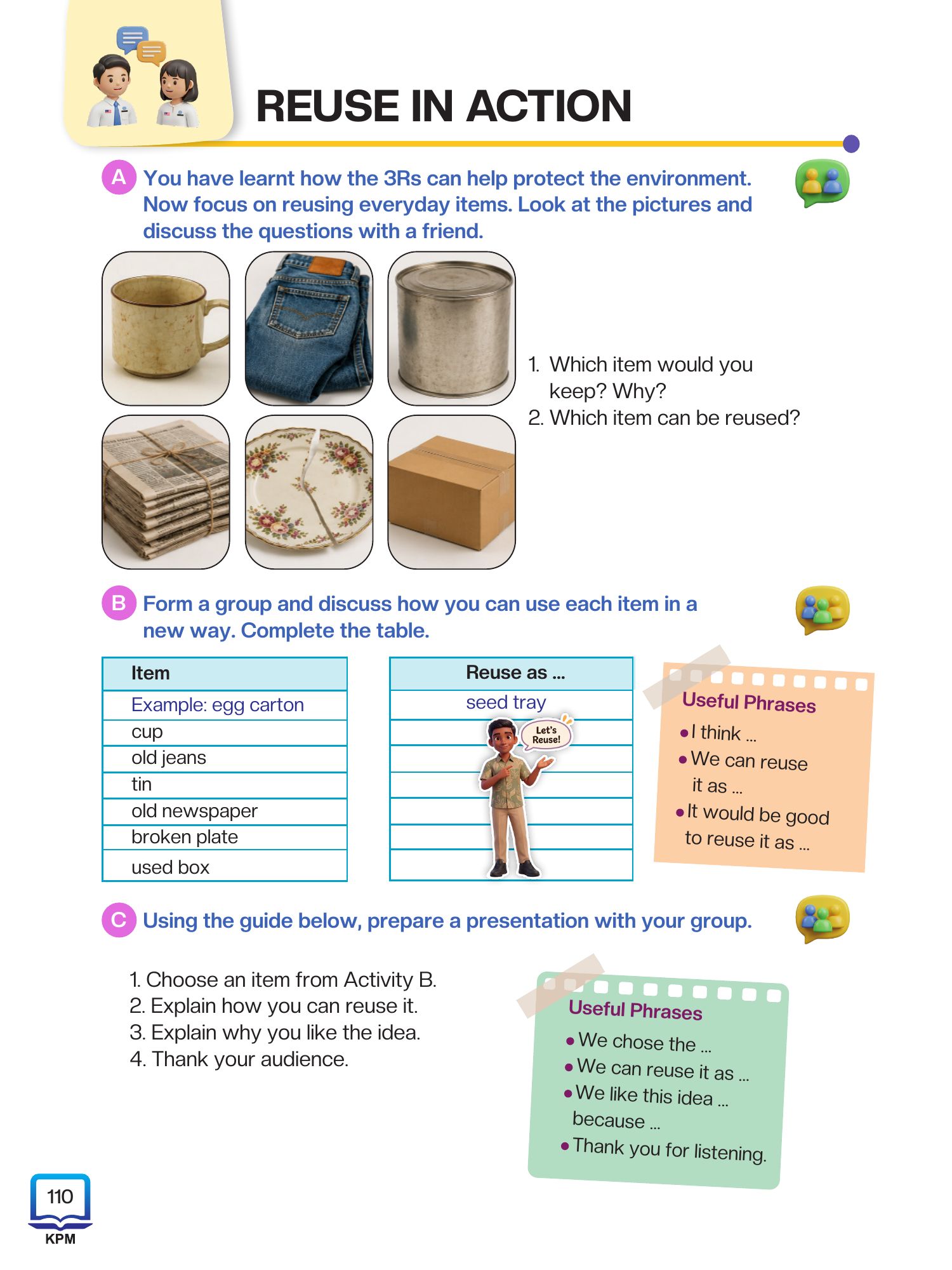
A You have learnt how the 3Rs can help protect the environment.
Now focus on reusing everyday items. Look at the pictures and
discuss the questions with a friend.
1. Which item would you
keep? Why?
2. Which item can be reused?
B Form a group and discuss how you can use each item in a
new way. Complete the table.
Item
Reuse as …
Example: egg carton
cup
old jeans
old newspaper
broken plate
seed tray
Useful Phrases
• I think …
• We can reuse
it as …
• It would be good
to reuse it as …
used box
C Using the guide below, prepare a presentation with your group.
1. Choose an item from Activity B.
2. Explain how you can reuse it.
3. Explain why you like the idea.
4. Thank your audience.
110
Useful Phrases
• We chose the ...
• We can reuse it as ...
• We like this idea ...
because ...
• Thank you for listenin
g.
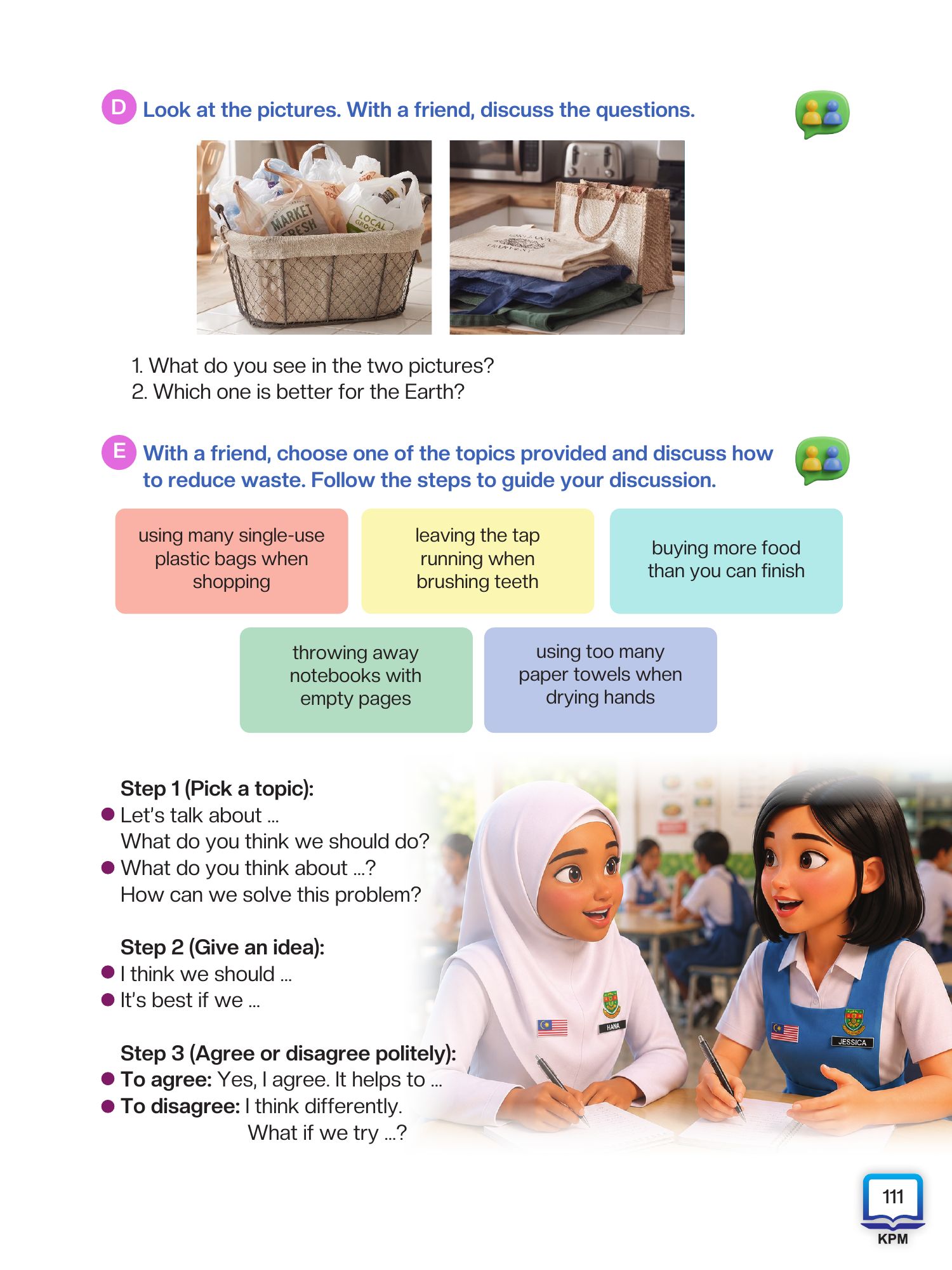
D Look at the pictures. With a friend, discuss the questions.
1. What do you see in the two pictures?
2. Which one is better for the Earth?
E With a friend, choose one of the topics provided and discuss how
to reduce waste. Follow the steps to guide your discussion.
using many single-use
plastic bags when
shopping
leaving the tap
running when
brushing teeth
throwing away
notebooks with
empty pages
buying more food
than you can finish
using too many
paper towels when
drying hands
Step 1 (Pick a topic):
Let’s talk about …
What do you think we should do?
What do you think about …?
How can we solve this problem?
Step 2 (Give an idea):
I think we should ...
It’s best if we …
Step 3 (Agree or disagree politely):
To agree: Yes, I agree. It helps to ...
To disagree: I think differently.
What if we try ...?
EVERY ACTION COUNTS
READING TEXT 1
A You have discussed ways to reduce waste. Now answer the
following questions with a friend.
1. What kinds of rubbish do you usually see at school?
2. What can pupils do to reduce waste at school?
B Read the text about practising the 3Rs in a school.
Small Changes, Big Results
The rubbish bins outside the school
hall were overflowing. Paper, plastic
bottles and food packaging were
spilling onto the ground. Arif and Mei
Ling, members of the Eco Club at
SMK Taman Ilmu, stopped to look at
the mess.
“Where does all this rubbish come
from?” they wondered. The next
day, they decided to find out. During
recess, they walked around the
school and looked at the rubbish in the
bins. They discovered that much of it
could be reduced, reused or recycled.
They shared their findings with their
teacher and came up with some ideas.
Soon, labelled recycling bins were placed
around the school. Pupils began using both
sides of their paper and bringing reusable
water bottles. Old boxes were also given a
new purpose in classroom activities.
There was still another problem. A lot of
food was being thrown away after recess.
The Eco Club suggested a campaign to
encourage pupils to take or buy only the
food they could finish.
A few weeks later, the bins were no
longer overflowing. The school had less
rubbish, and the pupils were proud of what
they had achieved. They learnt that small
changes could make a big difference.
C Read the statements and decide if each is True or False.
1. The rubbish bins outside the school hall were full.
2. Arif and Mei Ling found that all the rubbish could be reused or recycled.
3. Pupils were asked to bring disposable water bottles to school.
4. The amount of rubbish at the school decreased after a few weeks.
D Answer the questions based on the text.
1. What made Arif and Mei Ling decide to investigate the rubbish?
2. Give two changes that were introduced around the school.
3. How might the campaign help to reduce food waste?
4. What happened a few weeks after the changes were introduced?
112
READING TEXT 2
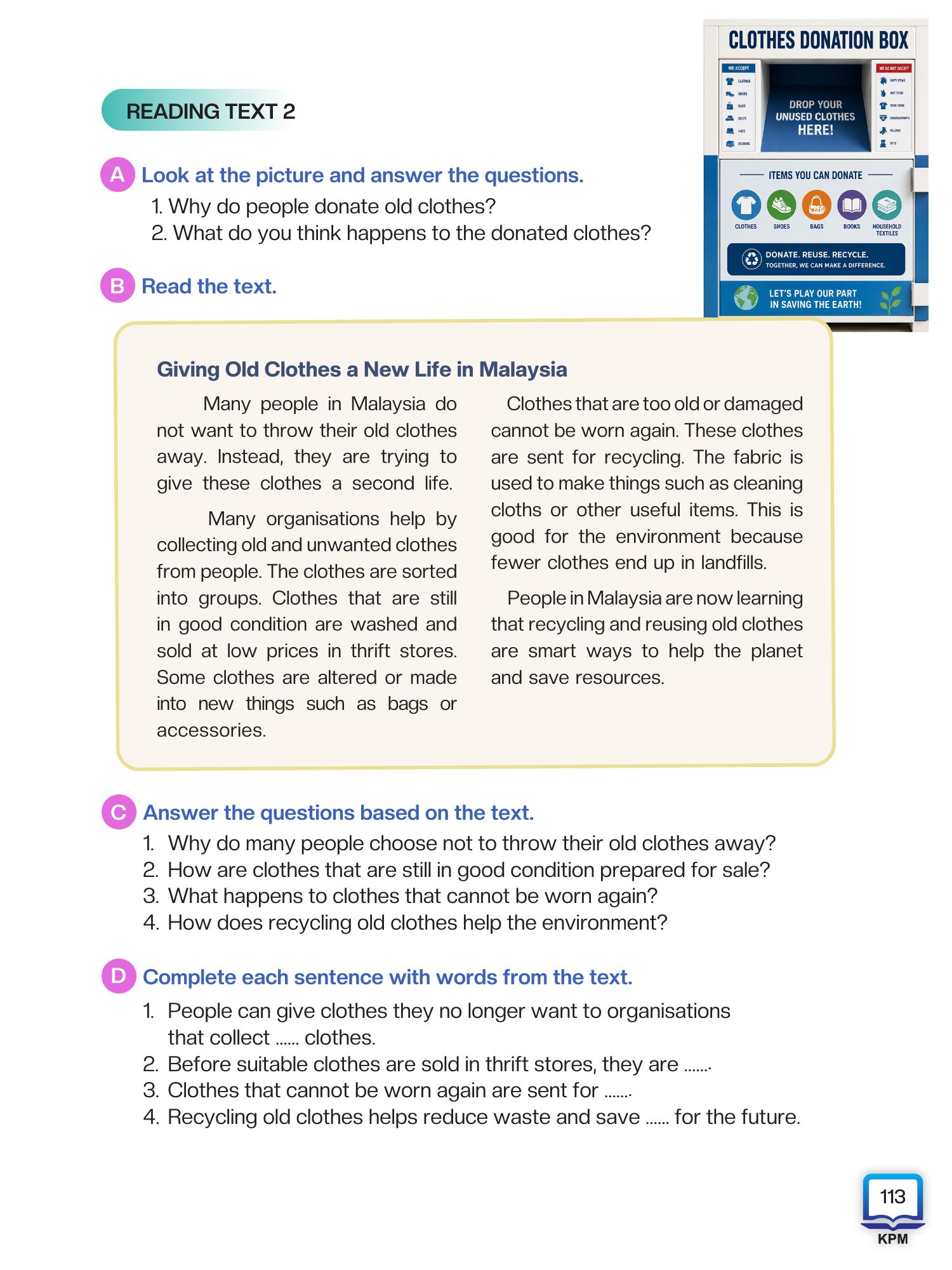
A Look at the picture and answer the questions.
1. Why do people donate old clothes?
2. What do you think happens to the donated clothes?
B Read the text.
Giving Old Clothes a New Life in Malaysia
Many people in Malaysia do
not want to throw their old clothes
away. Instead, they are trying to
give these clothes a second life.
Many organisations help by
collecting old and unwanted clothes
from people. The clothes are sorted
into groups. Clothes that are still
in good condition are washed and
sold at low prices in thrift stores.
Some clothes are altered or made
into new things such as bags or
accessories.
Clothes that are too old or damaged
cannot be worn again. These clothes
are sent for recycling. The fabric is
used to make things such as cleaning
cloths or other useful items. This is
good for the environment because
fewer clothes end up in landfills.
People in Malaysia are now learning
that recycling and reusing old clothes
are smart ways to help the planet
and save resources.
C Answer the questions based on the text.
1. Why do many people choose not to throw their old clothes away?
2. How are clothes that are still in good condition prepared for sale?
3. What happens to clothes that cannot be worn again?
4. How does recycling old clothes help the environment?
D Complete each sentence with words from the text.
1. People can give clothes they no longer want to organisations
that collect …… clothes.
2. Before suitable clothes are sold in thrift stores, they are …….
3. Clothes that cannot be worn again are sent for …….
4. Recycling old clothes helps reduce waste and save …… for the future.
113
E Read each situation and decide which of the 3Rs each action shows.
1. Mei Ling’s uniform is too small but still in good condition.
She gives it to her sister.
2. Hakim writes on both sides of each sheet
of paper to use less paper.
3. Dinesh has an empty plastic bottle, so he
puts it in the recycling bin at school.
4. Sara often buys too much food, so she now
buys only what she knows she can finish.
F Work in groups. Choose one problem. Discuss the problem and
suggest a solution using one or more of the 3Rs.
The school
canteen uses
many plastic
spoons and forks.
Pupils throw
away old school
decorations after
special events.
Our problem:
Our solution:
Why will it help?
Share your group’s solution with the class.
114
The library has
old magazines
that pupils no
longer read.
The school prints
many notices that
are only needed
for a short time.
MY RECYCLING PROJECT
A You have explored how to reuse and recycle everyday items. You are now
going to read a text on a recycling project.
Turning Old Glass Jars into Decorative Lanterns
Making a beautiful lantern from an old glass jar is a fun and easy recycling
project for everyone. First, you need to find an empty glass jar from your
kitchen. Then, wash the jar thoroughly with warm soapy water to make
it clean. Next, carefully dry the inside and outside with a soft towel.
After that, gently tie a colourful ribbon around the top part of the jar.
Finally, you can safely put a small battery-operated candle inside the jar.
You can now happily use your new lantern to decorate your room!
B Read the explanation on adverbs. Then, find the adverbs of manner and
sequence in Activity A.
When discussing how a project is done, we can use specific adverbs to make
our writing clear, organised and descriptive.
Adverbs of
Sequence
Adverbs of
Manner
These words show the order in which things happen.
Example: first, then, next, after that, finally
These words tell us how an action is done – for example,
during a craft project (such as cutting carefully or pressing gently).
Example: carefully, gently, slowly, well
C Read the mixed-up steps for recycling paper, then rewrite them in the
correct order using adverbs of sequence.
Gently press the wet paper flat to dry.
Mix old paper scraps with warm water thoroughly.
Collect old newspapers and junk mail.
Use the new recycled paper to write notes.
Remove any staples or tape from the old papers.
115
D Read each sentence about recycling. With a friend, choose the
correct adverb from the word bank to complete each sentence.
neatly
1.
2.
3.
4.
creatively
firmly
tightly
well
Mix the paper pulp and water …… until it becomes a soft paste.
Paint your glass jar lantern …… with bright colours.
Sort your old plastic bottles …… into separate boxes based on their size.
…… push the wooden spoon through the plastic bottle holes so it
stays in place.
5. When you make a T-shirt bag, you must sew the bottom part ……
so nothing falls out.
E Look at the pictures of Shu Ying’s recycling project and match each action
to the correct description (a-e).
1
2
4
Action
1.
2.
3.
4.
5.
collect
sort
clean
change
display
3
5
Description
a. I modify the bottles into new items.
b. I gather used plastic bottles for the project.
c. I wash and prepare the bottles.
d. I show the finished recycled items.
e. I put the bottles into groups based on their size.
F Use the information in Activity E and the adverbs you have learnt to write
a complete paragraph.
116
G Choose one of the recycling topics and find out more about it to
write a short essay.
How to Make a Colourful Storage Box from Shoeboxes
How to Make a Stationery Organiser from Toilet Paper Rolls
How to Turn an Old T-shirt into a Toy for a Pet
How to Make a Bird Feeder from a Plastic Bottle
How to Sew a Simple Phone Case from Old Jeans
H Write an essay about your chosen topic from
Activity G using the guide below.
Your essay should be divided into three main parts.
1.
Introduction:
Explain why throwing away these everyday items
is bad or why recycling them is useful.
Introduce the recycling project and state that it is
fun and easy.
2. Body Paragraph (the steps):
Use adverbs of sequence to show the correct
chronological order.
Use adverbs of manner to describe how each
step is performed.
3. Conclusion:
Explain the final result (for example, how you can
use or display your finished item).
Finish with a short sentence about why recycling
and protecting nature are important.
Check your writing:
Three or more paragraphs
Adverbs of sequence
Adverbs of manner
Important Tip:
Depending on the
number of points yo
u
have, you might ha
ve
more than one bo
dy
paragraph.
117
CREATIVE MIX
A You have learnt how small actions can reduce waste. Now read a play
about a bigger environmental issue inspired by the Malaysian legend,
The Dragon of Tasik Chini.
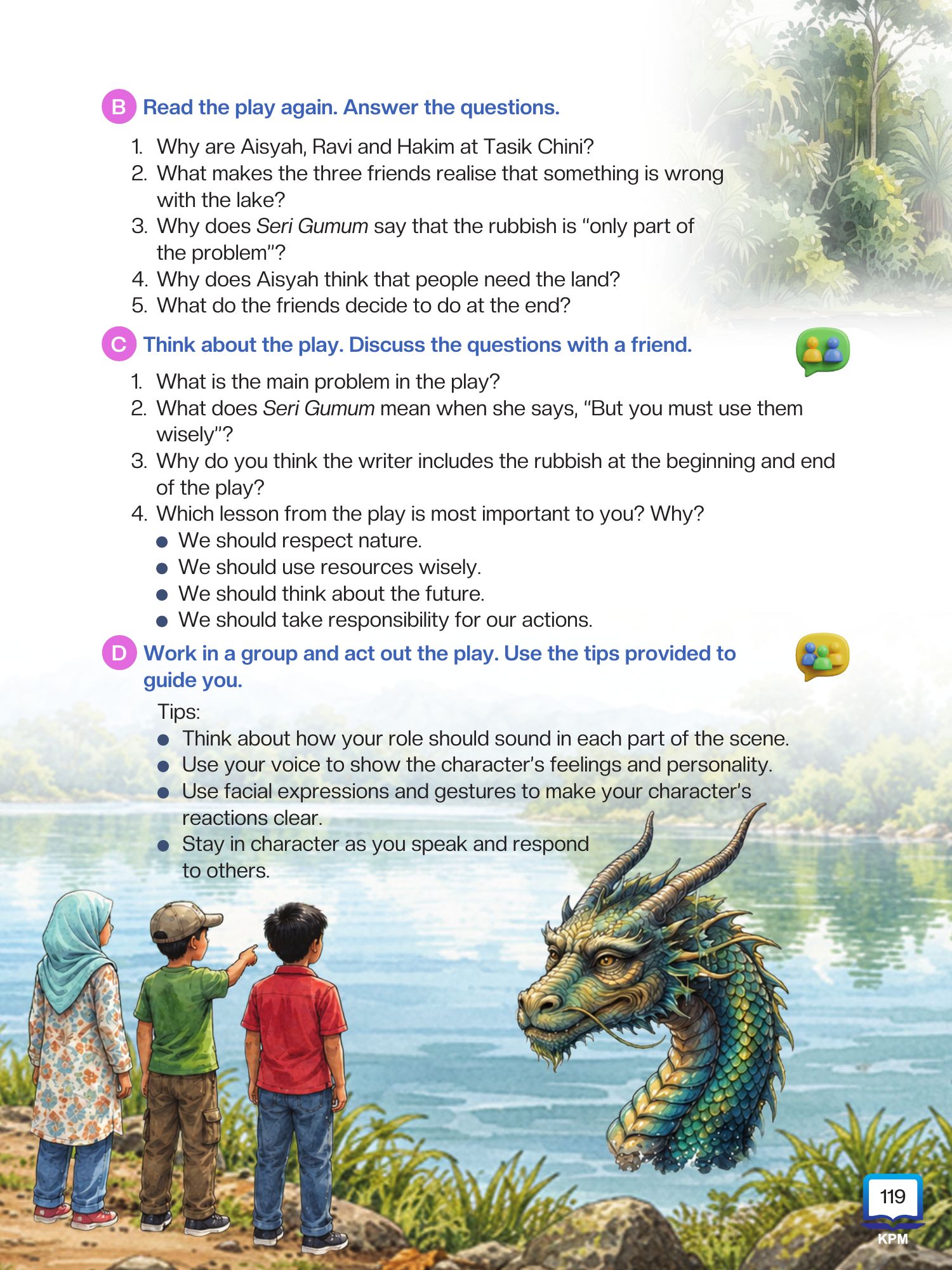
Narrator: Aisyah, Ravi and Hakim
are exploring Tasik Chini.
They stop beside the lake.
Hakim: This place is amazing.
No wonder there are so many
stories about it.
Aisyah: Look! Someone has
left rubbish here.
Ravi: It’s only a few bottles.
Aisyah: Imagine if every visitor
left a few.
Suddenly, they hear
a loud sound from the lake.
Hakim: What was that?
Ravi: I don’t know. Look at
the water!
The water moves.
Seri Gumum appears.
Aisyah: A dragon!
Seri Gumum: Do not be afraid.
I am Seri Gumum.
Hakim: The guardian of Tasik Chini?
Seri Gumum: I have watched over
this lake for a very long time.
But now, my home is changing.
Ravi: Because of the rubbish?
Seri Gumum: The rubbish is only part
of the problem. Trees are being cut
down, and the land is changing.
The water is becoming polluted.
118
Aisyah: But people need land for
houses, farms and roads.
Seri Gumum: Yes. You need the land
and its resources. But you must use
them wisely. Taking everything
without thinking about the future will
leave nothing for tomorrow.
Hakim: How can we help?
Seri Gumum: You can start by
respecting the places you visit.
Take your rubbish with you.
Protect the trees. And remind
others to do the same.
Ravi: We will.
Seri Gumum slowly disappears
beneath the water.
Aisyah: Do you think she will
come back?
Hakim: Maybe. As long as there is
still something worth protecting.
Narrator: The three friends look at the
lake. They came to explore an old legend.
Instead, they discovered a responsibility
that belongs to everyone.
Ravi: Come on. Let’s start with
these bottles.
They begin cleaning the lakeside.
B Read the play again. Answer the questions.
1. Why are Aisyah, Ravi and Hakim at Tasik Chini?
2. What makes the three friends realise that something is wrong
with the lake?
3. Why does Seri Gumum say that the rubbish is “only part of
the problem”?
4. Why does Aisyah think that people need the land?
5. What do the friends decide to do at the end?
C Think about the play. Discuss the questions with a friend.
1. What is the main problem in the play?
2. What does Seri Gumum mean when she says, “But you must use them
wisely”?
3. Why do you think the writer includes the rubbish at the beginning and end
of the play?
4. Which lesson from the play is most important to you? Why?
We should respect nature.
We should use resources wisely.
We should think about the future.
We should take responsibility for our actions.
D Work in a group and act out the play. Use the tips provided to
guide you.
Tips:
Think about how your role should sound in each part of the scene.
Use your voice to show the character’s feelings and personality.
Use facial expressions and gestures to make your character’s
reactions clear.
Stay in character as you speak and respond
to others.
119
YOUR LEARNING JOURNEY
A Think about what you have learnt about the 3Rs. Read the school news
report and complete it with the words provided.
reusable
recycling
clothes
food
waste
Greener SMK Taman Ilmu
Pupils at SMK Taman Ilmu are making simple changes to reduce …….
They use …… water bottles and sort materials for ……. They also try to reduce
…… waste by taking only what they can finish. Unwanted …… in good condition
can be donated to people who need them. These small actions can help make
the school a cleaner and greener place.
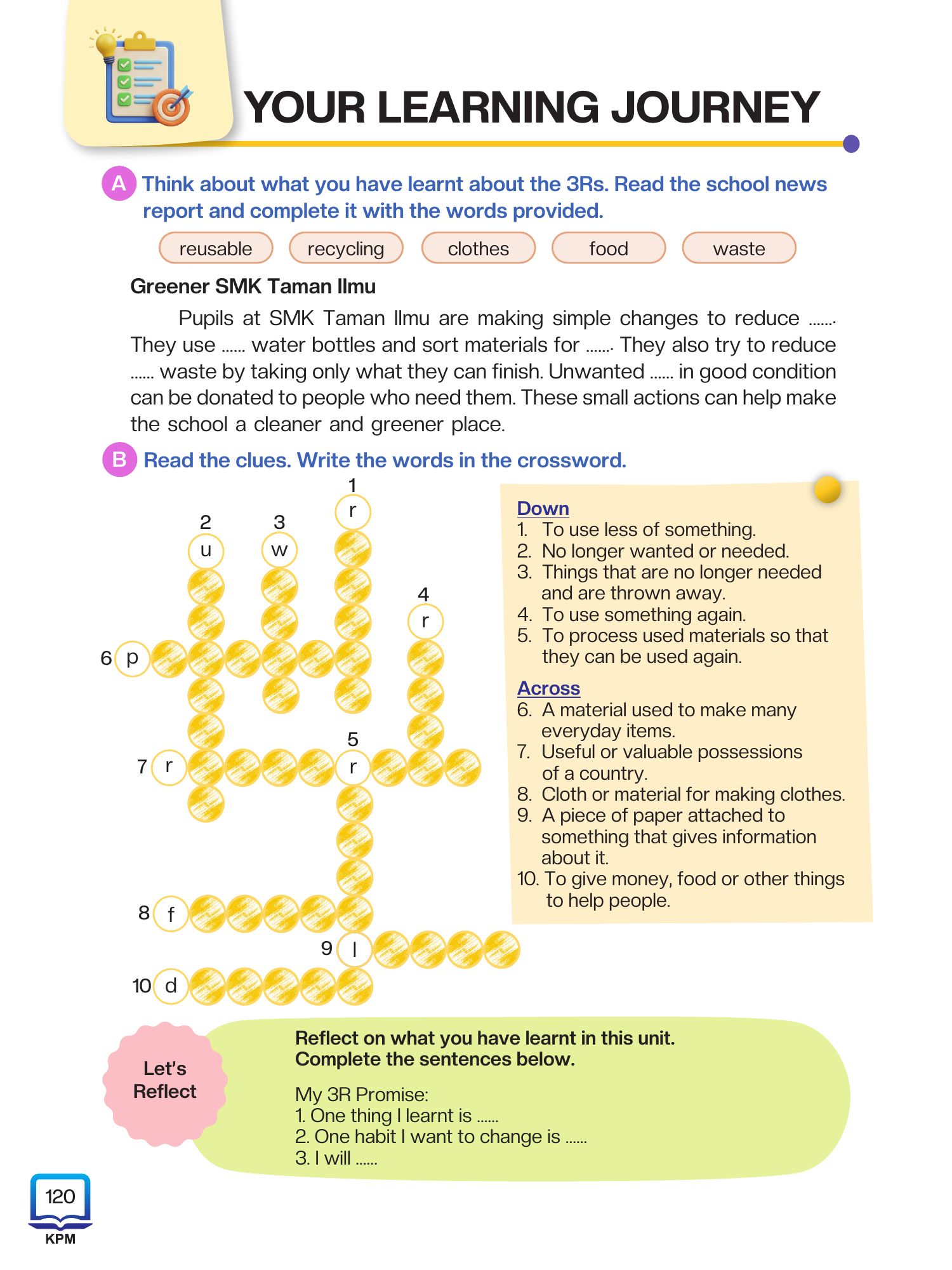
B Read the clues. Write the words in the crossword.
1
2
3
u
w
r
4
r
6 p
5
7 r
r
8 f
9
Down
1. To use less of something.
2. No longer wanted or needed.
3. Things that are no longer needed
and are thrown away.
4. To use something again.
5. To process used materials so that
they can be used again.
Across
6. A material used to make many
everyday items.
7. Useful or valuable possessions
of a country.
8. Cloth or material for making clothes.
9. A piece of paper attached to
something that gives information
about it.
10. To give money, food or other things
to help people.
l
10 d
Let’s
Reflect
120
Reflect on what you have learnt in this unit.
Complete the sentences below.
My 3R Promise:
1. One thing I learnt is ……
2. One habit I want to change is ……
3. I will …...